Speed and Structure: Federal Development with AWS Kiro

Speed and Structure: How Federal Teams Can Have Both with AWS Kiro

AWS Kiro federal development gives government teams a better way to balance rapid AI-assisted coding with the structure, traceability, and governance required for mission-critical systems.

I’ve spent enough years in federal IT modernization to tell a passing fad from a genuine shift. So when vibe coding took off, I wasn’t surprised it caught fire. I was impressed by its ability to take someone from describing an idea to a running prototype in an hour, even someone who has never written a line of code. The approach is loose by design. You describe what you want to an AI tool, take what it gives you, and refine by feel. For the right kind of work, it’s a game-changer. 

Vibe coding has earned its place. It’s the fastest way I’ve ever seen to prototype an idea, run an experiment, or test whether a concept has legs before anyone commits real resources to it. If you’re exploring, you should use it. 

Mission-critical government systems are a different story. When the work involves processing benefits, safeguarding sensitive data, or serving millions of citizens, the cost of being wrong stops being theoretical. These systems rarely stand alone. They depend on other systems and agencies; they face heightened security and accessibility demands, and they operate under federal compliance requirements such as NIST 800-53 and FedRAMP that leave little room for guesswork. Getting it wrong is costly and hard to walk back. The disciplined response has always been to document the requirements, review the architecture, and trace every decision. The problem was that this rigor was slow and expensive, which is exactly why teams kept reaching for speed instead. 

What’s changing isn’t the idea. Defining a system before you build it has always been sound engineering, but it was simply too slow to compete with speed. AI has erased that penalty, and tools like AWS’s Kiro are putting the approach front and center. It’s one of the shifts I’ll be watching most closely at the AWS Summit in Washington, D.C. 

What Spec-Driven Development Actually Is

So what does it actually involve? Before you build, you write a specification, a structured statement of what the system must do, how it should be architected, and what constraints it must meet. From there, the developer, or the AI agent, builds against that spec instead of a vague prompt. The requirements, the design, and the task plan come first, and the code follows. 

Kiro shows how this works in practice. AWS positions it as the successor to Amazon Q Developer, and it gives developers a choice in how they work. One mode is conversational, for quick, exploratory coding. The other is spec-driven, where the tool generates the requirements, design, and tasks first and builds against them. This lets a developer move between the two depending on the task and the stakes, exploring in the loose mode and building in the structured one. 

I follow the same pattern in my own work. When I’m experimenting or testing, I lean on the loose, conversational style, and when something is headed for production, I switch to a structured, spec-driven approach with real review. That isn’t a compromise between speed and rigor; it’s what mature development is starting to look like. 

What matters is that AWS made the spec-first workflow a first-class, built-in option, sitting right alongside the fast one. Structure has always been the foundation of durable systems, and vibe coding bent that for a while, trading rigor for speed. Bringing both modes into one tool is the industry’s answer, keeping the confidence of structure while preserving the speed that made vibe coding so appealing. 

For the government, flexibility matters.

It means vibe coding isn’t something federal teams have to keep at arm’s length. In the right setting, exploring an idea, building an internal tool, or working in a development or test environment, it’s a legitimate and fast way to make progress. The discipline kicks in when the work moves toward production, and the stakes rise, and the same toolchain lets them make that shift without switching tools, so they can apply the right approach to the task in front of them, start to finish. 

In a government setting, the value of that structure comes down to one word, confidence. It’s a concrete kind of confidence. A spec gives you traceability, a written line from what the agency needed to what was actually built, so when an auditor or an oversight body asks you to show where a requirement is met, you can. It also gives you something to check the AI’s output against. With pure vibe coding, there’s no structured record of what the system was supposed to do, only the prompts you typed and the code that came back, nothing authoritative to measure the result by. A spec turns the AI’s work from something you have to trust into something you can verify. 

Because the spec is structured, you can point specialized AI personas and skills at it (a security reviewer, a compliance checker, an architecture critic). They surface gaps and conflicts in the planning phase, where they’re cheap to resolve, rather than in a production system, where they’re expensive and public. It also creates continuity, so that when the next team inherits the system, often years later, they can understand what was built and why. 

This isn’t red tape. In an environment where teams rotate and systems outlive the people who built them, a clear specification is what keeps the mission on track. 

The Real Work Happens Before the IDE

Here’s what I tell every agency team we work with. The cloud is not your bottleneck. AWS GovCloud is fast, scalable, and increasingly capable, with mature tools and the infrastructure already in place. What breaks modernization programs isn’t the deployment, it’s arriving at deployment without a clear picture of what you’re building. 

That’s the gap the tooling can’t close for you. A spec session is only as strong as the spec it starts from, and someone still has to create it. For a government system, that takes more than a few lines typed at the start of a session, it takes the experts who run and manage those processes helping to shape and validate the model that comes out of it. 

Having spent years helping government teams understand spec-driven development and domain-driven design, we know this space well and care about it. It’s the thinking behind Continuum Design, a platform we developed and support that brings this discipline upstream, into the design phase, before any code is written. It helps teams turn the way an agency actually works into a shared, validated model that business and technical people can agree on, and that model becomes the foundation everything else is built on. So seeing the approach surface at the forefront of agentic IDEs lands as more than industry news. It’s a shift we’ve been hoping to see. 

In practice, that means producing documented requirements, data models, and a validated prototype in a fraction of the usual time. That spec then feeds into whatever a team builds with, whether that’s Kiro, another agentic tool, or a conventional workflow. We produce the spec, and the tools build from it. 

That hand-off is getting easier, and the reason is bigger than any single product. The tools are starting to talk to each other. Through MCP, the Model Context Protocol, an open standard that lets AI tools read from other systems, an agentic IDE like Kiro can connect to wherever a team’s context already lives, the same way it connects to tools like Jira or Linear. That openness lifts the whole market, and our own Continuum Design benefits from it too, since it runs an MCP server of its own. A developer in Kiro can pull a validated model from Continuum Design and begin a spec session from something stakeholders have already agreed on, rather than a blank page. The point isn’t the tool. It’s that the spec can stay the single source of truth, from upstream design through to production code. 

Why This Matters More Now

AWS’s commitment, announced in November 2025, to invest up to $50 billion in AI and supercomputing infrastructure specifically for U.S. government organizations signals something important. The federal AI moment is real, and it’s moving fast. Agencies that were running cautious pilots two years ago are now looking at production deployments, and the pressure to deliver, from Congress, from OMB, from the White House, is real. 

That pressure is exactly when corners get cut. In government, the corners that get cut are usually the upfront design work, the requirements gathering, the architecture review, the stakeholder alignment, because they feel slow and the timeline is urgent. 

The irony is that skipping those steps makes everything slower. Every hour saved at the front end of a program by skipping the spec tends to cost several hours downstream, in rework, in failed reviews, and in the requirements scrub that always follows when the thing that got built isn’t quite the thing that was needed. Done properly, with the right tooling, spec-driven development for federal government programs isn’t the slow path anymore. It’s the path that gets agencies to the finish line with something they can sustain. 

What I’m Watching at the Summit

The star of the show, for me, won’t be the tooling. Don’t get me wrong, I’m looking forward to hearing about the latest AWS services and the newest capabilities from the industry’s leading vendors. The sessions I’ll seek out, though, are the ones where agencies talk candidly about what actually worked. In my experience, the programs that succeeded all had one thing in common. They did the hard work of defining the problem before they started building the solution. 

Kiro is a meaningful signal that the industry has internalized that lesson at the tooling level. Spec-first development is no longer something a thoughtful practitioner has to champion in a requirements meeting, it’s becoming a standard part of how teams build for production. 

Even the best tooling doesn’t solve the human problem. Before an agentic IDE can execute against a specification, someone has to create one worth executing. That means aligning stakeholders who have competing priorities, translating mission requirements into technical constraints, and making architectural decisions that will shape the system for years. That work happens before the first prompt, and it determines whether the AI accelerates delivery or just accelerates the wrong thing faster. 

If you’re thinking about how to move an AI modernization effort from pilot to production, I’d welcome the conversation. If you’re at the Summit, keep an eye out for me roaming the halls of the Convention Center or reach out at robert.cole@alphaomega.com. The technology is ready, and the teams that pair that speed with a solid spec are the ones who will get there first.


Rob Cole leads the Digital Evolution & Cloud practice at Alpha Omega, an AWS Advanced Tier Services Partner

Cheap Tokens, Expensive Workflows: Deterministic AI Wins

The Case for Deterministic AI in Legacy Modernization

Three years ago, the cautious position on AI economics was that token prices might not fall fast enough to make large-scale AI workloads affordable. That prediction aged badly. GPT-4-class inference cost about $30 per million input tokens in early 2023. Today you can buy equivalent capability for under a dollar. Epoch AI measured price declines between 9x and 900x per year depending on the capability level. Nothing in the history of computing has gotten cheaper this fast.

And yet enterprise AI bills keep going up.

This is the part the cost-curve optimists missed. The unit of consumption changed. A user task handled by an agentic workflow doesn’t trigger one inference call, it triggers ten or twenty: planning, tool calls, retries, self-review, verification. Reasoning models burn large volumes of internal “thinking” tokens that get billed as output, sometimes 100x what the final answer contains. RAG and large-context analysis multiply tokens per request by 3-5x. And agentic coding tasks vary wildly in consumption from run to run. Two attempts at the same task can differ in cost by multiples.

It’s also worth noticing what the frontier itself costs now. Anthropic’s new flagship, Claude Fable 5, launched this month at $10 per million input tokens and $50 per million output — double its predecessor. The commodity tier keeps collapsing toward free while the capability tier holds premium pricing, and the agentic workloads everyone actually wants run on the capability tier. The per-token price collapsed; total spend became less predictable, not more. For a consumer chatbot, that’s a budgeting annoyance. For a multi-year modernization program with a fixed budget and congressional oversight, it’s a real problem.

The benchmark I leaned on just got crushed. Let me be honest about that.

A year ago, the strongest single number in this argument was the gap between public-benchmark and private-codebase performance: frontier models in the high 70s on SWE-bench Verified, low 20s on SWE-bench Pro, teens on private codebases. Code the model has never seen, the argument went, is where it falls apart — and a legacy system is by definition code the model has never seen.

Then Anthropic shipped Fable 5 and Mythos 5 on June 9, and the model scored 80.3% on SWE-bench Pro. Not Verified — Pro, the hard one. That’s an 11-point jump over Opus 4.8 and roughly 22 points clear of GPT-5.5. SWE-bench Verified is at 95% and effectively saturated. The headline customer story is Stripe running a codebase-wide migration across 50 million lines of Ruby in a single day — work Stripe estimated at over two months for a full team.

If you wrote a thesis on the private-codebase gap, intellectual honesty requires admitting that gap is closing much faster than skeptics expected. The accelerator didn’t just get better. It got dramatically better.

So is the argument dead? Look closer at three things.

First, the hard tail is still hard. On FrontierCode Diamond — Cognition’s benchmark holding models to production-codebase standards, not just “does the test pass” — Fable 5 scores 29.3% at maximum reasoning effort. Best in the world, more than double Opus 4.8, and still failing seven out of ten tasks held to the standard a mission-critical system actually requires: performant at scale, idiomatic, structured for long-term maintainability. That’s the standard a modernized federal system has to meet, and the frontier is at 30%.

Second, the Stripe story is real and it’s Ruby. Fifty million lines of one of the best-represented languages in any training corpus, at a company with elite engineering infrastructure to validate the output. It’s a genuinely impressive proof point for the accelerator role. It tells you very little about four decades of COBOL, PL/I, Natural, or a proprietary 4GL, where the validation infrastructure doesn’t exist and has to be built.

Third — and this is the one procurement people should sit with — the cost-variance problem got worse, not better, with the model that got better. Fable 5’s own system card shows its agentic coding score climbing from 75.0% to 80.4% on SWE-bench Pro as you turn the reasoning-effort dial from low to maximum, and FrontierCode nearly tripling from 11.5% to 30.9%. Accuracy is now literally a function of how many thinking tokens you’re willing to buy, at $50 per million on output. And Fable 5 introduces a new flavor of nondeterminism: its safety layer reroutes flagged queries to Opus 4.8 mid-task — about 5% of sessions overall, but over 20% of trials on some agentic benchmarks. Your agent can silently switch models partway through a trajectory. For a demo, fine. For an auditable transformation pipeline, that’s a finding waiting to be written.

Modernization was never a code generation problem

GenAI is genuinely good at explaining code, drafting documentation, generating tests, and helping developers move faster — and the industry numbers back this up. Across recent enterprise programs, AI-assisted modernization is credited with cutting timelines by 40-50%, mostly in analysis, translation, documentation, and test generation. In one healthcare program, AI-assisted translation converted about 65% of a legacy codebase while compliance review stayed in the loop. A fintech migration scoped at 700-800 hours cut effort by 40% using generative agents. None of that is in dispute, and none of it is the hard part.

Because modernizing a mission-critical system means preserving business rules, mapping dependencies, transforming architecture, validating that the new system behaves like the old one, and proving all of it to auditors and authorizing officials. In federal environments, getting this wrong doesn’t mean a bad sprint. It means benefits don’t go out, payments fail, cases stall, or a compliance finding lands on someone’s desk.

“Right 80% of the time” is a historic benchmark score and a disqualifying transformation standard. The model improved from “fails most unfamiliar tasks” to “fails a meaningful minority of them, unpredictably, at variable cost.” That’s enormous progress for an accelerator and still not an assurance story.

Why deterministic approaches hold up

Deterministic modernization treats the problem as controlled transformation rather than open-ended generation: parsing, dependency graphing, rule extraction, mapping, validation. The case for it has gotten stronger, not weaker, as the models improved.

The same source logic transforms the same way every time, across the whole codebase, with no run-to-run variance, no reasoning-effort dial that trades accuracy for token budget, and no degradation as the work scales. Every decision traces from legacy code to modernized output, which is what NIST AI RMF and federal governance guidance actually require, and what probabilistic generation can’t natively give you. The cost model is per system or per line of code, not per token consumed by an agent loop of unknown length, so neither a price correction in the inference market nor a flagship launch at double the old rate touches your modernization budget. And because deterministic transformation enforces a target architecture and coding standards uniformly, you come out the other side with less technical debt instead of a fresh layer of inconsistent generated code.

The hybrid model won — officially, this time

The argument was never GenAI versus deterministic AI, and the market has now formalized that. Gartner’s new tool category for this space — AI-Augmented Code Modernization — is defined explicitly as the combination of specialized AI agents, generative AI, and deterministic analysis. The hybrid isn’t a contrarian position anymore. It’s the category definition.

The division of labor is the same one that’s been emerging for two years, just with a much stronger accelerator. Deterministic AI carries the assurance burden: transformation, dependency analysis, rule extraction, behavioral validation. GenAI — and Fable 5 is a real step change here — accelerates everything around it: documentation, test scaffolding, requirements interpretation, helping SMEs understand forty-year-old code. Humans validate business logic and resolve the ambiguity that neither machine can.

What changed this month is that the accelerator crossed a threshold where it can do genuinely large mechanical migrations in friendly territory. What hasn’t changed is which component you can bet the mission on.

Buyers have caught up to this. With 85% of enterprises reporting that legacy systems block their AI adoption and legacy consuming the bulk of IT budgets, the evaluation questions are blunt: Can you scale across millions of lines without drift? Can you prove behavioral equivalence? Can you show line-level traceability? Can you commit to a fixed price? Can you survive an ATO process?

That’s the design point for Continuum Code: a deterministic modernization engine built for predictability, auditability, and cost control, using GenAI where it actually earns its keep — and Fable 5 just made that part of the engine considerably more valuable.

The bottom line

The strangest lesson of the past three years still holds: tokens got radically cheaper and cost discipline got harder. The newest frontier model is the best coding system ever built, and it ships with a reasoning dial that prices accuracy by the token, a premium rate card, and a safety layer that can swap models mid-task. Every one of those is fine for exploration and disqualifying for a fixed-budget assurance pipeline.

GenAI will keep getting better and will keep earning a bigger role as an accelerator — a bigger role than I would have predicted a year ago, frankly. But the core engine for large-scale legacy modernization needs to be deterministic, because the things that survived both the price collapse and the capability jump are the things that mattered all along: knowing what it costs, proving what it did, and getting the same answer every time.

AI in Cyber Defense: Governing Risk in the Age of Shadow AI

As cyber threats evolve in speed, scale, and sophistication, the conversation is no longer about whether to adopt AI in cyber defense—it’s about how to secure it. 

I’m looking forward to discussing this at the upcoming Potomac Officers Club 2026 Cyber Summit, where leaders across government and industry will explore how organizations are strengthening resilience, advancing Zero Trust, and operationalizing AI across defense environments. My focus will center on a growing reality across federal agencies and contractors alike: the rise of Shadow AI and its impact on cybersecurity. 

Shadow AI Is the New Attack Surface

AI is transforming how we work—but it’s also transforming how risk enters the enterprise. 

Today, every employee has access to powerful AI tools. With little technical expertise, users can generate code, build workflows, and deploy capabilities outside of governed environments. This has accelerated the growth of Shadow IT and Shadow AI, introducing: 

•  Unmonitored data exposure risks.
•  Unauthorized integrations and workflows
•  New and expanding attack surfaces
•  Increased potential for PII and CUI leakage 

These risks are no longer theoretical—they are actively reshaping the threat landscape. 

For a deeper look at this challenge, check out our Chief AI Transformation Officer’s Shadow AI blog.

From Detection to Continuous Control

Cyber defense is more than just identifying threats—it’s about maintaining continuous control over risk, compliance, and system integrity. 

As AI expands the attack surface, organizations must move beyond periodic assessments and reactive monitoring toward a model of operational cyber resilience, where: 

•  Security controls are continuously validated—not periodically assessed
• 
Risk is visible in real time across systems and environments
• 
Compliance is automated, traceable, and audit-ready
•  Cyber posture evolves alongside the systems it protects 

This shift is critical for organizations operating under frameworks like NIST 800-53 and CMMC, where gaps in visibility or delayed response introduce unacceptable risk. 

It also reflects how we deliver our cybersecurity and risk management capability, ensuring systems are not only protected, but continuously aligned to evolving threats and compliance requirements. 

Continuum Secure: Automating Control, Compliance, and Cyber Resilience at Scale

As cyber environments grow more complex, they must also maintain consistent control across systems, data, and compliance requirements. 

That’s why we’ve evolved our patented A2O solution into Continuum Secure. 

Continuum Secure automates the processes that traditionally slow cybersecurity operations, from RMF and ATO workflows to continuous monitoring and audit readiness. 

With capabilities that include: 

•  Automated NIST 800-53 control assessments
•  Continuous compliance monitoring
•  Real-time POA&M tracking and alerting
•  Enterprise risk dashboards and Zero Trust visibility
•  End-to-end audit traceability 

Continuum Secure provides the structure and visibility required to manage risk in real time, helping organizations strengthen cyber posture, reduce manual burden, and accelerate compliant delivery across mission environments. 

Securing National Security Missions in an AI-Driven Environment

For organizations operating in National Security environments, the stakes are even higher. 

Adversaries are leveraging AI to accelerate attacks and exploit vulnerabilities, while internal AI adoption continues to expand faster than governance frameworks can keep up. 

This dual pressure requires organizations to: 

•  Safeguard sensitive data across the enterprise
•  Operationalize Zero Trust principles
•  Govern AI usage with the same rigor as traditional systems
•  Maintain continuous visibility into risk and compliance 

The Path Forward

Cyber defense is entering a new phase—defined by AI, automation, and continuous adaptation. 

The organizations that succeed will be those that: 

•  Govern AI as rigorously as they deploy it
• 
Maintain continuous control over risk and compliance
•  Automate the processes that slow response and increase exposure
•  Deliver secure capabilities at mission speed 

At Alpha Omega, we are focused on helping agencies and partners make this transition—building secure, scalable solutions that strengthen resilience, accelerate delivery, and support national security outcomes.

CTO Nitin Vartak delivers Cyber talk at Potomac Officers Club
Nitin Vartak, CTO


I look forward to continuing this conversation at the Cyber Summit and collaborating with leaders across the community to shape the future of AI-driven cyber defense. 

From Shadow AI to Strategic Advantage

Balancing AI Innovation with Security:
An AI Governance Checklist for Federal Organizations

What Is Shadow AI?

Shadow AI emerges when teams use AI tools with company or client data outside approved guardrails, without a clear understanding of data handling, or beyond established governance boundaries.

If you’ve tested a chatbot to draft an email, used a code assistant to debug faster, or explored a model out of curiosity, you’ve already entered what the industry calls shadow AI.

At Alpha Omega, AI plays a direct role in how we:

  • Generate proposals
  • Prototype solutions
  • Optimize talent deployment
  • Orchestrate data workflows
  • Automate back-office processes

Our people drive innovation. AI amplifies their impact and removes repetitive work. That level of adoption creates opportunity and responsibility.

Shadow AI Signals Demand for Innovation

Shadow AI reflects a familiar pattern. CIOs have managed this dynamic for years through shadow IT.

Teams have always found ways to move faster:

  • Testing tools before formal approval
  • Solving problems ahead of governance processes
  • Exploring new capabilities independently

This behavior signals momentum, not risk.

Shadow AI follows the same pattern. Teams experiment with new tools and integrate AI into workflows before leadership gains full visibility. The real challenge comes from operating without shared guardrails.

Enable Innovation with Guardrails

Many organizations respond by restricting access. That approach slows progress and pushes experimentation further out of view.

A stronger approach creates balance:

  • Encourage curiosity and exploration
  • Define clear guardrails and data boundaries
  • Align experimentation with enterprise priorities

Organizations that lead in AI adoption guide experimentation instead of limiting it.

The message should stay clear: Innovation moves forward when guardrails support it.

Build a Culture of Responsible AI

Effective AI governance builds confidence. Teams move faster when they understand:

  • What data they can use
  • Which tools are approved
  • How to apply AI responsibly
  • Where AI delivers measurable value

At Alpha Omega, we enable teams to experiment within a framework that supports security, compliance, and operational outcomes. This approach builds trust, accelerates adoption, and reduces risk at the same time.

Turning Strategy into Action

Understanding shadow AI is only the starting point. Organizations need a clear, repeatable way to translate that understanding into action.

A structured approach to AI governance helps teams move quickly while maintaining control. It provides clarity on where experimentation can happen, how data should be handled, and how innovation scales safely.

The checklist here outlines a practical starting point – be sure to download the full checklist below.

A Practical AI Governance Checklist

1. Establish guardrails and safe experimentation environments
Define approved AI tools and create sandbox environments where teams can test ideas without exposing sensitive systems or data.

2. Set clear data boundaries and risk tolerance
Treat every AI interaction as a data-sharing event and define what data can and cannot be used.

3. Enable teams through governance, not restriction
Provide clear guidance, approved tools, and support channels that help teams innovate safely.

4. Train teams with real-world scenarios
Use practical examples to show how AI should be applied across everyday workflows.

5. Reinforce a culture of responsible innovation
Encourage curiosity while aligning AI use with enterprise priorities and security expectations.

What’s Next: Scaling AI with Confidence

Shadow AI highlights demand. Teams want to move faster and apply new capabilities to real problems.

Our role is to channel that energy.

Alpha Omega continues to evolve as a solutions organization. Our AI Community of Practice has grown into an active forum where teams share practical applications, lessons learned, and responsible approaches to adoption.

We build AI the same way we build everything else: with intention, discipline, and a focus on measurable value. Organizations that respond with clarity, governance, and trust will lead the next phase of AI adoption.

Download our AI Governance Checklist for Federal Organizations

For a more detailed, step-by-step framework, download:
AI Governance Checklist for Federal Organizations

Use it to:

  • Assess your current AI readiness
  • Define guardrails and governance structures
  • Enable safe, scalable AI adoption across teams

How AI is Reshaping Federal IT Delivery and Modernization

A Practical Playbook for Modernization and Operations

Over the last quarter, we took a hard look at how AI-driven efficiencies in federal IT are being applied across our contracts—from modernization and operations and maintenance (O&M) to cloud migration, PMO support, and cybersecurity.

The conclusion was clear:
AI belongs in the core of delivery—applied intentionally, responsibly, and with measurable outcomes.

We formalized how Continuum Automation Framework capabilities are applied across:

  • O&M enhancements
  • Modernization and refactoring
  • Greenfield development
  • Cloud migration
  • PMO automation
  • Cybersecurity and ATO support

Each solution scenario is mapped to the right capability, creating a more predictable, scalable delivery model.


Embedding AI Into Federal IT Delivery Models

This structured approach enables us to:

  • Deliver more competitive firm-fixed-price (FFP) programs
  • Reduce FTE dependency while maintaining output
  • Expand toward X-as-a-Service delivery models
  • Integrate modernization directly into O&M cost structures

The focus is clear: engineering efficiency into federal IT delivery.


AI-Assisted Development: Governed Flow Coding

A core part of the playbook is how we approach AI-assisted software development.

We standardize on Flow Coding—a generate-and-verify model where:

  • AI accelerates development
  • Developers maintain full ownership of architecture and quality

Why governance drives results

AI productivity gains vary based on:

  • Codebase maturity
  • Architectural discipline
  • Developer experience
  • Technical debt

In well-structured environments, productivity gains can reach 2–3x.
In complex legacy environments, results depend on how effectively governance and standards are applied.

Our playbook incorporates:

  • Conservative efficiency assumptions
  • Tiered productivity models
  • License cost considerations
  • Clear governance expectations


Modernization at Scale with Deterministic Refactoring

For federal modernization, we focus on deterministic refactoring using Continuum Code.

This includes:

  • Intelligent code conversion
  • Pattern-based refactoring
  • Dead code identification
  • Architectural restructuring

This approach is deterministic, developer-governed, and measurable.

Driving predictability in modernization

Execution is strengthened through:

  • Upfront complexity assessments beyond lines of code
  • Mandatory integration mapping
  • Realistic modeling of undocumented systems

These practices lead to:

  • More defensible bids
  • More predictable execution
  • Stronger delivery outcomes


Accelerating Development with Continuum Design

For greenfield development and structured refactoring, Continuum Design plays a central role.

It brings together:

  • Business process modeling
  • Domain-driven design (DDD)
  • Microservices architecture
  • Structured code generation

Where it delivers the most value

  • Refactoring well-understood systems
  • Small-to-medium application portfolios
  • Microservices and API-driven architectures

Applying the right tool to the right scenario

We carefully align its use to scenarios where DDD, APIs, and microservices are central to the effort, ensuring strong outcomes and maintaining delivery credibility.


Data Modernization and Integration with Continuum Connect

In the data domain, Continuum Connect enables:

  • Data migration and transformation
  • Multi-source integration
  • Pipeline orchestration

Priority is placed on high-complexity environments, where automation delivers the greatest impact.

Efficiency modeling reflects:

  • Integration depth
  • Security requirements
  • Deployment constraints

This ensures projections align with real-world federal conditions.


Cybersecurity and ATO as Scalable Services

Cyber delivery continues to evolve toward service-based models using Continuum Secure.

This includes:

  • ISSO-as-a-Service
  • ATO-as-a-Service
  • Unit-based pricing tied to system complexity

By embedding cyber early in delivery and aligning automation to program structures, we create scalable, repeatable service offerings.


Cloud Migration with Compliance Built In

For cloud migration, Concierto provides a software-driven, AWS-endorsed model.

The playbook emphasizes:

  • Post-deployment validation strategies
  • Early modeling of federal compliance (FISMA High, IL4+)
  • Alignment between AWS best practices and agency requirements

This approach ensures cloud modernization delivers efficiency, compliance, and architectural alignment.


Automation as a Core Delivery Capability

Platforms such as:

  • PowerApps
  • ServiceNow
  • Google Workspace
  • Copilot

are embedded directly into delivery strategies.

Efficiency timelines reflect real adoption patterns:

  • 6–12 months to realize full value
  • Dedicated resources included in cost models
  • Strong dependency on usability and user adoption

Automation is treated as a designed capability within delivery, not an add-on.


The Bottom Line: Discipline Drives Outcomes

This playbook reflects a deliberate approach to AI adoption in federal environments.

It centers on:

  • Governance
  • Realistic modeling
  • Scenario-based application
  • Service-driven delivery

The result is predictable, measurable AI-driven efficiency, aligned to the realities of federal programs.

That discipline is what differentiates successful modernization at scale.

Hybrid AI: Why Generative and Deterministic AI Work Better Together

Hybrid AI: Why Generative and Deterministic AI Work Better Together

The race to adopt AI has pushed most organizations to ask the wrong question: generative AI or deterministic AI? But hybrid AI, the deliberate combination of both, is how the world’s most advanced AI systems are actually built. And it’s how Alpha Omega is evolving the Continuum Automation framework.

Artificial intelligence development has largely followed two separate paths. One path focuses on deterministic systems that deliver predictable and verifiable outcomes. The other focuses on generative systems that explore possibilities and create new outputs based on learned patterns. Each approach provides value, but each also carries limitations when used alone.  The advantage comes from their combination, resulting in a class of intelligent systems capable of creativity without sacrificing reliability.

Two Approaches to AI—and Why Hybrid AI Solves What Neither Can Alone

Modern AI development has followed two distinct paths:

  • Deterministic AI operates on defined rules and algorithms. Given identical inputs, it produces identical outputs—predictable, verifiable, and trustworthy. It excels at formal verification, compliance validation, and guaranteed execution. Its limit: it struggles with ambiguity and cannot discover genuinely new solutions.
  • Generative AI learns patterns from data and creates new outputs based on those patterns—flexible, creative, capable of natural language understanding and rapid prototyping. Its limit: it cannot independently guarantee correctness. Without guardrails, it hallucinates.

Organizations increasingly face challenges that require both creativity and reliability: code modernization, security remediation, business logic automation, and AI-driven decision-making. Neither approach alone is sufficient. That tension is exactly what hybrid AI architecture is designed to resolve.

The Key to Hybrid AI: Putting Guardrails on Generative Systems

The surge in generative AI investment is justified—the capabilities are real and the opportunity is substantial. But generative AI without constraints creates a risk. It produces confident, fluent, and sometimes wrong outputs.

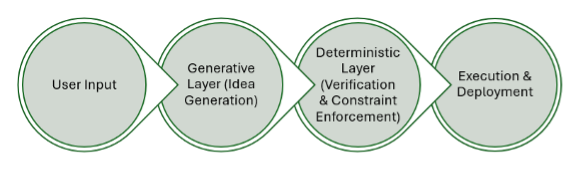
The answer is not to slow down on generative AI. It’s to pair it with a deterministic partner, to apply guardrails that catch errors, enforce constraints, and validate outputs before they reach execution. In a hybrid AI architecture, the responsibilities are cleanly divided:

Hybrid AI architecture diagram showing generative and deterministic layers with orchestration

  • The generative layer interprets human intent, generates candidate solutions, explores design alternatives, and explains reasoning in natural language.
  • The deterministic layer validates outputs against formal constraints, applies symbolic reasoning, enforces regulatory and security rules, and guarantees correctness before execution.
  • The orchestration layer coordinates the two, evaluates confidence scores, routes high-risk decisions to human review, and manages deployment and rollback.

Where Hybrid AI Architecture Is Being Used

Hybrid AI is already in practice across domains where creativity and correctness are both essential:

  • Code Refactoring: Generative models propose restructuring strategies for legacy systems. Deterministic analyzers confirm behavioral equivalence and run regression tests before deployment.
  • Security Remediation: Generative AI identifies potential vulnerabilities through pattern recognition. Deterministic systems confirm exploitability and validate remediation patches.
  • Business Logic Translation: Natural language requirements convert into structured rule sets. Deterministic engines validate rule consistency and execute decisions.
  • Design Systems: Generative models produce design variations while deterministic rules enforce accessibility, layout constraints, and brand guidelines.

Hybrid Patterns already in Use

Combining a generative or neural layer with a rule-based or symbolic layer has been used for years in various forms. What’s new is the scale, accessibility, and urgency.

In these systems, the generative AI layer handles natural language understanding, pattern recognition, and content generation. The deterministic layer manages rule-based, predefined flows that require consistency, control, and reliability. Two examples show how that works:

     Google DeepMind’s AlphaGeometry

In January 2024, Google DeepMind introduced AlphaGeometry, an AI system that solves Olympiad-level geometry problems. It combines a language model with a rule-based deduction engine.

DeepMind described the system as combining “the predictive power of a neural language model with a rule-bound deduction engine, which work in tandem to find solutions.” Read the full DeepMind post: AlphaGeometry: An Olympiad-level AI system for geometry.

     IBM’s Neuro-Symbolic AI

IBM Research frames its Neuro-Symbolic AI as a pathway toward artificial general intelligence, explicitly combining statistical machine learning with symbolic reasoning and formal logic.

IBM describes it as “augmenting and combining the strengths of statistical AI, like machine learning, with the capabilities of human-like symbolic knowledge and reasoning” – a revolution, not an evolution. More at IBM Research: Neuro-Symbolic AI.

The same pattern appears across the market. Google Cloud’s conversational agents, Amazon Bedrock with its guardrails framework, and Microsoft’s neuro-symbolic reasoning research all reflect the same architectural principle: generative systems identify patterns and propose paths; deterministic logic validates, enforces structure, and ensures reliable execution.

Building the Future on Hybrid AI: The Continuum Approach

At Alpha Omega, this approach shapes how we design automation solutions. Hybrid AI is the model we build with, deliver with, and have staked our Continuum Automation Framework on. We use this approach, and understand its value from direct experience, seeing firsthand what becomes possible when generative capability and deterministic control work together.

As AI matures, hybrid architectures will become the standard for intelligent systems in critical environments. The reason is straightforward: they deliver. Organizations that pair generative capability with deterministic control from the start build faster, operate more safely, and earn greater trust from the people who depend on their systems.

In Part 2, we break down the architecture, design choices, and engineering principles behind production-ready hybrid AI systems.


About the Author: Srinivas “Sri” Kothuri is Vice President of IT & Solutions at Alpha Omega, where he leads solution architecture and technical strategy for National Security pursuits. He brings more than 25 years of experience in digital transformation, cloud modernization, and AI-driven innovation across multiple federal agencies. Sri focuses on turning complex mission and acquisition requirements into practical, scalable solutions, prototypes, and reusable capabilities that strengthen capture efforts and support real operational impact.

Workday, AI, & Data: What’s Next in ERP and HCM Modernization?

Workday, AI, & Data: What Federal Agencies Must Do Next to Modernize ERP and HCM

Federal Workday modernization is entering a new phase where AI, trusted data, and governed workflows determine whether modernization programs deliver real mission value. 

I came back from Workday SKO (Sales Kick-Off) in Chicago with one clear conclusion: the market has moved beyond AI as a feature discussion and toward AI as an operating model decision. The strongest message at SKO was that AI becomes useful at enterprise scale only when it sits on trusted data, operates within governed workflows, and operates across an ecosystem built to turn insight into action. 

For federal agencies, the time for change is now. Modernization demands a secure, auditable, integration-ready foundation to support automation, analytics, and eventually agent-powered work across the enterprise. 

In federal environments, AI is only as strong as the system, data, and controls it runs on. 

Key Takeaway 

Federal Workday modernization is shifting from system replacement to AI-enabled enterprise execution. Agencies that combine trusted systems of record, governed workflows, and secure automation will unlock the real value of AI across HR, finance, and mission support operations.


What Workday SKO Revealed About the Future of AI 

Three themes came through consistently in Chicago. 

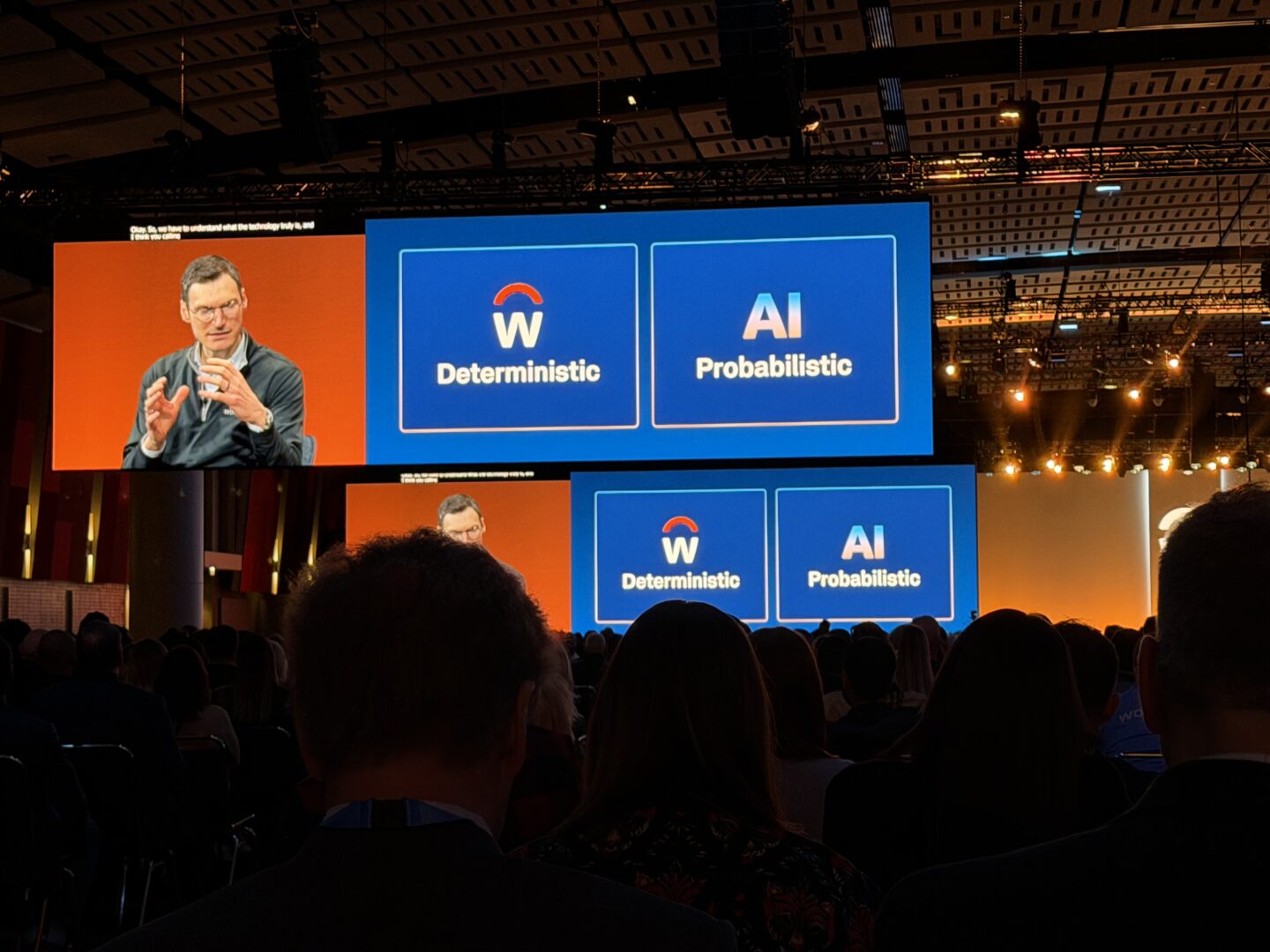
First, Workday drew a clear distinction between deterministic systems of record and probabilistic AI. AI has power, but it does not replace the operational discipline of an authoritative ERP and HCM foundation. In federal environments, that distinction matters even more because the cost of ambiguity is not just inefficiency—it is controlling weakness and audit exposure. 

Photo from Workday SKO highlighting the difference between Deterministic and Probabilistic AI
One of the clearest messages from the stage was the distinction between deterministic systems of record and probabilistic AI.

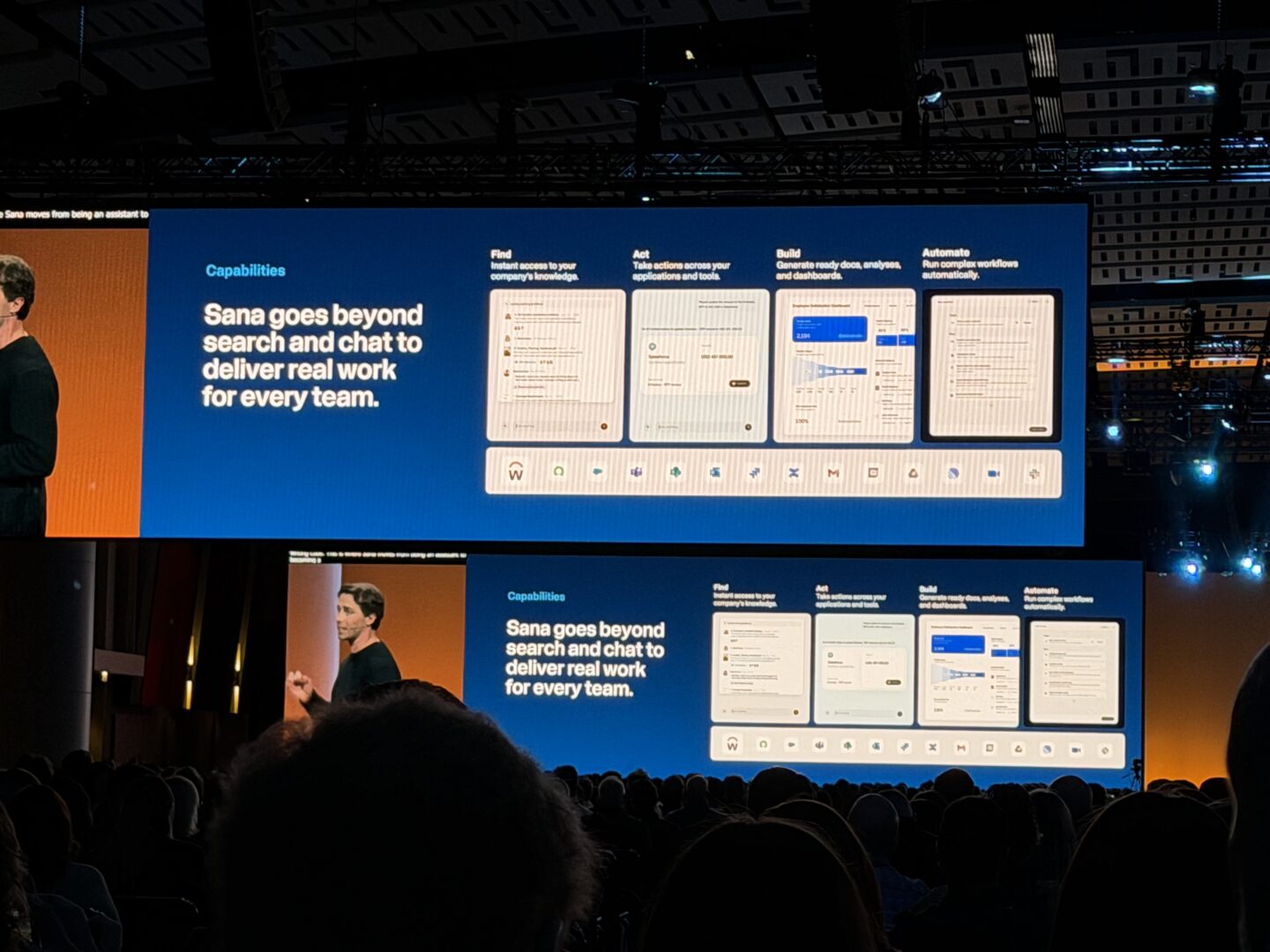
SecondSana, Workday’s new AI experience platform, was positioned as much more than a conversational layer. The direction is toward a new front door for work where search, assistants, agents, and automation are tied directly to enterprise context across Workday and other applications. 

This signals a shift toward an experience model where users do not simply retrieve answers—they move work forward inside governed workflows. 

Picture from Workday SKO - Sana slide - Workday’s new AI experience platform, was positioned as much more than a conversational layer.
Sana was presented as the experience and orchestration layer across Workday and the broader enterprise application landscape.

Third, the conversation has shifted from answers to execution. The focus is no longer only on what AI can say. It is what AI can safely do, with governance, policy enforcement, and measurable outcomes. That also explains the strong emphasis on partner alignment at SKO. Workday knows enterprise value will not scale through product messaging alone. It will scale through ecosystem execution. 


The Shift from AI Answers to AI Execution
 

One of the clearest themes at Workday SKO was the transition from answers to execution. 

For years, enterprise AI discussions focused on generating insights or summarizing information. The new focus is on enabling AI to take action within enterprise systems, safely and predictably. That shift is significant in federal environments where every transaction must operate within strict security, compliance, and audit frameworks. 

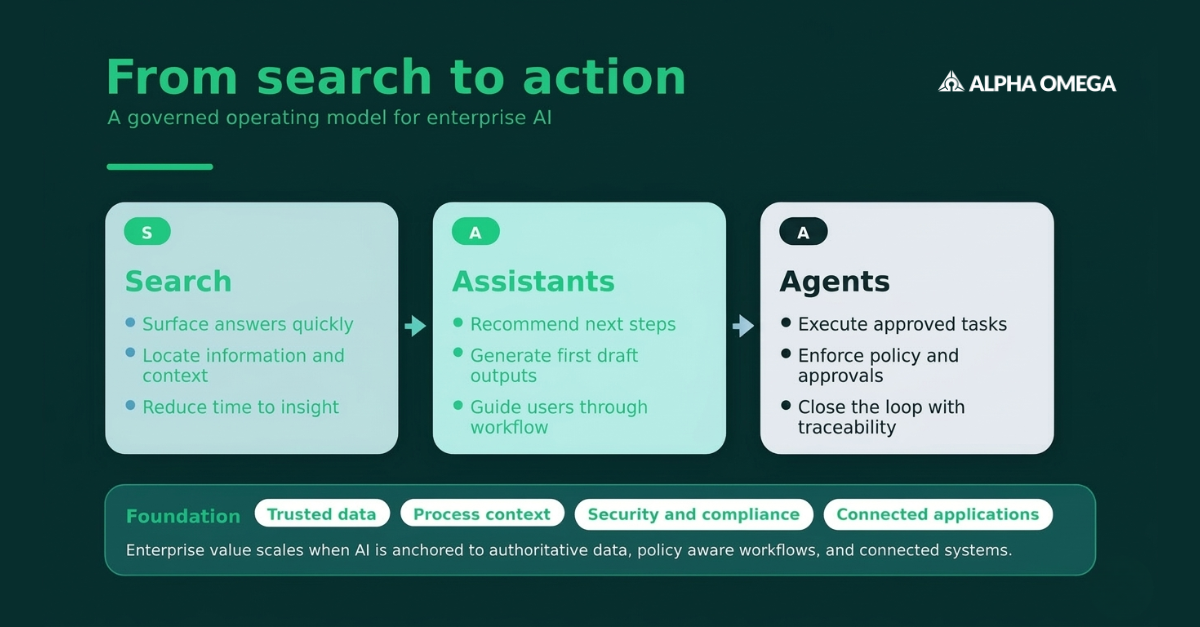
Graphic showing the progression the industry is moving toward is clear: search evolves into assistants, assistants mature into agents, and agents ultimately execute work inside enterprise platforms.
The market is moving from search to assistants to agents, and from answers to execution.

The progression the industry is moving toward is clear: search evolves into assistants, assistants mature into agents, and agents ultimately execute work inside enterprise platforms. In this model, AI can trigger workflows, automate approvals, and orchestrate processes across systems. 

For federal agencies, that level of capability only becomes viable when AI operates on trusted enterprise data and within governed workflows. Without that foundation, automation introduces more risk than value. 


Why Workday Modernization Matters for Federal Agencies 

Federal agencies are operating under several simultaneous constraints. They must:
– modernize while most IT budgets still support operations and maintenance of legacy environments.
– meet growing expectations around zero trust, cybersecurity, auditability, and compliance.
– integrate cloud platforms into complex legacy landscapes while driving change management in workforces that cannot absorb disruption without mission consequence.
 

That is why federal ERP modernization matters now. 

Cloud ERP and HCM platforms are the data and workflow backbone for higher-order capabilities, including automation, analytics, and AI-enabled decision support. 

A modern Workday foundation can standardize business processes, reduce manual reconciliation, improve data quality, and create a stronger control environment across HR and finance. These improvements establish the trusted data foundation required for AI to produce meaningful outcomes. 

The broader AI conversation has also matured. Workday has cited research showing that 82% of organizations are expanding the use of AI agents. Federal agencies will not be insulated from that shift. The real question is whether those capabilities will be introduced through governed enterprise platforms or through disconnected tools that create more operational risk than value. In federal settings, AI in ERP environments must operate within trusted data, role-based security, policy-aware workflows, and auditable outcomes. 

Responsible AI, enterprise trust, and governance are foundational requirements for scaled adoption. 


How Alpha Omega Bridges Strategy to Execution
 

Federal Workday programs do not succeed simply because a tenant is configured correctly. They succeed when agencies can move from strategy to execution across architecture, integration, security, testing, adoption, and operational support. 

This is where Alpha Omega differentiates beyond implementation.
Enter Alpha Omega’s
Continuum Automation Framework

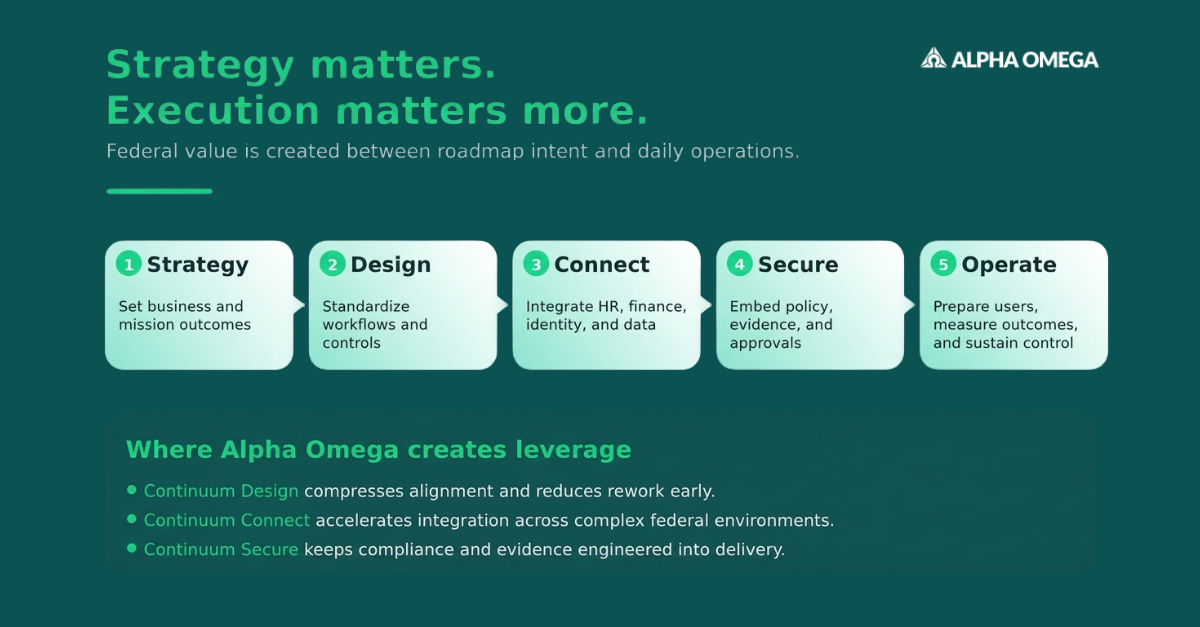
Continuum Design helps agencies align modernization intent early through rapid prototyping and clearer requirements translation. On complex federal programs, this reduces rework, shortens decision cycles, and improves business ownership. 

Continuum Connect addresses one of the hardest parts of federal delivery: integration across HR, finance, identity, shared services, reporting, and legacy mission systems. Workday can only function as a true system of engagement when the surrounding ecosystem is connected with discipline. 

Continuum Secure reinforces the security-first posture federal agencies require. Compliance, evidence, and control validation cannot be bolted onto a Workday program at the end—they must be engineered into delivery from the start. 

This is also why the SKO messaging around Workday Extend and Sana Agent Builder stood out. Workday is clearly building toward a platform where governed extensions, automation, and AI agents operate close to the enterprise data model and security framework. That direction aligns closely with Alpha Omega’s federal delivery model. 

The opportunity is to operationalize Workday to reduce friction, strengthen control, and accelerate measurable outcomes. 


What Agencies Should Do Next 

Agencies that want to extract real value from Workday modernization should focus on four actions. 

1. Treat modernization as data and process transformation, not application replacement.
Standardize business processes, reduce exception handling, and improve data stewardship before scaling AI. 

2. Rationalize integration architecture early. Agencies should identify where Workday must exchange data and trigger actions across finance, HR, identity, learning, case management, and mission support systems. 

3. Build governance for AI and automation now. Ownership, access controls, policy enforcement, monitoring, and escalation paths must be defined before AI agents or advanced automation move into production workflows. 

4. Invest in adoption as seriously as technology. Federal change management is never secondary. If users do not trust the system, understand the workflows, or see the control structure, adoption will stall regardless of platform capability. 


Closing Perspective 

Workday SKO was valuable not because it previewed another set of product features, but because it clarified where the enterprise technology market is heading. 

The conversation has moved from AI curiosity to enterprise execution. For federal agencies, that raises the bar. Success will go to organizations that pair trusted systems of record with governed AI, strong integration architecture, and disciplined execution. 

That is the lane Alpha Omega is built to support – Workday provides the platform. Federal agencies provide the mission. The task now is to bridge strategy to execution in a way that is secure, auditable, and outcome-driven. 

Federal agencies that approach Workday modernization as a platform for trusted data, governed AI, and enterprise execution will be best positioned to deliver mission outcomes in the next generation of government operations. 


About the Author Chris Molitor is Vice President at Alpha Omega, leading ERP and HCM modernization initiatives for federal agencies. He works with government leaders to align enterprise systems, data, and emerging AI capabilities so modernization efforts translate into secure, operational outcomes—not just system deployments.

AI Pilots in Federal Government | Moving from Pilot to Production

The 95% AI Pilot Failure Problem 

A widely circulated 2025 State of AI in Business study from MIT’s NANDA group found that 95% of enterprise AI pilots in federal government fail to generate measurable business value or scale into production systems. 

In federal environments, the challenge is amplified by structural realities: 

  • Security constraints and extended review cycles 
  • Legacy architectures that resist integration 
  • Compliance frameworks that demand auditability 
  • Unclear operational ownership once pilots mature 

Agencies are told to “use AI.” Yet pilots are often built without grounding in the workflows where they would actually operate. When leadership asks whether a solution can move into production, the answer becomes complicated. Security reviews stretch. Momentum fades. The pilot stalls. 

The lesson is not that AI underperforms. It is that architecture determines survivability. 

Federal Agencies Are Being Directed to Adopt AI 

AI deployment in government is not discretionary experimentation. It is policy driven. 

Executive Order 14179 calls for removing barriers to American leadership in artificial intelligence. OMB Memorandum M-24-10 directs agencies to accelerate responsible AI adoption while strengthening governance and risk management. The National AI Initiative Act of 2020 reinforces coordinated federal advancement of AI capabilities. 

These directives do not ask agencies to experiment casually. They expect integration into mission systems under existing compliance and security guardrails. That makes pilot design consequential. 

Why Most AI Pilots in Federal Government Fail to Reach Production

Frontier technology succeeds only when it delivers rapid time-to-value and integrates cleanly into existing workflows. Teams frequently attempt to build too much at once. New technology invites architectural ambition. Full-stack builds feel comprehensive and technically impressive, but in federal environments they can trigger months of security review and infrastructure approval. If a pilot is treated as a disposable experiment, it behaves like one. If it is designed as a production-ready system from the outset, its trajectory changes. 

The difference between the 95 percent stall and the few that scale is rarely model sophistication. It is architectural discipline.

Designing for Production from Day One

In one engagement, we were asked to explore LLM-assisted workflow acceleration. The technically ambitious path was to build a new stack from scratch. It would have taken months to clear security review.

Instead, we embedded the capability inside an existing low-code operational application that already resided within the enterprise boundary. The first working version with LLM integration was built in hours rather than weeks. More importantly, it inherited identity controls, logging, and compliance enforcement from the tenant. 

There was no restart for production. The pilot became the solution.

Build Inside Enterprise Guardrails

One of the most effective ways to improve pilot survivability is to build inside approved enterprise ecosystems rather than outside them. Low-code platforms such as Microsoft Power Platform provide governed environments that inherit the broader security and compliance stack. Infrastructure, identity enforcement, logging, data connectors, and tenant-level controls are already in place. In regulated federal environments, that inheritance is strategic. The fastest and most effective prototype is not always the one written from scratch. It is often the one embedded within trusted architectural boundaries. 

What Is “Vibe Coding”?

Vibe coding refers to using AI-assisted development tools to rapidly generate, refactor, or modify software by describing the intended functionality in natural language rather than manually writing every line of code. 

While this approach accelerates experimentation, unmanaged AI-generated code can quickly introduce security and governance risk. In federal systems, where identity management, logging, and compliance enforcement are mandatory, speed without guardrails increases exposure. Speed inside approved systems, by contrast, enables sustainable scale. 

Align Talent with the Approved Stack

AI expertise alone is insufficient in federal environments. Engineers must understand integration patterns, compliance frameworks, FedRAMP constraints, and the operational limitations that government systems impose. 

Organizations that align architectural fluency, certifications, and experience with cloud-native services and enterprise low-code platforms reduce delivery timelines and increase time-to-value. The goal is not simply to build AI functionality. It is to integrate intelligence into mission workflows without expanding the risk surface. 

The Path Beyond the 95%

Agencies do not have to choose between speed and security. Moving beyond the 95 percent failure rate requires discipline in a few critical areas: 

  • Designing pilots as production-ready systems from the outset 
  • Building within approved enterprise ecosystems rather than outside them 
  • Embedding identity, logging, and compliance controls from day one 
  • Aligning technical talent with the authorized cloud and low-code stack 

The organizations that scale are not necessarily using the most sophisticated models. They are intentional about architecture. When AI is embedded within systems prepared to support it, pilots evolve from proof-of-concept to durable mission capability. 


About the author: Shareef Hussam a mission-focused Systems Engineer supporting National Security at Alpha Omega, specializing in AI, low-code platforms, and cloud solutions. He architects and builds secure, production-grade systems that translate operational requirements into scalable technical solutions. His work centers on embedding technology within real-world workflows to generate measurable business impact.

Federal Automation Framework – Reducing Costs & Modernizing Government

Introduction: Why a Federal Automation Framework Is Essential Now

A federal automation framework is no longer optional—it is essential for agencies facing mounting cost pressures, cybersecurity threats, and rising citizen expectations. As the federal government works to modernize legacy systems and eliminate wasteful spending, innovation must move beyond isolated pilots to structured, measurable transformation. Innovation, especially digital automation, can deliver operational efficiency, cost reductions, and enhance public service outcomes when applied purposefully.

In this blog, we’ll evaluate the cost challenges of current federal systems, explain how solutions like Alpha Omega’s Continuum Automation Framework provide measurable benefits, and demonstrate alignment with major federal innovation priorities and Executive Orders from the Trump Administration. 

The Problem: Federal Systems Are Costly, Outdated, and Inefficient 

Legacy Systems Drain Budgets 

Federal agencies continue to rely heavily on aging information technology systems that are costly to maintain, operate, and secure. According to a Government Accountability Office (GAO) report on IT spending: for FY 2024, approximately $74 billion, nearly 78% of the federal IT budget, was devoted to operations and maintenance of existing systems, versus just $21 billion for development and modernization.  

Security and Operational Risks 

Legacy technology often lacks modern security features, exposing agencies to cyber threats and operational failures. These inefficiencies also contribute to poor customer experience for citizens interacting with government services. 

Billions Wasted on Contracts and Grants 

Beyond core IT systems, federal spending on contracts and grants is so extensive that recent policy efforts like Executive Order 14222, Implementing the President’s “Department of Government Efficiency” Cost Efficiency Initiative, have been issued specifically to curb waste and enforce accountability. EO 14222 directs agencies to review and reduce unnecessary costs tied to federal contracts, grants, and loans, a systemic response to rampant inefficiencies in federal spending.  

The Benefits of Innovation: Beyond Cost Cutting 

Innovation in government delivers value far beyond reduced spending. Some of the major benefits include:

1. Operational Efficiency and Time Savings – Automated workflows and intelligent systems eliminate manual processing, drastically reducing cycle times and human errors.

2. Enhanced Security and ComplianceModernized systems improve defense against cyber threats and provide built-in compliance features that reduce audit risk.

3. Better Citizen ExperiencesFaster, more reliable systems deliver more responsive services to the public, boosting trust and satisfaction.

4. Scalability and Future Readiness Innovative technologies can scale to meet future demands without exponential cost increases. 

Policy Alignment: Trump Administration Executive Orders and Innovation

The Trump Administration’s second term has included a series of Executive Orders that signal a renewed federal priority on efficiency, accountability, and technological leadership. Two major EO initiatives relevant to this blog are: 

Executive Order 14222: Cost Efficiency Initiative 

Signed on February 26, 2025, EO 14222 directs agencies to transform federal spending on contracts, grants, and loans by implementing centralized technology systems to record and justify every payment under covered contracts and grants. It mandates review and possible termination or modification of existing agreements to reduce spending or reallocate for better efficiency.  

This EO explicitly supports the use of modern technology tools to improve oversight and fiscal discipline, a natural fit for automation frameworks that track and optimize processes. 

Executive Order 14179: AI Leadership and Innovation 

EO 14179, “Removing Barriers to American Leadership in Artificial Intelligence”, is designed to strengthen U.S. global competitiveness in AI by rescinding policies that constrain innovation and establishing plans to accelerate responsible AI deployment in government.  

Together, EO 14222 and EO 14179 send a clear signal: the federal government must contain costs while embracing modern technology, including AI and automation, to drive efficiency and strategic advantage. 

Enter Alpha Omega’s Continuum Automation Framework 

So how can federal agencies turn these goals and mandates into operational reality? 

Alpha Omega’s Continuum Automation Framework is a holistic, scalable approach designed to transition agencies from costly legacy systems to efficient, modern, automated operations. 

What is the Continuum Automation Framework?

At its core, Continuum is a modular automation framework built to integrate with legacy infrastructures and modern platforms alike to design, generate, modernize, move data, and prove compliance – delivering total mission automation.

It supports: 

  • Process automation 
  • AI and machine learning integration 
  • Cross-system orchestration 
  • Centralized workflow management 
  • Real-time monitoring and analytics 

This combination makes it possible to deliver rapid ROI while laying the foundation for future innovation. 

Step-by-Step: How Continuum Delivers Efficiency

Alpha Omega’s Continuum Automation Framework operationalizes modernization through four integrated accelerators—Design, Code, Connect, and Secure—each engineered to reduce cost, compress timelines, and improve compliance outcomes.

1. Strategic Discovery with Continuum Design

Continuum Design rapidly inventories systems, maps workflows, and identifies automation candidates using structured architectural modeling and AI-assisted requirements analysis. 

Agencies leveraging Continuum Design typically see: 

  • 85% faster development timelines 
  • Standardized architecture artifacts generated in days instead of months 
  • Early identification of redundant or high-cost workflows 

By front-loading intelligence into modernization strategy, agencies eliminate unnecessary scope and align transformation directly with cost-efficiency mandates under EO 14222. 

2. Accelerated Modernization with Continuum Code

Rather than rewriting entire systems from scratch, Continuum Code automates application refactoring, transformation, and generation—modernizing legacy systems incrementally. 

Capabilities include: 

  • Automated code conversion and transformation 
  • AI-assisted development pipelines 
  • Infrastructure-as-Code automation 

Measured results include: 

  • 40–60% reduction in application modernization costs 
  • 75% faster release cycles 
  • Reduced defect rates through automated testing and mathematical validation 

This allows agencies to avoid “big bang” modernization risks while accelerating delivery. 

3. Data Modernization with Continuum Connect

Continuum Connect automates data migration, transformation, and integration across legacy and modern environments. 

Capabilities include: 

  • Canonical data modeling 
  • Secure API enablement 
  • Cross-system orchestration 

Results typically include: 

  • Up to 90% faster data migration timelines 
  • Reduced integration errors 
  • Elimination of redundant manual data reconciliation 

By stabilizing and standardizing data flows, agencies unlock AI capabilities without introducing operational fragility. 

4. Embedded Compliance with Continuum Secure

Security and compliance are often the largest bottlenecks in modernization. Continuum Secure automates evidence collection, control validation, and compliance monitoring across the system lifecycle. 

Agencies utilizing Continuum Secure have achieved: 

  • 90% reduction in manual ATO processes 
  • Automated audit documentation generation 
  • Continuous monitoring dashboards replacing manual reporting 

This directly supports federal mandates for fiscal discipline and oversight while improving security posture. 

5. Scalable Governance and Continuous Optimization

The framework integrates performance dashboards, KPIs, and policy-driven automation to ensure continuous improvement. 

Across enterprise implementations, agencies frequently realize: 

  • Double-digit percentage reductions in operational costs within 12–24 months 
  • Reduced contract overruns through automation-based tracking 
  • Lower long-term maintenance burdens 

This phased, accelerator-driven model ensures modernization delivers measurable efficiency gains while aligning with federal priorities on transparency, accountability, and innovation.

6. Fast Path to Procurement

Modernization speed is often constrained not by technology—but by acquisition timelines. Alpha Omega’s Fast Path to Procurement addresses this challenge directly by providing a streamlined acquisition ecosystem that enables agencies to move from requirement to award with significantly reduced friction. 

Fast Path leverages pre-competed, readily awardable solutions accessible through: 

  • Commercial Solutions Openings (CSOs) 
  • Other Transaction Authorities (OTAs) 
  • SBIR Phase III pathways 
  • Multiple commercial marketplaces 

By aligning with current acquisition policy directives and using existing contracting mechanisms, agencies can accelerate time to award while maintaining compliance, transparency, and fiscal discipline. 

Quantifying the Value: What Agencies Can Expect 

By automating routine tasks and optimizing processes: 

  • Operational costs decrease as manual labor and waste are reduced. 
  • System maintenance burdens shrink as fewer legacy workloads persist. 
  • Fewer contract overruns and wasteful grant spending occur thanks to automated tracking and justification. 
  • Security and compliance posture improve through built-in governance controls. 

While actual savings depend on agency size and scope, automation transformations frequently yield double-digit percentage reductions in operational costs within 12–24 months. 

Real-World Use Cases Compatible with Federal Priorities 

Automating Grant and Contract Management 

  • Centralized contract payment tracking 
  • Automated justification workflows 
  • AI-assisted fraud detection 

These capabilities directly reinforce goals under EO 14222, which calls for more transparent and accountable systems.  

AI-Enabled Document Processing for Citizen Services

  • Reduces backlog 
  • Improves accuracy 
  • Speeds decisions 

This case supports federal innovation goals under EO 14179 by harnessing AI to improve operational outcomes.  

Conclusion: A Federal Automation Framework Is the Path Forward 

A federal automation framework is no longer optional—it is essential for agencies seeking to modernize while controlling costs and strengthening accountability. With the majority of federal IT budgets consumed by maintaining legacy systems, structural efficiency must replace incremental fixes. 

Executive Orders 14222 and 14179 reinforce the mandate: reduce waste, improve oversight, and accelerate responsible AI adoption. Meeting these objectives requires more than policy alignment—it requires scalable execution. 

Alpha Omega’s Continuum Automation Framework, supported by Fast Path to Procurement, enables agencies to move from strategy to measurable impact—reducing operational costs, improving compliance, and accelerating modernization without prolonged acquisition delays. 

Innovation in government is not about chasing technology trends. It is about delivering mission outcomes with greater efficiency, resilience, and fiscal discipline. A structured federal automation framework turns modernization into a strategic advantage—not a recurring expense. 

AI Modernization for Federal Agencies

AI modernization for federal agencies is not the shortcut we hoped for.

Across the federal enterprise, agencies are racing to adopt artificial intelligence to automate decisions, accelerate analysis, and improve operational tempo. Yet many AI initiatives stall, underperform, or fail to operationalize.

The reason isn’t the algorithms.

It’s the legacy systems underneath them.

AI modernization for federal agencies cannot succeed when intelligence is layered onto brittle architectures, siloed data, and manual workflows. In national security and mission-critical environments—where reliability, auditability, and resilience are non-negotiable—modernization must come before intelligence. More precisely, AI must be paired with a deliberate architectural transformation that prepares systems to support intelligence at scale.

I call this transformation a legacy lift.

What is AI modernization for federal agencies?

AI modernization for federal agencies is the process of integrating artificial intelligence into mission systems by first modernizing data, architecture, security, and workflows—ensuring AI operates securely, compliantly, and at operational scale.

Why AI Modernization fails without legacy system modernization.

Most government mission systems were never designed to support AI.
They were built to:

  • Execute deterministic, rules-based workflows 
  • Store data in rigid schemas 
  • Prioritize stability over adaptability 

AI-driven systems demand the opposite: 

  • Continuous, near–real-time data ingestion 
  • Flexible integration patterns 
  • Observability and feedback loops 
  • Human-in-the-loop accountability 

When agencies attempt to “bolt on” AI to legacy platforms, they encounter predictable failure modes: 

  • Inconsistent or incomplete data pipelines 
  • Latency that undermines real-time decision support 
  • Security gaps introduced by shadow integrations 
  • Compliance challenges driven by opaque model behavior 

Rather than compensating for weaknesses, AI amplifies them. Without foundational modernization, intelligence becomes fragile, unscalable, and difficult to trust. 

What is a Legacy Lift?

legacy lift is a targeted modernization approach that prepares federal mission systems for AI by improving data readiness, modularity, security, and human oversight—without requiring a full system rewrite or multi-year pause on delivery. 

The goal is to decouple, stabilize, and standardize just enough of the underlying architecture to enable intelligence-driven outcomes safely and sustainably. 

A successful legacy lift focuses on four foundational layers. 

Layer 1: Data readiness before intelligence 

AI is only as effective as the data it consumes. Yet many mission systems still rely on: 

  • Batch updates instead of real-time feeds 
  • Hard-coded, brittle integrations 
  • Inconsistent data definitions across systems 

A legacy lift prioritizes: 

  • Canonical data models 
  • Secure, API-driven data access 
  • Data lineage and provenance tracking 
  • Clear ownership and stewardship 

Without these foundations, AI outputs cannot be trusted—especially in environments that require auditability, oversight, and defensibility.  

Layer 2: Modular architecture that can evolve 

Monolithic systems resist change. AI requires experimentation.
Modernized mission systems should: 

  • Expose functionality through services and APIs 
  • Separate data, logic, and presentation layers 
  • Allow AI components to be swapped, tuned, or retired without disrupting operations 

This modularity enables agencies to test and deploy AI responsibly—introducing intelligence incrementally without destabilizing mission-critical workflows. 

Layer 3: Built-in security and compliance 

In national security contexts, AI must operate within: 

  • Zero Trust principles 
  • Continuous monitoring requirements 
  • RMF, FISMA, and emerging AI governance mandates 

A legacy lift integrates security and compliance into the architecture itself, not as after-the-fact controls. This includes: 

  • Identity-aware data access 
  • Policy-driven authorization 
  • Automated evidence generation for audits 

AI systems that cannot explain their behavior or prove compliance will not scale—regardless of their technical sophistication. 

Layer 4: Human-centered AI integration 

AI should accelerate human decision-making, not replace it.
Modernized systems must support: 

  • Explainable outputs 
  • Clear confidence indicators 
  • Human override and escalation paths 

In operational environments where decisions carry real-world consequences, trust is built when operators understand not just what the system recommends—but why.  

How long does an ATO take without modernization?

In many federal environments, obtaining an Authorization to Operate (ATO) can take six to eighteen months. These prolonged timelines delay innovation, increase system risk, and discourage iterative improvement. 

Legacy lifts that embed security, automation, and continuous monitoring early in the lifecycle enable agencies to dramatically shorten approval cycles—moving from point-in-time authorization toward continuous authorization models that support faster delivery without compromising compliance. 

How can Agencies reduce risk when modernizing for AI?

Agencies can reduce risk when modernizing for AI by modernizing data foundations first, embedding security and compliance into system architecture, and introducing AI incrementally with human oversight and continuous monitoring.


What Agencies can do in the next 90 days.

Modernization does not require a blank slate. The most effective transformations start small and deliver momentum quickly.

In the next 90 days, agencies can: 

1. Identify a rapid contractual pathway and funding source to pilot AI-enabled modernization
2.
Select one mission workflow where AI could deliver value if foundational constraints were addressed
3. Define a fixed-price procurement approach for scaling successful pilots
4. Targeting 50–70% cost reductions compared to traditional modernization efforts
5. Measure success by operational outcomes—not scope or capacity 

This approach reduces risk while creating a clear path from experimentation to production. 

If we do nothing:

Without a legacy lift, agencies will continue to: 

  • Spend heavily on AI pilots that never operationalize 
  • Accumulate technical debt while chasing innovation 
  • Introduce security and compliance risk unintentionally 
  • Fall behind adversaries modernizing holistically 

AI is not a silver bullet. But when paired with deliberate modernization, it becomes a force multiplier. 

The Bottom Line

Mission modernization is no longer about replacing old systems—it’s about preparing them to think.

AI modernization for federal agencies succeeds only when legacy systems are ready to support intelligence. A legacy lift provides the path forward, enabling agencies to evolve mission systems without breaking trust, compliance, or continuity.