AI in Cyber Defense: Governing Risk in the Age of Shadow AI

As cyber threats evolve in speed, scale, and sophistication, the conversation is no longer about whether to adopt AI in cyber defense—it’s about how to secure it. 

I’m looking forward to discussing this at the upcoming Potomac Officers Club 2026 Cyber Summit, where leaders across government and industry will explore how organizations are strengthening resilience, advancing Zero Trust, and operationalizing AI across defense environments. My focus will center on a growing reality across federal agencies and contractors alike: the rise of Shadow AI and its impact on cybersecurity. 

Shadow AI Is the New Attack Surface

AI is transforming how we work—but it’s also transforming how risk enters the enterprise. 

Today, every employee has access to powerful AI tools. With little technical expertise, users can generate code, build workflows, and deploy capabilities outside of governed environments. This has accelerated the growth of Shadow IT and Shadow AI, introducing: 

•  Unmonitored data exposure risks.
•  Unauthorized integrations and workflows
•  New and expanding attack surfaces
•  Increased potential for PII and CUI leakage 

These risks are no longer theoretical—they are actively reshaping the threat landscape. 

For a deeper look at this challenge, check out our Chief AI Transformation Officer’s Shadow AI blog.

From Detection to Continuous Control

Cyber defense is more than just identifying threats—it’s about maintaining continuous control over risk, compliance, and system integrity. 

As AI expands the attack surface, organizations must move beyond periodic assessments and reactive monitoring toward a model of operational cyber resilience, where: 

•  Security controls are continuously validated—not periodically assessed
• 
Risk is visible in real time across systems and environments
• 
Compliance is automated, traceable, and audit-ready
•  Cyber posture evolves alongside the systems it protects 

This shift is critical for organizations operating under frameworks like NIST 800-53 and CMMC, where gaps in visibility or delayed response introduce unacceptable risk. 

It also reflects how we deliver our cybersecurity and risk management capability, ensuring systems are not only protected, but continuously aligned to evolving threats and compliance requirements. 

Continuum Secure: Automating Control, Compliance, and Cyber Resilience at Scale

As cyber environments grow more complex, they must also maintain consistent control across systems, data, and compliance requirements. 

That’s why we’ve evolved our patented A2O solution into Continuum Secure. 

Continuum Secure automates the processes that traditionally slow cybersecurity operations, from RMF and ATO workflows to continuous monitoring and audit readiness. 

With capabilities that include: 

•  Automated NIST 800-53 control assessments
•  Continuous compliance monitoring
•  Real-time POA&M tracking and alerting
•  Enterprise risk dashboards and Zero Trust visibility
•  End-to-end audit traceability 

Continuum Secure provides the structure and visibility required to manage risk in real time, helping organizations strengthen cyber posture, reduce manual burden, and accelerate compliant delivery across mission environments. 

Securing National Security Missions in an AI-Driven Environment

For organizations operating in National Security environments, the stakes are even higher. 

Adversaries are leveraging AI to accelerate attacks and exploit vulnerabilities, while internal AI adoption continues to expand faster than governance frameworks can keep up. 

This dual pressure requires organizations to: 

•  Safeguard sensitive data across the enterprise
•  Operationalize Zero Trust principles
•  Govern AI usage with the same rigor as traditional systems
•  Maintain continuous visibility into risk and compliance 

The Path Forward

Cyber defense is entering a new phase—defined by AI, automation, and continuous adaptation. 

The organizations that succeed will be those that: 

•  Govern AI as rigorously as they deploy it
• 
Maintain continuous control over risk and compliance
•  Automate the processes that slow response and increase exposure
•  Deliver secure capabilities at mission speed 

At Alpha Omega, we are focused on helping agencies and partners make this transition—building secure, scalable solutions that strengthen resilience, accelerate delivery, and support national security outcomes.
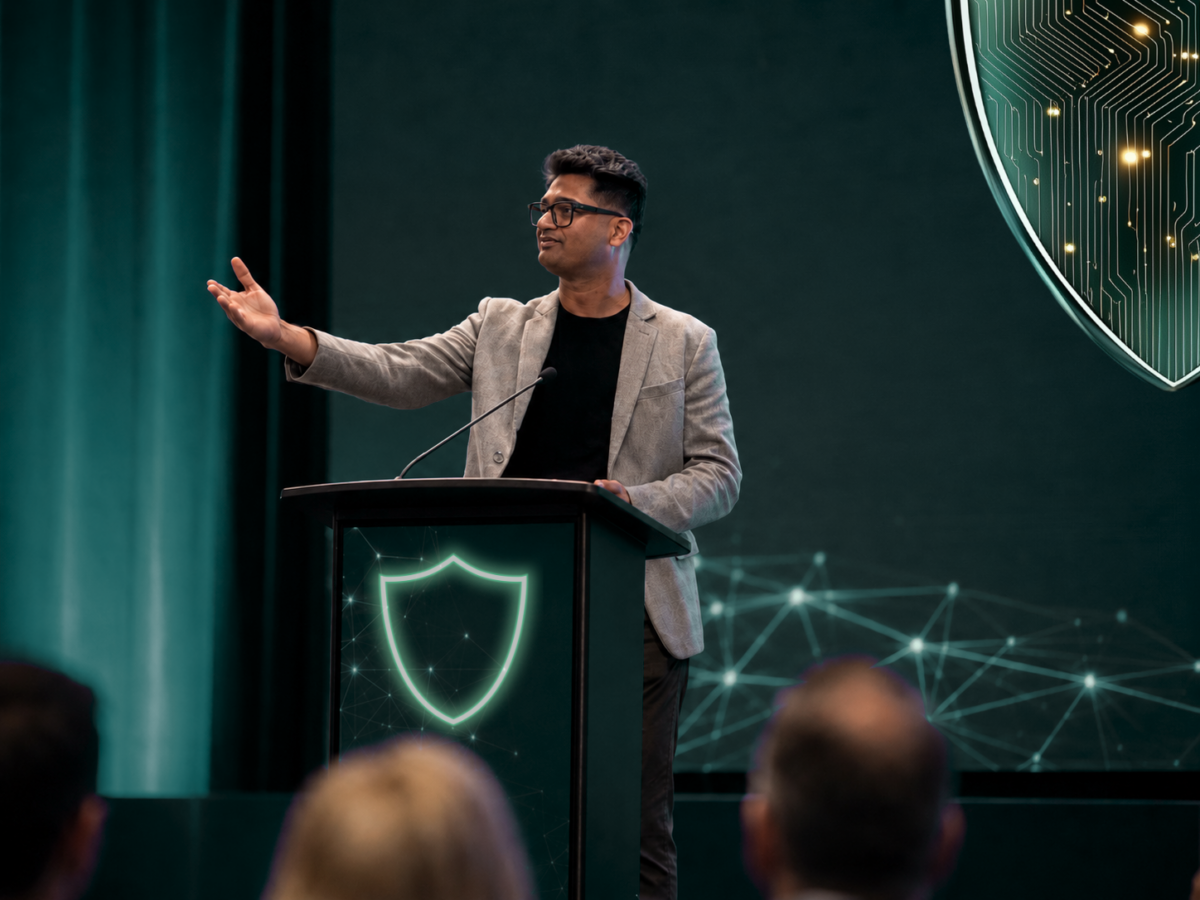
CTO Nitin Vartak delivers Cyber talk at Potomac Officers Club
Nitin Vartak, CTO


I look forward to continuing this conversation at the Cyber Summit and collaborating with leaders across the community to shape the future of AI-driven cyber defense. 
Reduce Time to ATO | How Federal Agencies Accelerate Authorization

How can I reduce time to ATO?

An Authorization to Operate (ATO) is a mandatory approval federal agencies must obtain before deploying any new software system under the Federal Information Security Management Act (FISMA). While essential for protecting systems from cyber threats, the ATO process is often slow, manual, and resource-intensive, making it difficult for agencies to innovate quickly. As agencies look to reduce time to ATO without sacrificing compliance or security, automation and modern security practices are becoming critical to streamlining approvals and sustaining continuous authorization.

Obtaining an ATO can be a long and tedious undertaking, and agencies often look to new technologies and processes that can help address the challenges of ATO processing.

Challenge No. 1: Identifying Baseline Security Controls

Security testing must be moved to the start of the process, incorporating it into the requirements and system design. Agencies must identify tools and practices that they can fully integrate throughout the software development life cycle (SDLC).

Challenge No. 2: Implementing Security Controls 

Leverage automation to achieve a successful security implementation. Ensure that all updates to your system pass through a standardized security check. Create cases using different attack vectors and test them. Automation allows agencies to check engineering activities while maintaining security processes. As systems may also have third-party libraries and frameworks, agencies need controls that can monitor and identify vulnerabilities within these components as well.

Challenge No. 3: Monitoring System Security

All efforts in identifying baseline security controls and automation will be pointless without a monitoring and reporting solution in place. Without visibility into the process, it is difficult to identify opportunities to adjust and optimize the system. Metrics such as vulnerability counts, mean-time-to-detect, and mean-time-to-respond provide essential insights into the status of security implementation.

Challenge No. 4: Prolonged Timelines

An ATO can take anywhere between 6-18 months to complete. This can stifle change and make applications stale. The prolonged timeline also delays rolling out innovations that create business value and increases system risk to an agency.

To address these challenges, government agencies must partner with service providers that can help them through the full ATO processing lifecycle. Agency decision makers should look for service providers with the following qualifications:

Strong history of supporting other government agencies to ensure that they are familiar with federal regulations and best practices. Consult with security professionals in other agencies to identify vendors they have experienced success with.

Strong reputation in providing integrations that can work within the development environment and with the integration and deployment pipelines.

Inclusion of compliance as a core component of reporting capabilities. Select partners that are familiar with compliance standards such as FISMA, National Institute of Standards and Technology (NIST), Security Technical Implementation Guides (STIG), and others.

Proven ways to reduce time to ATO. Identify partners with proven tools to reduce time to ATO without compromising consistency in results and continuous compliance and monitoring.

To effectively reduce time to ATO, agencies must shift from point-in-time security assessments to continuous, automated authorization processes. Integrating security controls earlier in the SDLC, automating evidence collection, and enabling real-time monitoring allow agencies to shorten approval cycles while improving consistency and reducing risk. Automation transforms ATO from a compliance bottleneck into a continuous, measurable security capability.

Addressing ATO Challenges with Alpha Omega

For more than 20 years, Alpha Omega has helped federal agencies modernize mission-critical systems while navigating the complexity of federal security and compliance requirements. Our teams partner closely with agency security, engineering, and program leadership to reduce time to ATO without compromising rigor, transparency, or trust.

By combining deep cybersecurity expertise, intelligent automation, and agile delivery practices, Alpha Omega helps agencies move from lengthy, manual authorization cycles to continuous, automation-enabled ATO processes. Agencies benefit from faster approvals measured in weeks instead of months, improved consistency across security controls, and real-time visibility into system risk and compliance posture.

Our patented, AI-driven accelerator, Continuum Secure, is purpose-built to automate the full ATO lifecycle. Built in collaboration with industry-leading automation platform UiPath, Continuum Secure streamlines evidence collection, executes and validates security controls, identifies gaps and exceptions, and provides always-on monitoring through technical and operational dashboards. This continuous automation approach enables agencies to remain audit-ready at all times, reduce rework during security reviews, and sustain authorization as systems evolve.

With Alpha Omega, agencies gain a trusted partner that not only understands federal ATO and RMF requirements but also delivers measurable reductions in authorization timelines, lower compliance costs, and stronger security outcomes across the lifecycle of modern federal systems.