AI in Cyber Defense: Governing Risk in the Age of Shadow AI

As cyber threats evolve in speed, scale, and sophistication, the conversation is no longer about whether to adopt AI in cyber defense—it’s about how to secure it. 

I’m looking forward to discussing this at the upcoming Potomac Officers Club 2026 Cyber Summit, where leaders across government and industry will explore how organizations are strengthening resilience, advancing Zero Trust, and operationalizing AI across defense environments. My focus will center on a growing reality across federal agencies and contractors alike: the rise of Shadow AI and its impact on cybersecurity. 

Shadow AI Is the New Attack Surface

AI is transforming how we work—but it’s also transforming how risk enters the enterprise. 

Today, every employee has access to powerful AI tools. With little technical expertise, users can generate code, build workflows, and deploy capabilities outside of governed environments. This has accelerated the growth of Shadow IT and Shadow AI, introducing: 

•  Unmonitored data exposure risks.
•  Unauthorized integrations and workflows
•  New and expanding attack surfaces
•  Increased potential for PII and CUI leakage 

These risks are no longer theoretical—they are actively reshaping the threat landscape. 

For a deeper look at this challenge, check out our Chief AI Transformation Officer’s Shadow AI blog.

From Detection to Continuous Control

Cyber defense is more than just identifying threats—it’s about maintaining continuous control over risk, compliance, and system integrity. 

As AI expands the attack surface, organizations must move beyond periodic assessments and reactive monitoring toward a model of operational cyber resilience, where: 

•  Security controls are continuously validated—not periodically assessed
• 
Risk is visible in real time across systems and environments
• 
Compliance is automated, traceable, and audit-ready
•  Cyber posture evolves alongside the systems it protects 

This shift is critical for organizations operating under frameworks like NIST 800-53 and CMMC, where gaps in visibility or delayed response introduce unacceptable risk. 

It also reflects how we deliver our cybersecurity and risk management capability, ensuring systems are not only protected, but continuously aligned to evolving threats and compliance requirements. 

Continuum Secure: Automating Control, Compliance, and Cyber Resilience at Scale

As cyber environments grow more complex, they must also maintain consistent control across systems, data, and compliance requirements. 

That’s why we’ve evolved our patented A2O solution into Continuum Secure. 

Continuum Secure automates the processes that traditionally slow cybersecurity operations, from RMF and ATO workflows to continuous monitoring and audit readiness. 

With capabilities that include: 

•  Automated NIST 800-53 control assessments
•  Continuous compliance monitoring
•  Real-time POA&M tracking and alerting
•  Enterprise risk dashboards and Zero Trust visibility
•  End-to-end audit traceability 

Continuum Secure provides the structure and visibility required to manage risk in real time, helping organizations strengthen cyber posture, reduce manual burden, and accelerate compliant delivery across mission environments. 

Securing National Security Missions in an AI-Driven Environment

For organizations operating in National Security environments, the stakes are even higher. 

Adversaries are leveraging AI to accelerate attacks and exploit vulnerabilities, while internal AI adoption continues to expand faster than governance frameworks can keep up. 

This dual pressure requires organizations to: 

•  Safeguard sensitive data across the enterprise
•  Operationalize Zero Trust principles
•  Govern AI usage with the same rigor as traditional systems
•  Maintain continuous visibility into risk and compliance 

The Path Forward

Cyber defense is entering a new phase—defined by AI, automation, and continuous adaptation. 

The organizations that succeed will be those that: 

•  Govern AI as rigorously as they deploy it
• 
Maintain continuous control over risk and compliance
•  Automate the processes that slow response and increase exposure
•  Deliver secure capabilities at mission speed 

At Alpha Omega, we are focused on helping agencies and partners make this transition—building secure, scalable solutions that strengthen resilience, accelerate delivery, and support national security outcomes.
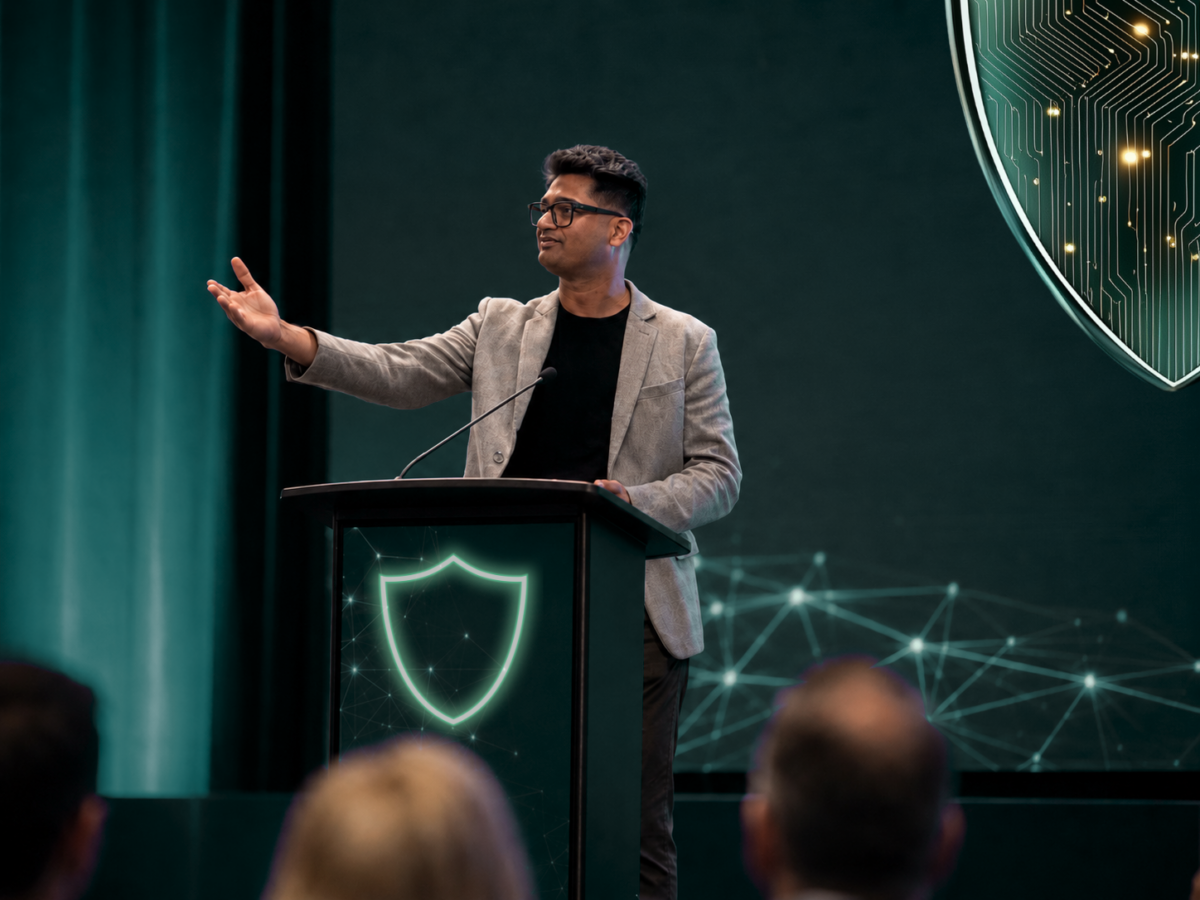
CTO Nitin Vartak delivers Cyber talk at Potomac Officers Club
Nitin Vartak, CTO


I look forward to continuing this conversation at the Cyber Summit and collaborating with leaders across the community to shape the future of AI-driven cyber defense. 
From Shadow AI to Strategic Advantage

Balancing AI Innovation with Security:
An AI Governance Checklist for Federal Organizations

What Is Shadow AI?

Shadow AI emerges when teams use AI tools with company or client data outside approved guardrails, without a clear understanding of data handling, or beyond established governance boundaries.

If you’ve tested a chatbot to draft an email, used a code assistant to debug faster, or explored a model out of curiosity, you’ve already entered what the industry calls shadow AI.

At Alpha Omega, AI plays a direct role in how we:

  • Generate proposals
  • Prototype solutions
  • Optimize talent deployment
  • Orchestrate data workflows
  • Automate back-office processes

Our people drive innovation. AI amplifies their impact and removes repetitive work. That level of adoption creates opportunity and responsibility.

Shadow AI Signals Demand for Innovation

Shadow AI reflects a familiar pattern. CIOs have managed this dynamic for years through shadow IT.

Teams have always found ways to move faster:

  • Testing tools before formal approval
  • Solving problems ahead of governance processes
  • Exploring new capabilities independently

This behavior signals momentum, not risk.

Shadow AI follows the same pattern. Teams experiment with new tools and integrate AI into workflows before leadership gains full visibility. The real challenge comes from operating without shared guardrails.

Enable Innovation with Guardrails

Many organizations respond by restricting access. That approach slows progress and pushes experimentation further out of view.

A stronger approach creates balance:

  • Encourage curiosity and exploration
  • Define clear guardrails and data boundaries
  • Align experimentation with enterprise priorities

Organizations that lead in AI adoption guide experimentation instead of limiting it.

The message should stay clear: Innovation moves forward when guardrails support it.

Build a Culture of Responsible AI

Effective AI governance builds confidence. Teams move faster when they understand:

  • What data they can use
  • Which tools are approved
  • How to apply AI responsibly
  • Where AI delivers measurable value

At Alpha Omega, we enable teams to experiment within a framework that supports security, compliance, and operational outcomes. This approach builds trust, accelerates adoption, and reduces risk at the same time.

Turning Strategy into Action

Understanding shadow AI is only the starting point. Organizations need a clear, repeatable way to translate that understanding into action.

A structured approach to AI governance helps teams move quickly while maintaining control. It provides clarity on where experimentation can happen, how data should be handled, and how innovation scales safely.

The checklist here outlines a practical starting point – be sure to download the full checklist below.

A Practical AI Governance Checklist

1. Establish guardrails and safe experimentation environments
Define approved AI tools and create sandbox environments where teams can test ideas without exposing sensitive systems or data.

2. Set clear data boundaries and risk tolerance
Treat every AI interaction as a data-sharing event and define what data can and cannot be used.

3. Enable teams through governance, not restriction
Provide clear guidance, approved tools, and support channels that help teams innovate safely.

4. Train teams with real-world scenarios
Use practical examples to show how AI should be applied across everyday workflows.

5. Reinforce a culture of responsible innovation
Encourage curiosity while aligning AI use with enterprise priorities and security expectations.

What’s Next: Scaling AI with Confidence

Shadow AI highlights demand. Teams want to move faster and apply new capabilities to real problems.

Our role is to channel that energy.

Alpha Omega continues to evolve as a solutions organization. Our AI Community of Practice has grown into an active forum where teams share practical applications, lessons learned, and responsible approaches to adoption.

We build AI the same way we build everything else: with intention, discipline, and a focus on measurable value. Organizations that respond with clarity, governance, and trust will lead the next phase of AI adoption.

Download our AI Governance Checklist for Federal Organizations

For a more detailed, step-by-step framework, download:
AI Governance Checklist for Federal Organizations

Use it to:

  • Assess your current AI readiness
  • Define guardrails and governance structures
  • Enable safe, scalable AI adoption across teams