Speed and Structure: Federal Development with AWS Kiro

Speed and Structure: How Federal Teams Can Have Both with AWS Kiro

AWS Kiro federal development gives government teams a better way to balance rapid AI-assisted coding with the structure, traceability, and governance required for mission-critical systems.

I’ve spent enough years in federal IT modernization to tell a passing fad from a genuine shift. So when vibe coding took off, I wasn’t surprised it caught fire. I was impressed by its ability to take someone from describing an idea to a running prototype in an hour, even someone who has never written a line of code. The approach is loose by design. You describe what you want to an AI tool, take what it gives you, and refine by feel. For the right kind of work, it’s a game-changer. 

Vibe coding has earned its place. It’s the fastest way I’ve ever seen to prototype an idea, run an experiment, or test whether a concept has legs before anyone commits real resources to it. If you’re exploring, you should use it. 

Mission-critical government systems are a different story. When the work involves processing benefits, safeguarding sensitive data, or serving millions of citizens, the cost of being wrong stops being theoretical. These systems rarely stand alone. They depend on other systems and agencies; they face heightened security and accessibility demands, and they operate under federal compliance requirements such as NIST 800-53 and FedRAMP that leave little room for guesswork. Getting it wrong is costly and hard to walk back. The disciplined response has always been to document the requirements, review the architecture, and trace every decision. The problem was that this rigor was slow and expensive, which is exactly why teams kept reaching for speed instead. 

What’s changing isn’t the idea. Defining a system before you build it has always been sound engineering, but it was simply too slow to compete with speed. AI has erased that penalty, and tools like AWS’s Kiro are putting the approach front and center. It’s one of the shifts I’ll be watching most closely at the AWS Summit in Washington, D.C. 

What Spec-Driven Development Actually Is

So what does it actually involve? Before you build, you write a specification, a structured statement of what the system must do, how it should be architected, and what constraints it must meet. From there, the developer, or the AI agent, builds against that spec instead of a vague prompt. The requirements, the design, and the task plan come first, and the code follows. 

Kiro shows how this works in practice. AWS positions it as the successor to Amazon Q Developer, and it gives developers a choice in how they work. One mode is conversational, for quick, exploratory coding. The other is spec-driven, where the tool generates the requirements, design, and tasks first and builds against them. This lets a developer move between the two depending on the task and the stakes, exploring in the loose mode and building in the structured one. 

I follow the same pattern in my own work. When I’m experimenting or testing, I lean on the loose, conversational style, and when something is headed for production, I switch to a structured, spec-driven approach with real review. That isn’t a compromise between speed and rigor; it’s what mature development is starting to look like. 

What matters is that AWS made the spec-first workflow a first-class, built-in option, sitting right alongside the fast one. Structure has always been the foundation of durable systems, and vibe coding bent that for a while, trading rigor for speed. Bringing both modes into one tool is the industry’s answer, keeping the confidence of structure while preserving the speed that made vibe coding so appealing. 

For the government, flexibility matters.

It means vibe coding isn’t something federal teams have to keep at arm’s length. In the right setting, exploring an idea, building an internal tool, or working in a development or test environment, it’s a legitimate and fast way to make progress. The discipline kicks in when the work moves toward production, and the stakes rise, and the same toolchain lets them make that shift without switching tools, so they can apply the right approach to the task in front of them, start to finish. 

In a government setting, the value of that structure comes down to one word, confidence. It’s a concrete kind of confidence. A spec gives you traceability, a written line from what the agency needed to what was actually built, so when an auditor or an oversight body asks you to show where a requirement is met, you can. It also gives you something to check the AI’s output against. With pure vibe coding, there’s no structured record of what the system was supposed to do, only the prompts you typed and the code that came back, nothing authoritative to measure the result by. A spec turns the AI’s work from something you have to trust into something you can verify. 

Because the spec is structured, you can point specialized AI personas and skills at it (a security reviewer, a compliance checker, an architecture critic). They surface gaps and conflicts in the planning phase, where they’re cheap to resolve, rather than in a production system, where they’re expensive and public. It also creates continuity, so that when the next team inherits the system, often years later, they can understand what was built and why. 

This isn’t red tape. In an environment where teams rotate and systems outlive the people who built them, a clear specification is what keeps the mission on track. 

The Real Work Happens Before the IDE

Here’s what I tell every agency team we work with. The cloud is not your bottleneck. AWS GovCloud is fast, scalable, and increasingly capable, with mature tools and the infrastructure already in place. What breaks modernization programs isn’t the deployment, it’s arriving at deployment without a clear picture of what you’re building. 

That’s the gap the tooling can’t close for you. A spec session is only as strong as the spec it starts from, and someone still has to create it. For a government system, that takes more than a few lines typed at the start of a session, it takes the experts who run and manage those processes helping to shape and validate the model that comes out of it. 

Having spent years helping government teams understand spec-driven development and domain-driven design, we know this space well and care about it. It’s the thinking behind Continuum Design, a platform we developed and support that brings this discipline upstream, into the design phase, before any code is written. It helps teams turn the way an agency actually works into a shared, validated model that business and technical people can agree on, and that model becomes the foundation everything else is built on. So seeing the approach surface at the forefront of agentic IDEs lands as more than industry news. It’s a shift we’ve been hoping to see. 

In practice, that means producing documented requirements, data models, and a validated prototype in a fraction of the usual time. That spec then feeds into whatever a team builds with, whether that’s Kiro, another agentic tool, or a conventional workflow. We produce the spec, and the tools build from it. 

That hand-off is getting easier, and the reason is bigger than any single product. The tools are starting to talk to each other. Through MCP, the Model Context Protocol, an open standard that lets AI tools read from other systems, an agentic IDE like Kiro can connect to wherever a team’s context already lives, the same way it connects to tools like Jira or Linear. That openness lifts the whole market, and our own Continuum Design benefits from it too, since it runs an MCP server of its own. A developer in Kiro can pull a validated model from Continuum Design and begin a spec session from something stakeholders have already agreed on, rather than a blank page. The point isn’t the tool. It’s that the spec can stay the single source of truth, from upstream design through to production code. 

Why This Matters More Now

AWS’s commitment, announced in November 2025, to invest up to $50 billion in AI and supercomputing infrastructure specifically for U.S. government organizations signals something important. The federal AI moment is real, and it’s moving fast. Agencies that were running cautious pilots two years ago are now looking at production deployments, and the pressure to deliver, from Congress, from OMB, from the White House, is real. 

That pressure is exactly when corners get cut. In government, the corners that get cut are usually the upfront design work, the requirements gathering, the architecture review, the stakeholder alignment, because they feel slow and the timeline is urgent. 

The irony is that skipping those steps makes everything slower. Every hour saved at the front end of a program by skipping the spec tends to cost several hours downstream, in rework, in failed reviews, and in the requirements scrub that always follows when the thing that got built isn’t quite the thing that was needed. Done properly, with the right tooling, spec-driven development for federal government programs isn’t the slow path anymore. It’s the path that gets agencies to the finish line with something they can sustain. 

What I’m Watching at the Summit

The star of the show, for me, won’t be the tooling. Don’t get me wrong, I’m looking forward to hearing about the latest AWS services and the newest capabilities from the industry’s leading vendors. The sessions I’ll seek out, though, are the ones where agencies talk candidly about what actually worked. In my experience, the programs that succeeded all had one thing in common. They did the hard work of defining the problem before they started building the solution. 

Kiro is a meaningful signal that the industry has internalized that lesson at the tooling level. Spec-first development is no longer something a thoughtful practitioner has to champion in a requirements meeting, it’s becoming a standard part of how teams build for production. 

Even the best tooling doesn’t solve the human problem. Before an agentic IDE can execute against a specification, someone has to create one worth executing. That means aligning stakeholders who have competing priorities, translating mission requirements into technical constraints, and making architectural decisions that will shape the system for years. That work happens before the first prompt, and it determines whether the AI accelerates delivery or just accelerates the wrong thing faster. 

If you’re thinking about how to move an AI modernization effort from pilot to production, I’d welcome the conversation. If you’re at the Summit, keep an eye out for me roaming the halls of the Convention Center or reach out at robert.cole@alphaomega.com. The technology is ready, and the teams that pair that speed with a solid spec are the ones who will get there first.


Rob Cole leads the Digital Evolution & Cloud practice at Alpha Omega, an AWS Advanced Tier Services Partner

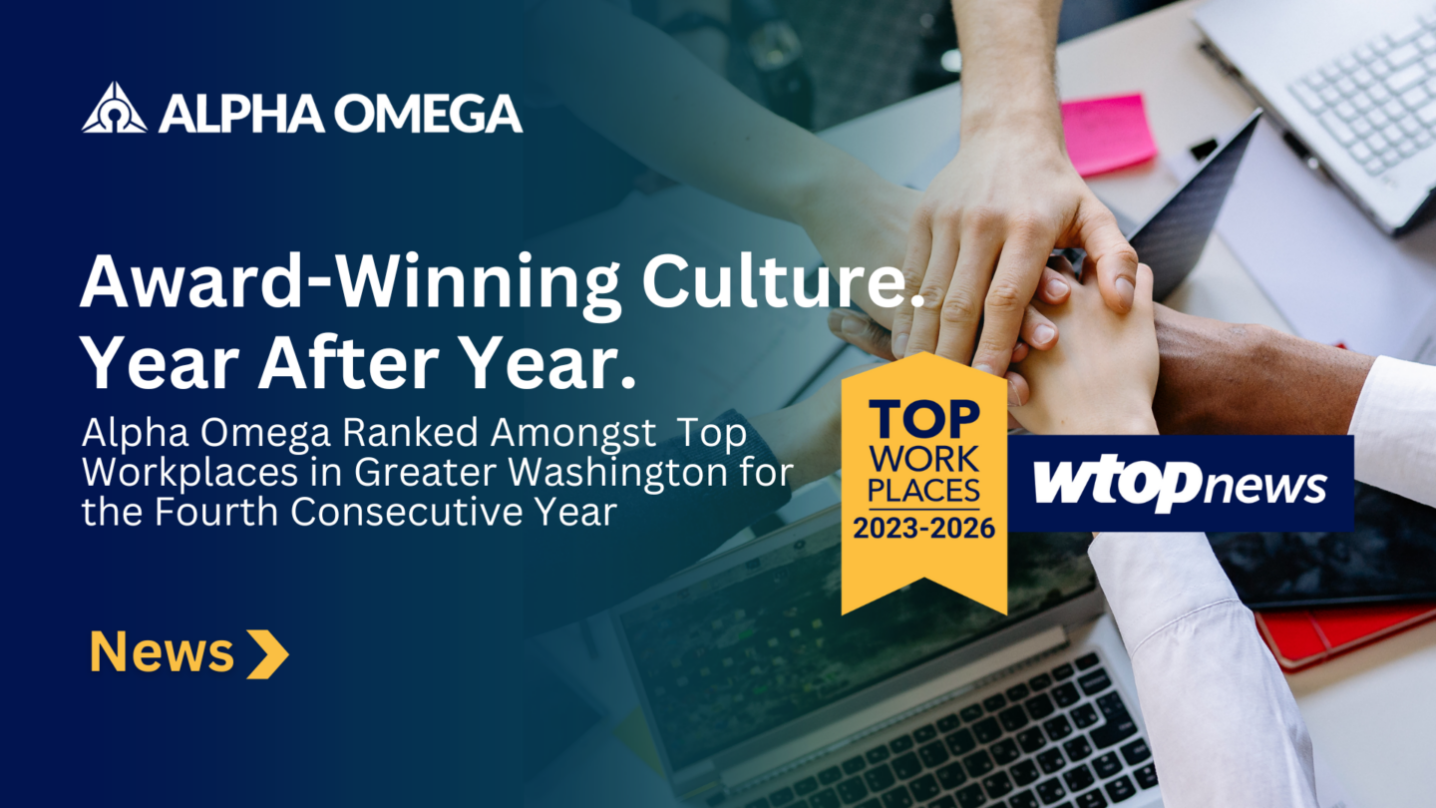
Alpha Omega Named a 2026 Washington, D.C. Top Workplace

Alpha Omega Named a 2026 Washington, D.C. Top Workplace 

Alpha Omega has been named a 2026 Washington, D.C. Top Workplace, marking our fourth consecutive year receiving this employee-driven recognition.

This award is especially meaningful because it is based entirely on employee feedback. It reflects the experiences, perspectives, and voices of the people who make Alpha Omega a great place to work. 

“The DC Top Workplace award is especially meaningful because it reflects the voices of our team members,” said Gautam Ijoor, CEO of Alpha Omega. “Our people and our commitment to community and the nation have always driven Alpha Omega’s growth. Our team’s innovation, dedication, and collaboration reinforce the culture we build together as we support critical federal customer priorities.”

What Makes a 2026 Washington, D.C. Top Workplace? 

The Top Workplaces program recognizes organizations that create strong cultures built on trust, communication, growth, and engagement. Employees evaluate their workplace through an anonymous survey, making this recognition a direct reflection of our culture. 

In fact, the recognition extends beyond the Washington, D.C. Top Workplace list. This year, Alpha Omega also received nine Top Workplaces Culture Excellence Awards from Energage, including a first-time win for Compensation & Benefits. The company earned repeat recognition in:

  • Innovation
  • Leadership
  • Purpose & Values
  • Employee Well-Being
  • Employee Appreciation
  • Professional Development
  • Work-Life Flexibility
  • Technology Industry

Marking the fourth consecutive year Alpha Omega has been recognized across these categories. Together, these honors reflect the culture, opportunities, and employee experience that continue to define Team Alpha Omega.

A Recognition Built by Our Team 

As Alpha Omega continues to grow, we remain committed to investing in our people. Through leadership development, career mobility, learning opportunities, and employee recognition programs, we strive to create an environment where employees can grow, lead, and make an impact. 

“We are proud of the culture our team continues to strengthen,” said Tanja Guerra, Chief Human Resources Officer of Alpha Omega. “Our employees bring purpose and excellence to their work every day, and we remain committed to investing in their growth, well-being, and success.”

This recognition joins a growing list of workplace honors from organizations including USA Today, Virginia Business, The Washington Post, and Energage.

Most importantly, it reflects the incredible people who bring our mission and values to life every day.

Alpha Omega welcomes driven professionals who want to contribute to high-impact federal missions in AI, digital modernization, cybersecurity, DevSecOps, and solutions delivery. For opportunities at Alpha Omega, visit our careers page.

Alpha Omega has been named a 2026 Washington, D.C. Top Workplace, marking our fourth consecutive year receiving this employee feedback-driven recognition.
For the 13th year, Washington D.C. Top Workplaces is honoring the best places to work in the region, and for the first time, the awards are in partnership with WTOP News.

Cheap Tokens, Expensive Workflows: Deterministic AI Wins

The Case for Deterministic AI in Legacy Modernization

Three years ago, the cautious position on AI economics was that token prices might not fall fast enough to make large-scale AI workloads affordable. That prediction aged badly. GPT-4-class inference cost about $30 per million input tokens in early 2023. Today you can buy equivalent capability for under a dollar. Epoch AI measured price declines between 9x and 900x per year depending on the capability level. Nothing in the history of computing has gotten cheaper this fast.

And yet enterprise AI bills keep going up.

This is the part the cost-curve optimists missed. The unit of consumption changed. A user task handled by an agentic workflow doesn’t trigger one inference call, it triggers ten or twenty: planning, tool calls, retries, self-review, verification. Reasoning models burn large volumes of internal “thinking” tokens that get billed as output, sometimes 100x what the final answer contains. RAG and large-context analysis multiply tokens per request by 3-5x. And agentic coding tasks vary wildly in consumption from run to run. Two attempts at the same task can differ in cost by multiples.

It’s also worth noticing what the frontier itself costs now. Anthropic’s new flagship, Claude Fable 5, launched this month at $10 per million input tokens and $50 per million output — double its predecessor. The commodity tier keeps collapsing toward free while the capability tier holds premium pricing, and the agentic workloads everyone actually wants run on the capability tier. The per-token price collapsed; total spend became less predictable, not more. For a consumer chatbot, that’s a budgeting annoyance. For a multi-year modernization program with a fixed budget and congressional oversight, it’s a real problem.

The benchmark I leaned on just got crushed. Let me be honest about that.

A year ago, the strongest single number in this argument was the gap between public-benchmark and private-codebase performance: frontier models in the high 70s on SWE-bench Verified, low 20s on SWE-bench Pro, teens on private codebases. Code the model has never seen, the argument went, is where it falls apart — and a legacy system is by definition code the model has never seen.

Then Anthropic shipped Fable 5 and Mythos 5 on June 9, and the model scored 80.3% on SWE-bench Pro. Not Verified — Pro, the hard one. That’s an 11-point jump over Opus 4.8 and roughly 22 points clear of GPT-5.5. SWE-bench Verified is at 95% and effectively saturated. The headline customer story is Stripe running a codebase-wide migration across 50 million lines of Ruby in a single day — work Stripe estimated at over two months for a full team.

If you wrote a thesis on the private-codebase gap, intellectual honesty requires admitting that gap is closing much faster than skeptics expected. The accelerator didn’t just get better. It got dramatically better.

So is the argument dead? Look closer at three things.

First, the hard tail is still hard. On FrontierCode Diamond — Cognition’s benchmark holding models to production-codebase standards, not just “does the test pass” — Fable 5 scores 29.3% at maximum reasoning effort. Best in the world, more than double Opus 4.8, and still failing seven out of ten tasks held to the standard a mission-critical system actually requires: performant at scale, idiomatic, structured for long-term maintainability. That’s the standard a modernized federal system has to meet, and the frontier is at 30%.

Second, the Stripe story is real and it’s Ruby. Fifty million lines of one of the best-represented languages in any training corpus, at a company with elite engineering infrastructure to validate the output. It’s a genuinely impressive proof point for the accelerator role. It tells you very little about four decades of COBOL, PL/I, Natural, or a proprietary 4GL, where the validation infrastructure doesn’t exist and has to be built.

Third — and this is the one procurement people should sit with — the cost-variance problem got worse, not better, with the model that got better. Fable 5’s own system card shows its agentic coding score climbing from 75.0% to 80.4% on SWE-bench Pro as you turn the reasoning-effort dial from low to maximum, and FrontierCode nearly tripling from 11.5% to 30.9%. Accuracy is now literally a function of how many thinking tokens you’re willing to buy, at $50 per million on output. And Fable 5 introduces a new flavor of nondeterminism: its safety layer reroutes flagged queries to Opus 4.8 mid-task — about 5% of sessions overall, but over 20% of trials on some agentic benchmarks. Your agent can silently switch models partway through a trajectory. For a demo, fine. For an auditable transformation pipeline, that’s a finding waiting to be written.

Modernization was never a code generation problem

GenAI is genuinely good at explaining code, drafting documentation, generating tests, and helping developers move faster — and the industry numbers back this up. Across recent enterprise programs, AI-assisted modernization is credited with cutting timelines by 40-50%, mostly in analysis, translation, documentation, and test generation. In one healthcare program, AI-assisted translation converted about 65% of a legacy codebase while compliance review stayed in the loop. A fintech migration scoped at 700-800 hours cut effort by 40% using generative agents. None of that is in dispute, and none of it is the hard part.

Because modernizing a mission-critical system means preserving business rules, mapping dependencies, transforming architecture, validating that the new system behaves like the old one, and proving all of it to auditors and authorizing officials. In federal environments, getting this wrong doesn’t mean a bad sprint. It means benefits don’t go out, payments fail, cases stall, or a compliance finding lands on someone’s desk.

“Right 80% of the time” is a historic benchmark score and a disqualifying transformation standard. The model improved from “fails most unfamiliar tasks” to “fails a meaningful minority of them, unpredictably, at variable cost.” That’s enormous progress for an accelerator and still not an assurance story.

Why deterministic approaches hold up

Deterministic modernization treats the problem as controlled transformation rather than open-ended generation: parsing, dependency graphing, rule extraction, mapping, validation. The case for it has gotten stronger, not weaker, as the models improved.

The same source logic transforms the same way every time, across the whole codebase, with no run-to-run variance, no reasoning-effort dial that trades accuracy for token budget, and no degradation as the work scales. Every decision traces from legacy code to modernized output, which is what NIST AI RMF and federal governance guidance actually require, and what probabilistic generation can’t natively give you. The cost model is per system or per line of code, not per token consumed by an agent loop of unknown length, so neither a price correction in the inference market nor a flagship launch at double the old rate touches your modernization budget. And because deterministic transformation enforces a target architecture and coding standards uniformly, you come out the other side with less technical debt instead of a fresh layer of inconsistent generated code.

The hybrid model won — officially, this time

The argument was never GenAI versus deterministic AI, and the market has now formalized that. Gartner’s new tool category for this space — AI-Augmented Code Modernization — is defined explicitly as the combination of specialized AI agents, generative AI, and deterministic analysis. The hybrid isn’t a contrarian position anymore. It’s the category definition.

The division of labor is the same one that’s been emerging for two years, just with a much stronger accelerator. Deterministic AI carries the assurance burden: transformation, dependency analysis, rule extraction, behavioral validation. GenAI — and Fable 5 is a real step change here — accelerates everything around it: documentation, test scaffolding, requirements interpretation, helping SMEs understand forty-year-old code. Humans validate business logic and resolve the ambiguity that neither machine can.

What changed this month is that the accelerator crossed a threshold where it can do genuinely large mechanical migrations in friendly territory. What hasn’t changed is which component you can bet the mission on.

Buyers have caught up to this. With 85% of enterprises reporting that legacy systems block their AI adoption and legacy consuming the bulk of IT budgets, the evaluation questions are blunt: Can you scale across millions of lines without drift? Can you prove behavioral equivalence? Can you show line-level traceability? Can you commit to a fixed price? Can you survive an ATO process?

That’s the design point for Continuum Code: a deterministic modernization engine built for predictability, auditability, and cost control, using GenAI where it actually earns its keep — and Fable 5 just made that part of the engine considerably more valuable.

The bottom line

The strangest lesson of the past three years still holds: tokens got radically cheaper and cost discipline got harder. The newest frontier model is the best coding system ever built, and it ships with a reasoning dial that prices accuracy by the token, a premium rate card, and a safety layer that can swap models mid-task. Every one of those is fine for exploration and disqualifying for a fixed-budget assurance pipeline.

GenAI will keep getting better and will keep earning a bigger role as an accelerator — a bigger role than I would have predicted a year ago, frankly. But the core engine for large-scale legacy modernization needs to be deterministic, because the things that survived both the price collapse and the capability jump are the things that mattered all along: knowing what it costs, proving what it did, and getting the same answer every time.

Alpha Omega Wins 2026 ACG Deal of the Year Award

Dual Strategic Acquisitions Drive Growth, Innovation, and Federal Mission Impact

VIENNA, Va., June 5, 2026 — Alpha Omega, a leading federal technology solutions firm specializing in AI-driven modernization, digital transformation, and cybersecurity, has been named the winner of the 2026 ACG National Capital Deal of the Year Award (Revenue Category: $50M–$250M).

The recognition follows Alpha Omega’s transformational acquisition of Macro Solutions and SeKON, completed on the same day in 2025. The transactions expanded the company’s scale by more than 60 percent, strengthened its position across national security and defense health markets, and accelerated its evolution into a premier federal technology solutions firm.

Presented annually by the Association for Corporate Growth (ACG), the Corporate Growth Awards honor companies, executives, and deal teams that create enterprise value through mergers and acquisitions, strategic partnerships, organic growth, and capital investment. 

Since its founding in 2016, Alpha Omega has achieved sustained growth, earning a place on the Inc. 5000 list for eight consecutive years and surpassing $200 million in annual revenue in 2025. The company accomplished this growth through disciplined execution, strong customer delivery, and strategic acquisitions.

“Our strategy has always been to build a company that meets the federal government’s modernization challenges with speed, technical depth, and measurable impact,” said Gautam Ijoor, CEO of Alpha Omega. “The ACG Deal of the Year Award recognizes the transformational impact of bringing together three organizations with complementary strengths. The result is a stronger Alpha Omega with expanded capabilities, deeper expertise, innovative intellectual property, and a greater capacity to serve our customers.”

Building a Stronger Federal Technology Solutions Company 

The acquisitions expanded Alpha Omega’s portfolio with new contracts, specialized subject matter expertise, differentiated technology, and active mission support across the Army, Navy, Air Force, Defense Health Agency, and agencies within the U.S. Department of Health and Human Services. The combined organization is also positioned to compete more effectively for large-scale opportunities, including GSA Alliant III and Army MAPS.

In 2025, Alpha Omega further strengthened its market position through the development of the Continuum Automation Framework, a suite of automation accelerators designed to help agencies modernize faster, reduce technical debt, and improve mission resilience. The company also achieved CMMI Maturity Level 5 for Development and Services, reflecting the highest standards of engineering maturity, process discipline, and delivery excellence.

Alpha Omega continues to earn workplace recognition from organizations including Virginia Business, The Washington Post, WTOP, and USA Today for its commitment to employee development, leadership, and mission-driven culture.