
A Summer of Modernization at Alpha Omega

What my internship is teaching me about real life, AI, and an industry I never expected to love.

As a rising junior at Lebanon Valley College, I am incredibly grateful for the opportunity to spend this summer as an Alpha Omega intern and gain meaningful, hands-on experience. My government contracting internship has introduced me to a completely different industry while giving me the opportunity to make a real contribution.

I am working on Continuum Insights, an internal tool that uses AI-driven analysis to help Alpha Omega better understand its data and manage costs. Along the way, I am learning how to work with Claude and use AI more effectively and efficiently.

I am currently double majoring in Actuarial Science and Data Science, so most of my coursework focuses on using data to understand risk, trends, and decision-making in the insurance industry. My time at Alpha Omega gives me the chance to explore government contracting and the data behind it. I am proud to support the business by helping modernize an aspect of its internal operations, an experience that has given me a firsthand look at Alpha Omega’s broader commitment to automation at mission speed.

Learning a New Language

Coming from the classroom, I didn’t know much about what it meant to contract with the government, let alone how the business side of the industry worked. During my first few weeks, I asked a lot of questions, absorbed as much information as possible, and immediately put what I learned into practice.

It was a lot to take in, but that early confusion has made the summer even more valuable. I wasn’t just learning a tool or process. I was learning how an entire industry operates.

Developing Continuum Insights

Continuum Insights gives Alpha Omega’s teams a clearer, faster view of operational data. Instead of digging through spreadsheets for days, team members can use a web-based tool to find the information they need in minutes.

The goal isn’t flashy. It’s practical: better visibility and control, a more modern way to analyze internal data, and less time spent searching for numbers so teams can spend more time acting on them.

Before I wrap up for the summer, I’ll help Alpha Omega roll Continuum Insights out to support customers – turning complex data and manual processes into actionable insights. Seeing how technology can improve our own operations has made me excited about the possibility of doing this work in the future, using data, automation, and modern technology to help government agencies operate more efficiently and achieve better mission outcomes.

At first, working on a project that granted me access to company data felt a little intimidating, especially given my limited experience. However, the team’s guidance and confidence in my abilities quickly turned those nerves into excitement.

Soon, Alpha Omega will roll this tool out to their customers. It isn’t a class project that someone grades once and forgets. The company depends on its accuracy, so I have to pay attention to every detail. That responsibility has changed how I think about my work.

Where AI Fits In

One of the biggest surprises this summer has been how much I enjoy learning to work with Claude. Before this internship, I had a skeptical view of AI. I thought it was something lazy students used to produce subpar results that professors often caught, so why bother using it? People also asked me, “Are you scared AI will take your future job?” I always answered no because I figured my own thinking could outpower AI. Plus, if I didn’t use it, I thought there was nothing to worry about.

Using AI to help build a real internal tool has been eye-opening. I’ve learned how to break down a problem so AI can help me solve it efficiently. I know how to check and refine what it returns rather than simply accepting it.

I’ve come to realize that using AI doesn’t remove my own thinking from the equation. Instead, it gives me a tool that can support my day-to-day work. Using Claude has also shown me how Alpha Omega applies AI with impact to improve efficiency while keeping people and their judgment at the center.

Now I can answer that question with more confidence: I’m not scared AI will take my job because I know how to use it as an asset, not as a replacement for my work. I believe this skill will matter much more in this industry—and in my own future—over the next few years. I’m grateful that I get to start building it now instead of later.

An Industry I Didn’t Expect to Like This Much

Government contracting isn’t anything like what I study at school, and that’s exactly what makes it interesting. I get to see how a company like Alpha Omega balances speed with accountability, how much thought goes into supporting a mission rather than simply closing a deal, and how much internal discipline it takes to run an organization of this size.
In all honesty, I didn’t expect to find the industry this fascinating or to learn this much from my government contracting internship.

Grateful and Looking Ahead

I’m proud to make an impact at Alpha Omega this summer by helping modernize one aspect of how the company tracks and understands its own data. More than that, I’m grateful that Alpha Omega took a chance on a rising junior who walked in knowing very little about government contracting.

This internship is giving me a real look at the GovCon industry, and it’s motivating me to learn more. I’m extremely blessed to have such a supportive team around me, including COO Eric Laychock; Senior Director Yusuf Raza; my fellow interns; and the rest of the Alpha Omega team. They have encouraged me, patiently answered my questions, and taught me valuable
professional and life lessons.

I’m looking forward to taking everything I’m learning back to school and, eventually, into a career where I can use data and modern technology to make a meaningful impact.


Turning practical innovation into operational excellence
The same principles Liam is exploring through Continuum Insights, using automation to reduce manual work, strengthen decision-making, and improve efficiency, guide how Alpha Omega helps federal agencies modernize. Our Continuum Automation Framework brings together AI-driven accelerators to modernize, build, connect, and secure mission systems, delivering total mission automation.
Explore the Continuum Automation Framework →

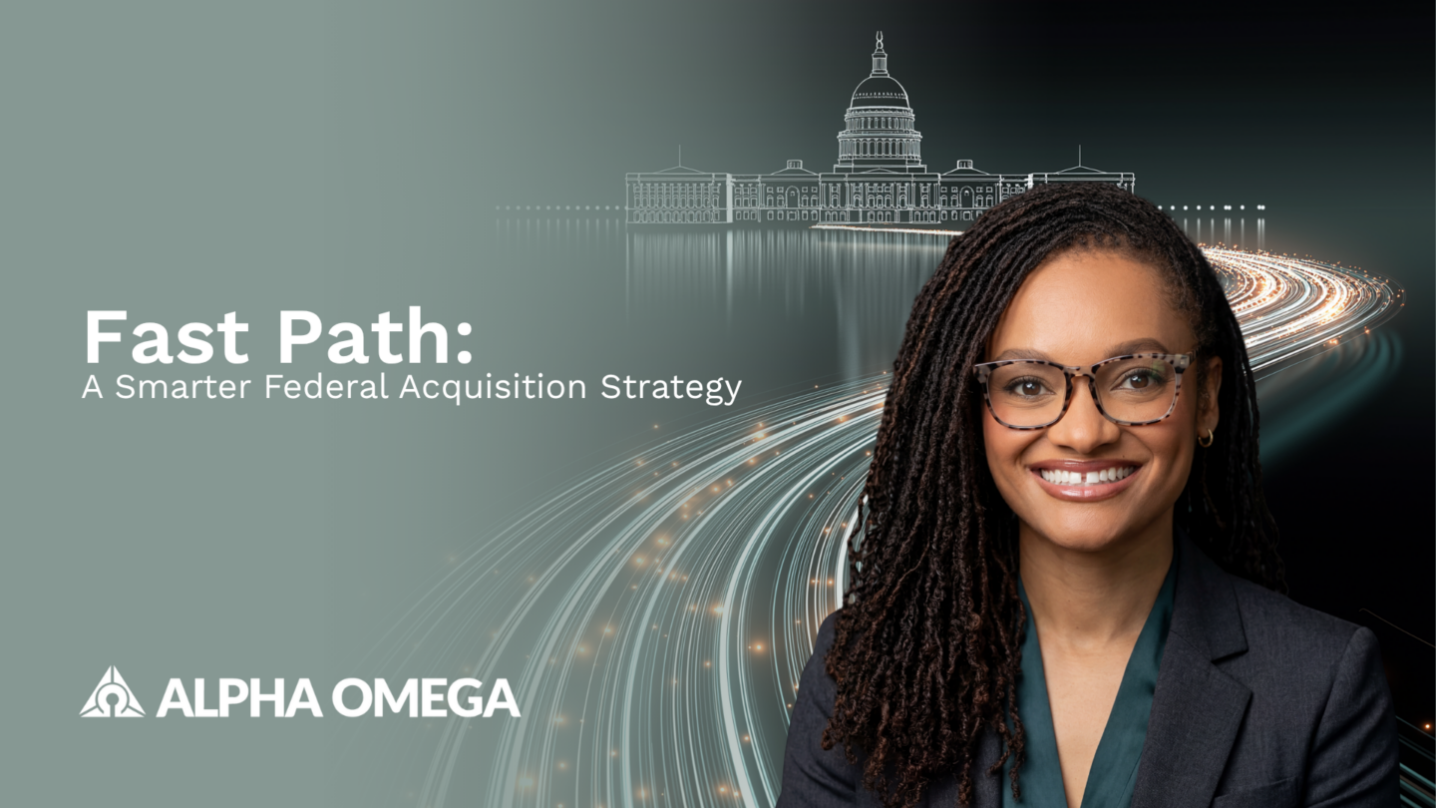
Fast Path: A Smarter Federal Acquisition Strategy

Fast Path: Accelerating Mission Outcomes Through Smarter Acquisition

Why modern federal acquisition strategy is about delivering on the mission, not just awarding contracts.

Federal agencies today are under increasing pressure to deliver mission outcomes faster while navigating an increasingly complex acquisition landscape. Modernization can no longer take years to move from concept to capability, yet agencies must still uphold the principles that define good government: competition, transparency, accountability, and responsible stewardship of taxpayer dollars.

Having spent more than 15 years in federal acquisition leadership roles across agencies including NASA, GSA (Technology Transformation Services and FEDSIM Defense Sector), and the Department of Transportation before transitioning to industry, I’ve seen this evolution from both sides of the table. One thing has become abundantly clear:

The conversation is no longer simply about buying technology. It’s about delivering mission value faster.

This shift is changing how agencies think about acquisition. For years, success was often measured by whether a contract was awarded correctly. While compliance remains essential, today’s leaders are asking a more important question:

How quickly can we deliver meaningful capability to the people depending on it? 

The answer is making smarter acquisition decisions earlier.

Agencies Have More Options Than Ever Before 

Today’s acquisition professionals have access to an expanding toolkit. Commercial Solutions Openings (CSOs), Other Transaction Authorities (OTAs), SBIR Authority, commercial marketplaces, and digital acquisition approaches through the new Revolutionary FAR Overhaul (RFO) are creating new opportunities to accelerate delivery while maintaining responsible oversight. Recent policy direction has reinforced this momentum by encouraging agencies, particularly within the Department of War, to leverage commercial-first acquisition strategies whenever appropriate.  

The challenge isn’t whether these pathways exist. The challenge is knowing which pathway best aligns with the mission, the technology, and the desired outcome. 

I’ve seen organizations spend months debating procurement strategy before ever discussing the operational problem they’re trying to solve. In reality, acquisition should never be viewed as a standalone function. The best acquisition strategies begin with understanding the mission first and selecting the right pathway to support it. 

The View from Both Sides of the Table 

One lesson has stayed with me throughout my career. 

I remember leading acquisitions where every stakeholder wanted speed, but everyone also wanted certainty. Program offices wanted capability now. Industry wanted clarity. Leadership wanted innovation. Contracting professionals were responsible for balancing those priorities while ensuring every decision could withstand scrutiny. 

That experience taught me something I still believe today: acquisition professionals are rarely choosing between speed and compliance. They’re balancing mission urgency with responsible stewardship. Modernization isn’t about moving faster for the sake of speed. It’s about removing unnecessary friction so agencies can deliver capability with confidence. That perspective continues to shape how I approach acquisition today. 

Why Strategy Matters More Than Speed Alone 

That lesson became even more meaningful during my time in government, including my work supporting the Revolutionary FAR Overhaul. I came to appreciate that innovation doesn’t come from creating new acquisition authorities alone. It comes from giving acquisition professionals the knowledge and confidence to use those authorities strategically. 

Speed without strategy creates risk. Strategy without execution creates delay. 

The goal is to strike the right balance, reducing friction while preserving the integrity of the acquisition process so agencies can achieve mission delivery faster and with greater confidence. 

That’s where organizations need more than contracting expertise. They need partners who understand acquisition, technology, and delivery together. 

Bringing Acquisition and Mission Together Through Fast Path 

At Alpha Omega, that philosophy is reflected in our Fast Path approach. 

Fast Path isn’t about buying faster at all costs. It’s a strategic acquisition acceleration methodology that helps agencies align acquisition strategies with modernization priorities, proven commercial capabilities, and mission objectives. Rather than viewing procurement as the destination, Fast Path focuses on reducing unnecessary friction between identifying a need and delivering a working solution. 

Through commercial acquisition pathways such as Tradewinds, Platform One, and SBIR, agencies can access proven technologies using acquisition strategies designed to reduce procurement timelines while maintaining compliance and quality. Combined with Alpha Omega’s Continuum Automation Framework, Fast Path helps agencies modernize legacy systems, accelerate software delivery, automate compliance activities, and move from concept to capability more efficiently. 

What excites me most is that these aren’t simply new contracting mechanisms. They represent a broader shift in how government and industry work together. When federal acquisition strategy aligns with mission priorities from the beginning, agencies spend less time navigating process and more time delivering results for the people they serve. 

Continuing the Conversation at NCMA World Congress 

These ideas are at the heart of a session I’ll be presenting at the NCMA World Congress, where we’ll explore a topic that doesn’t get nearly enough attention: what happens before the solicitation is often what determines acquisition success. 

Too often, the focus begins once the solicitation is released. In reality, some of the most important decisions are made long before that: understanding the mission, engaging stakeholders, evaluating acquisition pathways, conducting market research, and building an acquisition strategy that positions programs for success. 

Whether you’re in government or industry, acquisition shouldn’t be viewed as a series of transactional steps. It should be viewed as a strategic function that enables mission delivery. 

I hope you’ll join us as we discuss practical lessons learned from both sides of the acquisition table and explore how agencies and industry can partner more effectively to accelerate mission outcomes. 

Looking Ahead 

Federal acquisition is entering one of its most exciting periods in decades. Commercial innovation is advancing rapidly; acquisition policies continue to evolve, and agencies have more flexibility than ever before to rethink how mission capabilities are delivered. 

The opportunity isn’t simply to award contracts more quickly. It’s to create acquisition strategies that accelerate mission impact. Because ultimately, acquisition isn’t measured by how efficiently we complete a procurement. 

It’s measured by how effectively we help government deliver for the American people.


Brittney Chappell is Vice President of Capture at Alpha Omega. A former federal acquisition leader, she brings more than 15 years of experience across NASA, GSA, the Department of Transportation, and the Executive Office of the President, helping agencies modernize acquisition and accelerate mission delivery.