Federal Automation Framework – Reducing Costs & Modernizing Government

Introduction: Why a Federal Automation Framework Is Essential Now

A federal automation framework is no longer optional—it is essential for agencies facing mounting cost pressures, cybersecurity threats, and rising citizen expectations. As the federal government works to modernize legacy systems and eliminate wasteful spending, innovation must move beyond isolated pilots to structured, measurable transformation. Innovation, especially digital automation, can deliver operational efficiency, cost reductions, and enhance public service outcomes when applied purposefully.

In this blog, we’ll evaluate the cost challenges of current federal systems, explain how solutions like Alpha Omega’s Continuum Automation Framework provide measurable benefits, and demonstrate alignment with major federal innovation priorities and Executive Orders from the Trump Administration. 

The Problem: Federal Systems Are Costly, Outdated, and Inefficient 

Legacy Systems Drain Budgets 

Federal agencies continue to rely heavily on aging information technology systems that are costly to maintain, operate, and secure. According to a Government Accountability Office (GAO) report on IT spending: for FY 2024, approximately $74 billion, nearly 78% of the federal IT budget, was devoted to operations and maintenance of existing systems, versus just $21 billion for development and modernization.  

Security and Operational Risks 

Legacy technology often lacks modern security features, exposing agencies to cyber threats and operational failures. These inefficiencies also contribute to poor customer experience for citizens interacting with government services. 

Billions Wasted on Contracts and Grants 

Beyond core IT systems, federal spending on contracts and grants is so extensive that recent policy efforts like Executive Order 14222, Implementing the President’s “Department of Government Efficiency” Cost Efficiency Initiative, have been issued specifically to curb waste and enforce accountability. EO 14222 directs agencies to review and reduce unnecessary costs tied to federal contracts, grants, and loans, a systemic response to rampant inefficiencies in federal spending.  

The Benefits of Innovation: Beyond Cost Cutting 

Innovation in government delivers value far beyond reduced spending. Some of the major benefits include:

1. Operational Efficiency and Time Savings – Automated workflows and intelligent systems eliminate manual processing, drastically reducing cycle times and human errors.

2. Enhanced Security and ComplianceModernized systems improve defense against cyber threats and provide built-in compliance features that reduce audit risk.

3. Better Citizen ExperiencesFaster, more reliable systems deliver more responsive services to the public, boosting trust and satisfaction.

4. Scalability and Future Readiness Innovative technologies can scale to meet future demands without exponential cost increases. 

Policy Alignment: Trump Administration Executive Orders and Innovation

The Trump Administration’s second term has included a series of Executive Orders that signal a renewed federal priority on efficiency, accountability, and technological leadership. Two major EO initiatives relevant to this blog are: 

Executive Order 14222: Cost Efficiency Initiative 

Signed on February 26, 2025, EO 14222 directs agencies to transform federal spending on contracts, grants, and loans by implementing centralized technology systems to record and justify every payment under covered contracts and grants. It mandates review and possible termination or modification of existing agreements to reduce spending or reallocate for better efficiency.  

This EO explicitly supports the use of modern technology tools to improve oversight and fiscal discipline, a natural fit for automation frameworks that track and optimize processes. 

Executive Order 14179: AI Leadership and Innovation 

EO 14179, “Removing Barriers to American Leadership in Artificial Intelligence”, is designed to strengthen U.S. global competitiveness in AI by rescinding policies that constrain innovation and establishing plans to accelerate responsible AI deployment in government.  

Together, EO 14222 and EO 14179 send a clear signal: the federal government must contain costs while embracing modern technology, including AI and automation, to drive efficiency and strategic advantage. 

Enter Alpha Omega’s Continuum Automation Framework 

So how can federal agencies turn these goals and mandates into operational reality? 

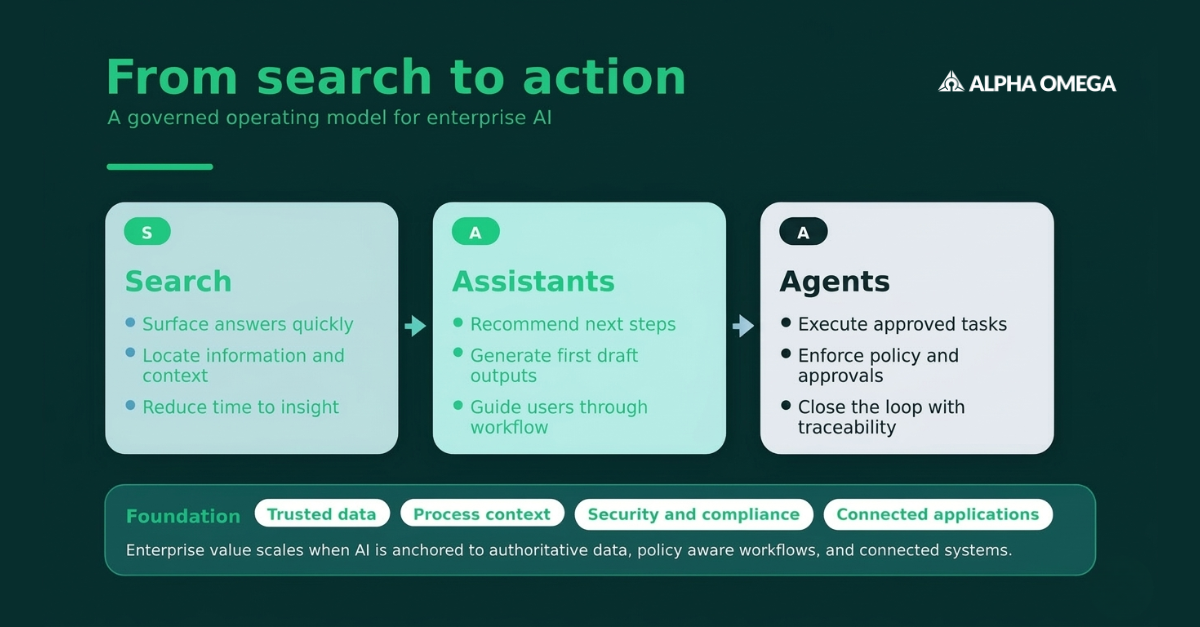
Alpha Omega’s Continuum Automation Framework is a holistic, scalable approach designed to transition agencies from costly legacy systems to efficient, modern, automated operations. 

What is the Continuum Automation Framework?

At its core, Continuum is a modular automation framework built to integrate with legacy infrastructures and modern platforms alike to design, generate, modernize, move data, and prove compliance – delivering total mission automation.

It supports: 

  • Process automation 
  • AI and machine learning integration 
  • Cross-system orchestration 
  • Centralized workflow management 
  • Real-time monitoring and analytics 

This combination makes it possible to deliver rapid ROI while laying the foundation for future innovation. 

Step-by-Step: How Continuum Delivers Efficiency

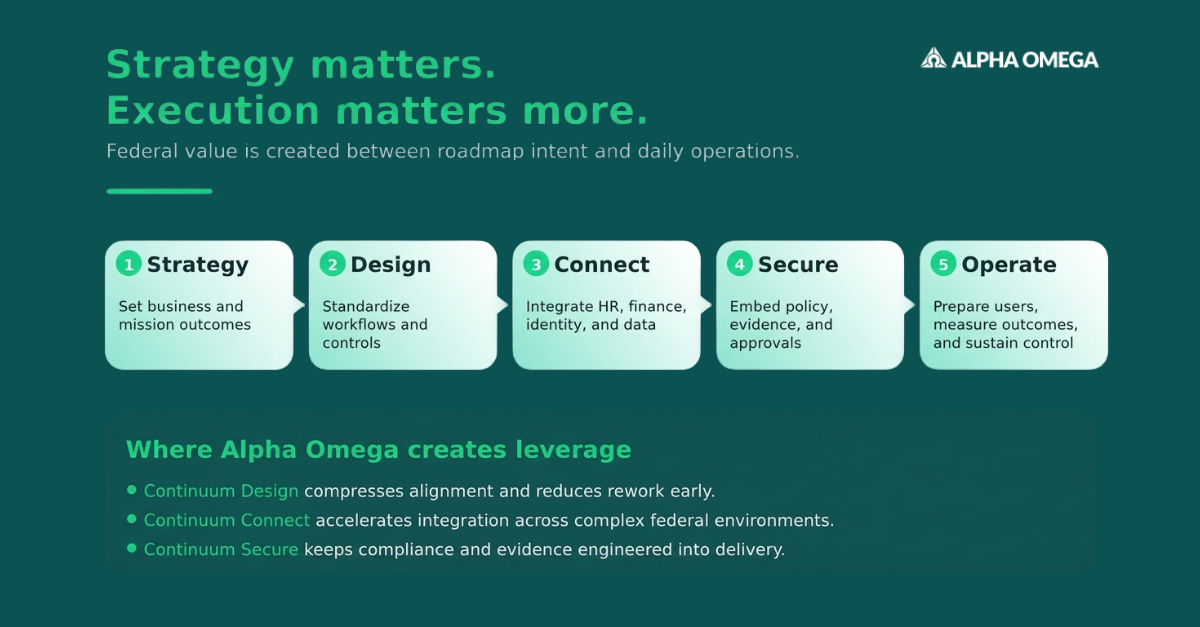
Alpha Omega’s Continuum Automation Framework operationalizes modernization through four integrated accelerators—Design, Code, Connect, and Secure—each engineered to reduce cost, compress timelines, and improve compliance outcomes.

1. Strategic Discovery with Continuum Design

Continuum Design rapidly inventories systems, maps workflows, and identifies automation candidates using structured architectural modeling and AI-assisted requirements analysis. 

Agencies leveraging Continuum Design typically see: 

  • 85% faster development timelines 
  • Standardized architecture artifacts generated in days instead of months 
  • Early identification of redundant or high-cost workflows 

By front-loading intelligence into modernization strategy, agencies eliminate unnecessary scope and align transformation directly with cost-efficiency mandates under EO 14222. 

2. Accelerated Modernization with Continuum Code

Rather than rewriting entire systems from scratch, Continuum Code automates application refactoring, transformation, and generation—modernizing legacy systems incrementally. 

Capabilities include: 

  • Automated code conversion and transformation 
  • AI-assisted development pipelines 
  • Infrastructure-as-Code automation 

Measured results include: 

  • 40–60% reduction in application modernization costs 
  • 75% faster release cycles 
  • Reduced defect rates through automated testing and mathematical validation 

This allows agencies to avoid “big bang” modernization risks while accelerating delivery. 

3. Data Modernization with Continuum Connect

Continuum Connect automates data migration, transformation, and integration across legacy and modern environments. 

Capabilities include: 

  • Canonical data modeling 
  • Secure API enablement 
  • Cross-system orchestration 

Results typically include: 

  • Up to 90% faster data migration timelines 
  • Reduced integration errors 
  • Elimination of redundant manual data reconciliation 

By stabilizing and standardizing data flows, agencies unlock AI capabilities without introducing operational fragility. 

4. Embedded Compliance with Continuum Secure

Security and compliance are often the largest bottlenecks in modernization. Continuum Secure automates evidence collection, control validation, and compliance monitoring across the system lifecycle. 

Agencies utilizing Continuum Secure have achieved: 

  • 90% reduction in manual ATO processes 
  • Automated audit documentation generation 
  • Continuous monitoring dashboards replacing manual reporting 

This directly supports federal mandates for fiscal discipline and oversight while improving security posture. 

5. Scalable Governance and Continuous Optimization

The framework integrates performance dashboards, KPIs, and policy-driven automation to ensure continuous improvement. 

Across enterprise implementations, agencies frequently realize: 

  • Double-digit percentage reductions in operational costs within 12–24 months 
  • Reduced contract overruns through automation-based tracking 
  • Lower long-term maintenance burdens 

This phased, accelerator-driven model ensures modernization delivers measurable efficiency gains while aligning with federal priorities on transparency, accountability, and innovation.

6. Fast Path to Procurement

Modernization speed is often constrained not by technology—but by acquisition timelines. Alpha Omega’s Fast Path to Procurement addresses this challenge directly by providing a streamlined acquisition ecosystem that enables agencies to move from requirement to award with significantly reduced friction. 

Fast Path leverages pre-competed, readily awardable solutions accessible through: 

  • Commercial Solutions Openings (CSOs) 
  • Other Transaction Authorities (OTAs) 
  • SBIR Phase III pathways 
  • Multiple commercial marketplaces 

By aligning with current acquisition policy directives and using existing contracting mechanisms, agencies can accelerate time to award while maintaining compliance, transparency, and fiscal discipline. 

Quantifying the Value: What Agencies Can Expect 

By automating routine tasks and optimizing processes: 

  • Operational costs decrease as manual labor and waste are reduced. 
  • System maintenance burdens shrink as fewer legacy workloads persist. 
  • Fewer contract overruns and wasteful grant spending occur thanks to automated tracking and justification. 
  • Security and compliance posture improve through built-in governance controls. 

While actual savings depend on agency size and scope, automation transformations frequently yield double-digit percentage reductions in operational costs within 12–24 months. 

Real-World Use Cases Compatible with Federal Priorities 

Automating Grant and Contract Management 

  • Centralized contract payment tracking 
  • Automated justification workflows 
  • AI-assisted fraud detection 

These capabilities directly reinforce goals under EO 14222, which calls for more transparent and accountable systems.  

AI-Enabled Document Processing for Citizen Services

  • Reduces backlog 
  • Improves accuracy 
  • Speeds decisions 

This case supports federal innovation goals under EO 14179 by harnessing AI to improve operational outcomes.  

Conclusion: A Federal Automation Framework Is the Path Forward 

A federal automation framework is no longer optional—it is essential for agencies seeking to modernize while controlling costs and strengthening accountability. With the majority of federal IT budgets consumed by maintaining legacy systems, structural efficiency must replace incremental fixes. 

Executive Orders 14222 and 14179 reinforce the mandate: reduce waste, improve oversight, and accelerate responsible AI adoption. Meeting these objectives requires more than policy alignment—it requires scalable execution. 

Alpha Omega’s Continuum Automation Framework, supported by Fast Path to Procurement, enables agencies to move from strategy to measurable impact—reducing operational costs, improving compliance, and accelerating modernization without prolonged acquisition delays. 

Innovation in government is not about chasing technology trends. It is about delivering mission outcomes with greater efficiency, resilience, and fiscal discipline. A structured federal automation framework turns modernization into a strategic advantage—not a recurring expense. 

AI Modernization for Federal Agencies

AI modernization for federal agencies is not the shortcut we hoped for.

Across the federal enterprise, agencies are racing to adopt artificial intelligence to automate decisions, accelerate analysis, and improve operational tempo. Yet many AI initiatives stall, underperform, or fail to operationalize.

The reason isn’t the algorithms.

It’s the legacy systems underneath them.

AI modernization for federal agencies cannot succeed when intelligence is layered onto brittle architectures, siloed data, and manual workflows. In national security and mission-critical environments—where reliability, auditability, and resilience are non-negotiable—modernization must come before intelligence. More precisely, AI must be paired with a deliberate architectural transformation that prepares systems to support intelligence at scale.

I call this transformation a legacy lift.

What is AI modernization for federal agencies?

AI modernization for federal agencies is the process of integrating artificial intelligence into mission systems by first modernizing data, architecture, security, and workflows—ensuring AI operates securely, compliantly, and at operational scale.

Why AI Modernization fails without legacy system modernization.

Most government mission systems were never designed to support AI.
They were built to:

  • Execute deterministic, rules-based workflows 
  • Store data in rigid schemas 
  • Prioritize stability over adaptability 

AI-driven systems demand the opposite: 

  • Continuous, near–real-time data ingestion 
  • Flexible integration patterns 
  • Observability and feedback loops 
  • Human-in-the-loop accountability 

When agencies attempt to “bolt on” AI to legacy platforms, they encounter predictable failure modes: 

  • Inconsistent or incomplete data pipelines 
  • Latency that undermines real-time decision support 
  • Security gaps introduced by shadow integrations 
  • Compliance challenges driven by opaque model behavior 

Rather than compensating for weaknesses, AI amplifies them. Without foundational modernization, intelligence becomes fragile, unscalable, and difficult to trust. 

What is a Legacy Lift?

legacy lift is a targeted modernization approach that prepares federal mission systems for AI by improving data readiness, modularity, security, and human oversight—without requiring a full system rewrite or multi-year pause on delivery. 

The goal is to decouple, stabilize, and standardize just enough of the underlying architecture to enable intelligence-driven outcomes safely and sustainably. 

A successful legacy lift focuses on four foundational layers. 

Layer 1: Data readiness before intelligence 

AI is only as effective as the data it consumes. Yet many mission systems still rely on: 

  • Batch updates instead of real-time feeds 
  • Hard-coded, brittle integrations 
  • Inconsistent data definitions across systems 

A legacy lift prioritizes: 

  • Canonical data models 
  • Secure, API-driven data access 
  • Data lineage and provenance tracking 
  • Clear ownership and stewardship 

Without these foundations, AI outputs cannot be trusted—especially in environments that require auditability, oversight, and defensibility.  

Layer 2: Modular architecture that can evolve 

Monolithic systems resist change. AI requires experimentation.
Modernized mission systems should: 

  • Expose functionality through services and APIs 
  • Separate data, logic, and presentation layers 
  • Allow AI components to be swapped, tuned, or retired without disrupting operations 

This modularity enables agencies to test and deploy AI responsibly—introducing intelligence incrementally without destabilizing mission-critical workflows. 

Layer 3: Built-in security and compliance 

In national security contexts, AI must operate within: 

  • Zero Trust principles 
  • Continuous monitoring requirements 
  • RMF, FISMA, and emerging AI governance mandates 

A legacy lift integrates security and compliance into the architecture itself, not as after-the-fact controls. This includes: 

  • Identity-aware data access 
  • Policy-driven authorization 
  • Automated evidence generation for audits 

AI systems that cannot explain their behavior or prove compliance will not scale—regardless of their technical sophistication. 

Layer 4: Human-centered AI integration 

AI should accelerate human decision-making, not replace it.
Modernized systems must support: 

  • Explainable outputs 
  • Clear confidence indicators 
  • Human override and escalation paths 

In operational environments where decisions carry real-world consequences, trust is built when operators understand not just what the system recommends—but why.  

How long does an ATO take without modernization?

In many federal environments, obtaining an Authorization to Operate (ATO) can take six to eighteen months. These prolonged timelines delay innovation, increase system risk, and discourage iterative improvement. 

Legacy lifts that embed security, automation, and continuous monitoring early in the lifecycle enable agencies to dramatically shorten approval cycles—moving from point-in-time authorization toward continuous authorization models that support faster delivery without compromising compliance. 

How can Agencies reduce risk when modernizing for AI?

Agencies can reduce risk when modernizing for AI by modernizing data foundations first, embedding security and compliance into system architecture, and introducing AI incrementally with human oversight and continuous monitoring.


What Agencies can do in the next 90 days.

Modernization does not require a blank slate. The most effective transformations start small and deliver momentum quickly.

In the next 90 days, agencies can: 

1. Identify a rapid contractual pathway and funding source to pilot AI-enabled modernization
2.
Select one mission workflow where AI could deliver value if foundational constraints were addressed
3. Define a fixed-price procurement approach for scaling successful pilots
4. Targeting 50–70% cost reductions compared to traditional modernization efforts
5. Measure success by operational outcomes—not scope or capacity 

This approach reduces risk while creating a clear path from experimentation to production. 

If we do nothing:

Without a legacy lift, agencies will continue to: 

  • Spend heavily on AI pilots that never operationalize 
  • Accumulate technical debt while chasing innovation 
  • Introduce security and compliance risk unintentionally 
  • Fall behind adversaries modernizing holistically 

AI is not a silver bullet. But when paired with deliberate modernization, it becomes a force multiplier. 

The Bottom Line

Mission modernization is no longer about replacing old systems—it’s about preparing them to think.

AI modernization for federal agencies succeeds only when legacy systems are ready to support intelligence. A legacy lift provides the path forward, enabling agencies to evolve mission systems without breaking trust, compliance, or continuity.

Leading Humans and AI: The Next Evolution of Leadership

Leading Humans and AI: The Next Evolution of Leadership

For decades, leadership excellence has been defined by emotional intelligence, our ability to motivate people, read the room, navigate conflict, and inspire teams through uncertainty.

Now, the room has changed.

Today’s leaders aren’t just managing people. They’re directing AI agents alongside humans, creating hybrid teams that operate faster, scale further, and think differently than any workforce before them. This isn’t a future-state concept. It’s happening now—quietly reshaping how decisions are made, how work gets done, and how leadership itself is defined.

And while the technology is new, the leadership challenge is not.

The Leadership Question We’re Not Asking Loud Enough

Much of the conversation around AI fixates on models, tools, and capabilities. But the real differentiator isn’t the technology; it’s how leaders guide it.

The most effective AI-enabled organizations aren’t run by the most technical executives. They’re led by those who bring clarity, judgment, and accountability into an environment where speed can easily outpace wisdom.

 The data reinforces this reality:

  • Leadership effectiveness translates directly to AI effectiveness.
    A 2025 National Bureau of Economic Research (NBER) paper found an 81% correlation between how well individuals lead human teams and how effectively they direct AI systems. The same social intelligence that builds trust and alignment in people also drives stronger outcomes with AI.
  • Innovation accelerates when AI is treated as part of the team.
    A Harvard Business School study found that when managers treat AI as a teammate—with clear roles and structured feedback—hybrid human–AI teams are three times more likely to produce breakthrough innovations. Speed alone doesn’t create value; leadership discipline does.
  • Human-led hybrids outperform autonomy.
    Research from Stanford and Carnegie Mellon shows that human-led hybrid teams outperform fully autonomous AI by 68.7% in accuracy. AI brings efficiency and scale. Humans bring context, ethics, and quality. The highest-performing systems aren’t hands-off—they’re led.

The implication is profound: AI doesn’t replace leadership—it raises the bar for it.

Why Great Human Leaders Excel with AI

Managing AI doesn’t demand less humanity; it demands more intentional leadership.

Clarity becomes the new charisma.
AI systems thrive on precise objectives, well-defined constraints, and unambiguous success criteria. Leaders who already excel at setting direction and aligning teams are naturally effective at guiding AI—whether they call it prompt engineering or not.

Feedback is no longer optional.
Just as high-performing employees need coaching, AI systems require continuous refinement. Leaders who establish disciplined feedback loops—reviewing outputs, correcting drift, and tightening focus—unlock far greater value than those who “set and forget.”

Psychological safety extends to machines.
In human teams, the ability to say “I don’t know” prevents bad decisions. In AI systems, that same principle is mission-critical. Leaders must design workflows where AI can pause, escalate, or defer rather than fabricate certainty. Trust is built not on perfection, but on transparency.

The Real Risk Isn’t AI—it’s Leadership Drift 

As AI absorbs repetitive and analytical work, leaders face an unexpected risk: disconnection.

When decision-making accelerates and human teams operate remotely, leadership can quietly become transactional. The irony is that AI—meant to free leaders—can instead isolate them if intentional connection isn’t prioritized.

This is where the strongest organizations will pull ahead.

At Alpha Omega, supporting federal missions where trust, compliance, and accountability are non-negotiable, we see this firsthand. Across agencies responsible for national security, public health, federal financial systems, space operations, and scientificresearch, AI succeeds only when human leadership remains firmly in control—setting guardrails, validating outcomes, and reinforcing culture.

AI scales execution.
Humans own judgment.
Leaders must protect that line.

Bridging the Empathy Gap in a Hybrid World

AI will never replace empathy, but it will change where leaders apply it.

When machines handle the repeatable, leaders gain the opportunity to go deeper with their people: mentoring emerging talent, reinforcing mission purpose, and strengthening cultures resilient enough to absorb constant change.

This is not a softer form of leadership. It’s a more strategic one.

The leaders who thrive in the AI era will be those who invest more—not less—in human connection, precisely because technology makes it possible.

The Future of Leadership Is Hybrid

The question is no longer whether AI belongs in the workplace. The question is whether leadership will evolve fast enough to guide it responsibly.

The future belongs to leaders who can:

  • Direct humans with empathy
  • Guide AI with discipline and clarity
  • And integrate both into teams that are faster, smarter, and more accountable than ever before

AI may redefine work—but leadership will determine whether it elevates or erodes trust, quality, and mission impact.

That is the real leadership challenge of our time.

Beyond the Hype: Customizing AI for Real-World Government Impact

Customizing AI for Government Impact

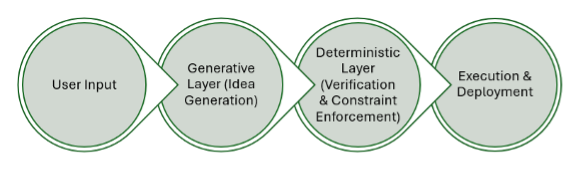
As drivers of technology, we are excited by the possibility of breakthroughs and innovation. Chasing every new trend can waste time, resources, and focus if it’s not grounded in actual agency needs. Just like keeping a toolbox full of tools for different jobs, we need to apply the same consideration to AI. Federal agencies need to widen their focus on AI implementations beyond just generative AI to explore deterministic AI, which offers distinct advantages for upgrading and improving federal IT systems.

Deterministic AI empowers federal agencies to eliminate persistent IT modernization challenges, slash support costs and lower total costs of ownership. It also fosters innovation by freeing funds to leverage new technologies and improve operations. These capabilities lead directly to tangible benefits for taxpayers, such as enhanced efficiency and competitiveness, reduced risks, and increased ability to innovate even further.

Combining multiple AI approaches ensures agencies have the right tools to get the job done when it has never mattered more. Agencies in 2025 are under extreme pressure to demonstrate their value. AI is an omnipresent buzzword as a potential panacea to improve speed and efficiency, augment operations, and cut costs.

With stakes this high, agencies would do well to remember AI is not monolithic — many approaches exist, each with its own strengths. Moreover, understanding which AI approach best suits particular needs is essential for agencies to successfully modernize their IT systems, offer innovative new services, and continue to serve the American people.

Understanding key differences

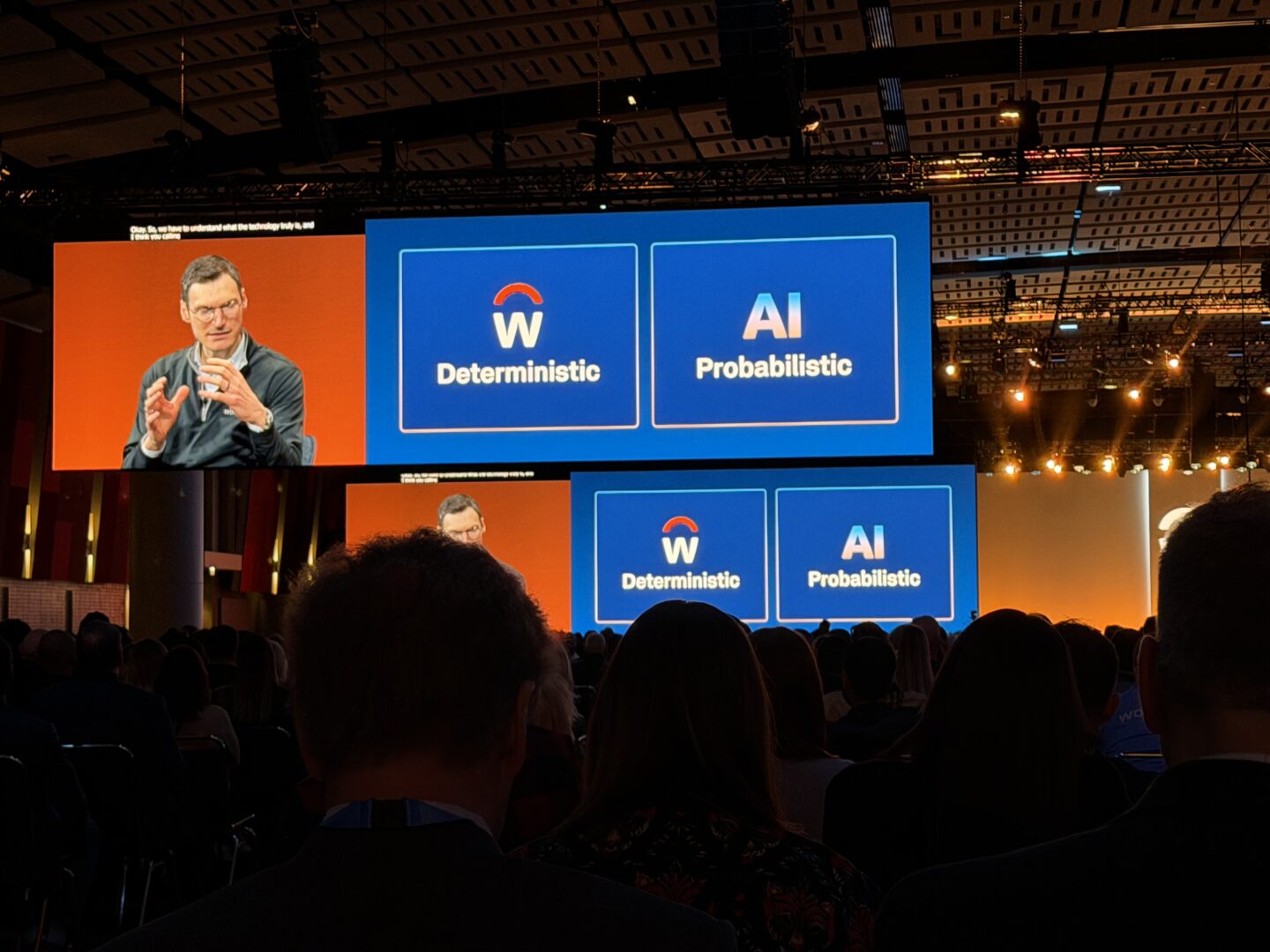
Generative AI deserves praise as a go-to approach to AI for doing many things well, such as producing human-like written prose from large volumes of disparate information. It shines at creating documentation and training materials or summarizing a year’s worth of interactions for an annual performance review, for instance. But if you have a tight deadline to translate two million lines of COBOL into Java for a mission-critical IT system, deterministic AI is the way to go.

Generative AI assembles new content based on mathematical probability, meaning the system doesn’t always give the same output to a given input, and sometimes it hallucinates or provides incomplete or misleading information. This is the reason we review every piece of content generated by Copilot or ChatGPT for its accuracy and contextual applicability. Similarly, many new AI code conversion tools that depend solely on LLMs fail miserably at modernizing complex code. This is where deterministic AI comes to rescue.

Deterministic AI is designed for consistency, accuracy and security. Deterministic AI focuses on semantics — understanding the original intent behind existing code and precisely replicating it in new code. It’s like expert human developers ensuring outputs works exactly as intended, every time. In that respect, deterministic AI’s strengths play directly to the mission needs of federal agencies looking to modernize and enhance their IT systems.

IT modernization at warp speed

Code built or modernized with deterministic AI excels at repairing software errors, resolving security vulnerabilities, and preventing data breaches. It is more maintainable and auditable, making it more reliable and secure for critical operations.

Deterministic AI helps streamline automation and futureproof systems by baking in the ability to easily update them to meet evolving technologies and requirements. One of its greatest boons is significantly accelerating the IT modernization process, replacing outdated systems with modern architecture in months, not years.

Deterministic AI provides a long-awaited suite of capabilities to tackle one of the most intractable challenges in federal IT: modernizing legacy applications. These systems can be frustratingly hard to manually integrate into single systems, especially as they often are decades old and lack documentation and subject matter experts (SMEs) to explain how they work.

This situation often leads to a “Don’t touch it!” attitude toward aging mission-critical systems, out of fear of breaking irreplaceable relics while attempting to upgrade them. Meanwhile, those systems’ drawbacks continue to waste valuable time, money and opportunities for improvement.

Deterministic AI overcomes these obstacles by understanding the intent across multiple applications — either in one agency or across many — and discovering what needs to happen so things keep working and don’t break. It then rationalizes the myriad applications into a single modern application.

Case in point, the U.S. Air Force in 2024 applied deterministic AI to upgrade its web application framework from outdated Angular JS to the modern Angular framework. The project required fast, secure, error-free conversion of old code into new code — requirements tailor-made for deterministic AI.

The Air Force completed a prototype in only three months without any available documentation or SME involvement. The prototype modernized their legacy system and empowered strategy-to-execution planning, enhancing the efficiency of mission-critical operations. That success has encouraged the Air Force to actively explore expanding its use of deterministic AI to modernize other applications.

Readiness and future-focus

To get the right AI tools to nail delivery of mission-critical capabilities, federal agencies should:

  • Know what they need: Leaders should review their programs and the technical viability of available technologies — whether deterministic AI, generative AI or one of the many other types of AI — to most efficiently deliver envisioned capabilities and outcomes.
  • Look in the right place: Accelerated IT modernization is not just about code, it requires expedited procurement as well. History abounds with projects in limbo from procurements taking years. Fortunately, the U.S. Department of Defense’s Tradewinds solutions marketplace portal is dedicated to cutting red tape and rapidly putting vetted IT solutions, including AI, where they can do the most good. The Air Force leveraged Tradewinds to award the contract for its deterministic AI-enabled prototype.
  • Find the right partner: Agencies should look for capabilities such as semantic understanding of code, ability to repair errors and resolve security vulnerabilities, and comprehensive support for any language across any stack. They should also assess vendors’ experience and past performance to ensure optimal fit and results.

It’s never been more urgent or important for federal agencies to demonstrate they can efficiently provide continually improving services at lower cost. Integrating AI, especially deterministic AI, will help federal agencies deliver not just on the promise of AI, but their own promise to serve the American people.


Navigating the Ethical and Security Maze: AI in the Federal Government

In the digital corridors of the federal government, artificial intelligence (AI) is not just a technological advancement but a transformative force. The potential of AI to enhance efficiency and decision-making in government services is enormous. This includes predictive analytics in national security, automated processing in citizen services, and the utilization of multimodal emotion recognition (MER) to assist and secure our borders. However, as this technology becomes deeply integrated into the federal fabric, ethical and security risks are increasingly coming to the forefront. Alpha Omega continues to find ways of integrating security protocols as part of our solution delivery platform. 

While service providers and agencies alike find newer ways to integrate AI into their proposed solutions, it is necessary to engage certain barometers during the solution design process.  

The Ethical Conundrum 

AI systems, fueled by algorithms, can unconsciously introduce biases present in their training data, leading to unequal treatment of different demographic groups. In the federal context, this could mean biased decision-making in areas such as law enforcement, benefit allocation, or hiring practices. The ethical implications are significant, potentially impacting fundamental rights and freedoms. 

Moreover, the transparency of AI decision-making processes is another ethical challenge. The “black box” nature of complex algorithms can make it difficult to understand how certain decisions are reached, challenging the democratic principles of accountability and transparency. 

Security concerns with AI range from data breaches involving sensitive citizen data to the potential weaponization of AI through autonomous drones or cyber warfare. Deepfakes and AI-powered disinformation campaigns can undermine national stability, influence elections, and disrupt social cohesion. 

The risks are not limited to external threats; internally, the unauthorized use of AI, or “shadow AI,” can result in unsanctioned activities that evade the government’s stringent security protocols, leading to unintended vulnerabilities. 

Countermeasures and Solutions 

To minimize these risks, federal agencies must ensure that service providers address specific key areas within the mentioned sections. Additionally, it is crucial that the suite of services and strategies developed by their partners revolves around the ethical and secure use of AI. 

Bias Detection and Mitigation Tools: Integrating tools which help to identify and reduce bias ensuring that the models are fair and equitable into the AI development lifecycle. Examples include services like IBM Watson’s Fairness 360 or Google’s What-If Tool provide such insights. 

Explainable AI Platforms: Platforms like DARPA’s XAI project and Microsoft’s InterpretML aid in demystifying AI decisions, enhancing transparency. They offer a window into how AI models make predictions, which is crucial for maintaining public trust. 

AI Security Protocols: Ensuring that the solution design contains AI-specific cybersecurity services which offer advanced threat detection, using AI to combat AI-powered attacks. They provide real-time monitoring and response to secure sensitive government data and infrastructure. 

Data Privacy Tools: Technologies that enable privacy-preserving data analysis, such as homomorphic encryption and differential privacy, should be adopted to ensure that data can be analyzed without exposing the underlying information which is crucial for maintaining citizen privacy. 

Regulatory Compliance Platforms: To align with evolving AI regulations, compliance platforms like OneTrust and Compliance.ai can assist federal agencies in navigating the complex regulatory landscape, ensuring AI systems are up to date with legal and ethical standards. 

Cybersecurity Mesh: The AI community has a lot of literature available on this type of architectural design. This architectural approach allows for a more modular, responsive security strategy, encapsulating each device in its own protective perimeter. Picking services which orchestrate security across all touchpoints, is an essential strategy against sophisticated AI threats. 

Moving Forward with Prudence 

As AI becomes more pervasive in federal operations, the balance between leveraging its capabilities and managing its risks becomes more delicate. By incorporating ethical considerations into the design of AI systems and adopting robust security measures in their solicitations, the federal government can harness the power of AI while safeguarding the principles of democracy and the security of the nation. 

The path ahead is complex, but with conscientious efforts and the right set of tools, we can help create solutions for our federal partners and help them steer AI towards the greater good, exemplifying a model for responsible and secure AI use globally. We at Alpha Omega continue to work hard to create implementation frameworks and solution models which focus on the ethical and responsible use of AI making sure that our solutions are in compliance with regulatory requirements while providing target state results.