Federal Automation Framework – Reducing Costs & Modernizing Government

Introduction: Why a Federal Automation Framework Is Essential Now

A federal automation framework is no longer optional—it is essential for agencies facing mounting cost pressures, cybersecurity threats, and rising citizen expectations. As the federal government works to modernize legacy systems and eliminate wasteful spending, innovation must move beyond isolated pilots to structured, measurable transformation. Innovation, especially digital automation, can deliver operational efficiency, cost reductions, and enhance public service outcomes when applied purposefully.

In this blog, we’ll evaluate the cost challenges of current federal systems, explain how solutions like Alpha Omega’s Continuum Automation Framework provide measurable benefits, and demonstrate alignment with major federal innovation priorities and Executive Orders from the Trump Administration. 

The Problem: Federal Systems Are Costly, Outdated, and Inefficient 

Legacy Systems Drain Budgets 

Federal agencies continue to rely heavily on aging information technology systems that are costly to maintain, operate, and secure. According to a Government Accountability Office (GAO) report on IT spending: for FY 2024, approximately $74 billion, nearly 78% of the federal IT budget, was devoted to operations and maintenance of existing systems, versus just $21 billion for development and modernization.  

Security and Operational Risks 

Legacy technology often lacks modern security features, exposing agencies to cyber threats and operational failures. These inefficiencies also contribute to poor customer experience for citizens interacting with government services. 

Billions Wasted on Contracts and Grants 

Beyond core IT systems, federal spending on contracts and grants is so extensive that recent policy efforts like Executive Order 14222, Implementing the President’s “Department of Government Efficiency” Cost Efficiency Initiative, have been issued specifically to curb waste and enforce accountability. EO 14222 directs agencies to review and reduce unnecessary costs tied to federal contracts, grants, and loans, a systemic response to rampant inefficiencies in federal spending.  

The Benefits of Innovation: Beyond Cost Cutting 

Innovation in government delivers value far beyond reduced spending. Some of the major benefits include:

1. Operational Efficiency and Time Savings – Automated workflows and intelligent systems eliminate manual processing, drastically reducing cycle times and human errors.

2. Enhanced Security and ComplianceModernized systems improve defense against cyber threats and provide built-in compliance features that reduce audit risk.

3. Better Citizen ExperiencesFaster, more reliable systems deliver more responsive services to the public, boosting trust and satisfaction.

4. Scalability and Future Readiness Innovative technologies can scale to meet future demands without exponential cost increases. 

Policy Alignment: Trump Administration Executive Orders and Innovation

The Trump Administration’s second term has included a series of Executive Orders that signal a renewed federal priority on efficiency, accountability, and technological leadership. Two major EO initiatives relevant to this blog are: 

Executive Order 14222: Cost Efficiency Initiative 

Signed on February 26, 2025, EO 14222 directs agencies to transform federal spending on contracts, grants, and loans by implementing centralized technology systems to record and justify every payment under covered contracts and grants. It mandates review and possible termination or modification of existing agreements to reduce spending or reallocate for better efficiency.  

This EO explicitly supports the use of modern technology tools to improve oversight and fiscal discipline, a natural fit for automation frameworks that track and optimize processes. 

Executive Order 14179: AI Leadership and Innovation 

EO 14179, “Removing Barriers to American Leadership in Artificial Intelligence”, is designed to strengthen U.S. global competitiveness in AI by rescinding policies that constrain innovation and establishing plans to accelerate responsible AI deployment in government.  

Together, EO 14222 and EO 14179 send a clear signal: the federal government must contain costs while embracing modern technology, including AI and automation, to drive efficiency and strategic advantage. 

Enter Alpha Omega’s Continuum Automation Framework 

So how can federal agencies turn these goals and mandates into operational reality? 

Alpha Omega’s Continuum Automation Framework is a holistic, scalable approach designed to transition agencies from costly legacy systems to efficient, modern, automated operations. 

What is the Continuum Automation Framework?

At its core, Continuum is a modular automation framework built to integrate with legacy infrastructures and modern platforms alike to design, generate, modernize, move data, and prove compliance – delivering total mission automation.

It supports: 

  • Process automation 
  • AI and machine learning integration 
  • Cross-system orchestration 
  • Centralized workflow management 
  • Real-time monitoring and analytics 

This combination makes it possible to deliver rapid ROI while laying the foundation for future innovation. 

Step-by-Step: How Continuum Delivers Efficiency

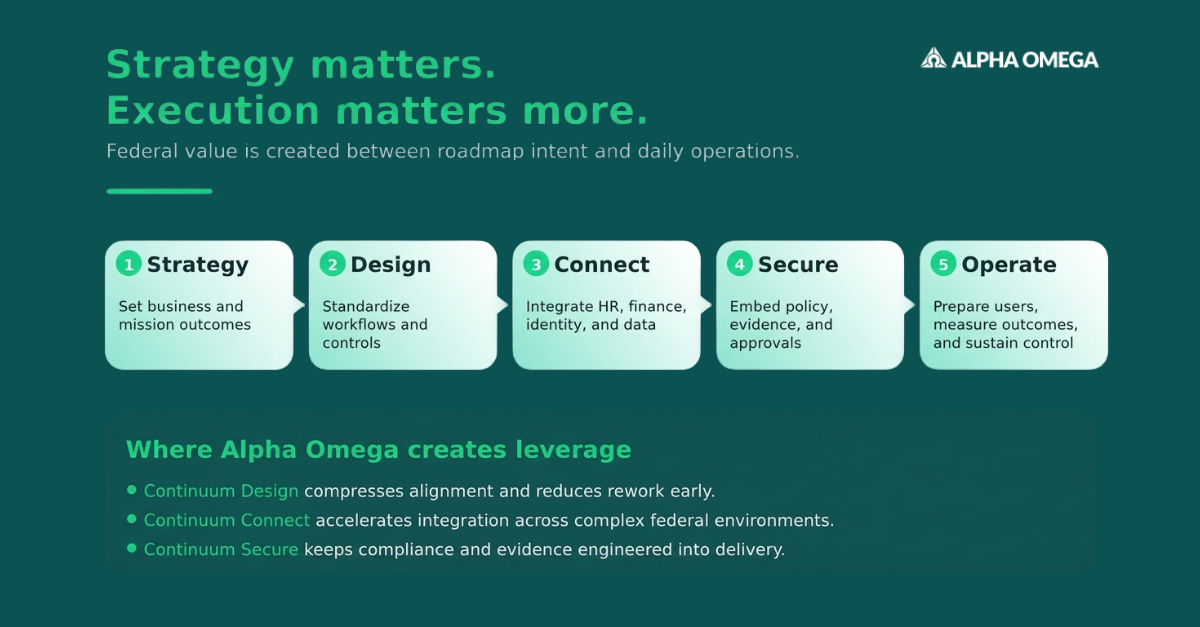
Alpha Omega’s Continuum Automation Framework operationalizes modernization through four integrated accelerators—Design, Code, Connect, and Secure—each engineered to reduce cost, compress timelines, and improve compliance outcomes.

1. Strategic Discovery with Continuum Design

Continuum Design rapidly inventories systems, maps workflows, and identifies automation candidates using structured architectural modeling and AI-assisted requirements analysis. 

Agencies leveraging Continuum Design typically see: 

  • 85% faster development timelines 
  • Standardized architecture artifacts generated in days instead of months 
  • Early identification of redundant or high-cost workflows 

By front-loading intelligence into modernization strategy, agencies eliminate unnecessary scope and align transformation directly with cost-efficiency mandates under EO 14222. 

2. Accelerated Modernization with Continuum Code

Rather than rewriting entire systems from scratch, Continuum Code automates application refactoring, transformation, and generation—modernizing legacy systems incrementally. 

Capabilities include: 

  • Automated code conversion and transformation 
  • AI-assisted development pipelines 
  • Infrastructure-as-Code automation 

Measured results include: 

  • 40–60% reduction in application modernization costs 
  • 75% faster release cycles 
  • Reduced defect rates through automated testing and mathematical validation 

This allows agencies to avoid “big bang” modernization risks while accelerating delivery. 

3. Data Modernization with Continuum Connect

Continuum Connect automates data migration, transformation, and integration across legacy and modern environments. 

Capabilities include: 

  • Canonical data modeling 
  • Secure API enablement 
  • Cross-system orchestration 

Results typically include: 

  • Up to 90% faster data migration timelines 
  • Reduced integration errors 
  • Elimination of redundant manual data reconciliation 

By stabilizing and standardizing data flows, agencies unlock AI capabilities without introducing operational fragility. 

4. Embedded Compliance with Continuum Secure

Security and compliance are often the largest bottlenecks in modernization. Continuum Secure automates evidence collection, control validation, and compliance monitoring across the system lifecycle. 

Agencies utilizing Continuum Secure have achieved: 

  • 90% reduction in manual ATO processes 
  • Automated audit documentation generation 
  • Continuous monitoring dashboards replacing manual reporting 

This directly supports federal mandates for fiscal discipline and oversight while improving security posture. 

5. Scalable Governance and Continuous Optimization

The framework integrates performance dashboards, KPIs, and policy-driven automation to ensure continuous improvement. 

Across enterprise implementations, agencies frequently realize: 

  • Double-digit percentage reductions in operational costs within 12–24 months 
  • Reduced contract overruns through automation-based tracking 
  • Lower long-term maintenance burdens 

This phased, accelerator-driven model ensures modernization delivers measurable efficiency gains while aligning with federal priorities on transparency, accountability, and innovation.

6. Fast Path to Procurement

Modernization speed is often constrained not by technology—but by acquisition timelines. Alpha Omega’s Fast Path to Procurement addresses this challenge directly by providing a streamlined acquisition ecosystem that enables agencies to move from requirement to award with significantly reduced friction. 

Fast Path leverages pre-competed, readily awardable solutions accessible through: 

  • Commercial Solutions Openings (CSOs) 
  • Other Transaction Authorities (OTAs) 
  • SBIR Phase III pathways 
  • Multiple commercial marketplaces 

By aligning with current acquisition policy directives and using existing contracting mechanisms, agencies can accelerate time to award while maintaining compliance, transparency, and fiscal discipline. 

Quantifying the Value: What Agencies Can Expect 

By automating routine tasks and optimizing processes: 

  • Operational costs decrease as manual labor and waste are reduced. 
  • System maintenance burdens shrink as fewer legacy workloads persist. 
  • Fewer contract overruns and wasteful grant spending occur thanks to automated tracking and justification. 
  • Security and compliance posture improve through built-in governance controls. 

While actual savings depend on agency size and scope, automation transformations frequently yield double-digit percentage reductions in operational costs within 12–24 months. 

Real-World Use Cases Compatible with Federal Priorities 

Automating Grant and Contract Management 

  • Centralized contract payment tracking 
  • Automated justification workflows 
  • AI-assisted fraud detection 

These capabilities directly reinforce goals under EO 14222, which calls for more transparent and accountable systems.  

AI-Enabled Document Processing for Citizen Services

  • Reduces backlog 
  • Improves accuracy 
  • Speeds decisions 

This case supports federal innovation goals under EO 14179 by harnessing AI to improve operational outcomes.  

Conclusion: A Federal Automation Framework Is the Path Forward 

A federal automation framework is no longer optional—it is essential for agencies seeking to modernize while controlling costs and strengthening accountability. With the majority of federal IT budgets consumed by maintaining legacy systems, structural efficiency must replace incremental fixes. 

Executive Orders 14222 and 14179 reinforce the mandate: reduce waste, improve oversight, and accelerate responsible AI adoption. Meeting these objectives requires more than policy alignment—it requires scalable execution. 

Alpha Omega’s Continuum Automation Framework, supported by Fast Path to Procurement, enables agencies to move from strategy to measurable impact—reducing operational costs, improving compliance, and accelerating modernization without prolonged acquisition delays. 

Innovation in government is not about chasing technology trends. It is about delivering mission outcomes with greater efficiency, resilience, and fiscal discipline. A structured federal automation framework turns modernization into a strategic advantage—not a recurring expense. 

AI Modernization for Federal Agencies

AI modernization for federal agencies is not the shortcut we hoped for.

Across the federal enterprise, agencies are racing to adopt artificial intelligence to automate decisions, accelerate analysis, and improve operational tempo. Yet many AI initiatives stall, underperform, or fail to operationalize.

The reason isn’t the algorithms.

It’s the legacy systems underneath them.

AI modernization for federal agencies cannot succeed when intelligence is layered onto brittle architectures, siloed data, and manual workflows. In national security and mission-critical environments—where reliability, auditability, and resilience are non-negotiable—modernization must come before intelligence. More precisely, AI must be paired with a deliberate architectural transformation that prepares systems to support intelligence at scale.

I call this transformation a legacy lift.

What is AI modernization for federal agencies?

AI modernization for federal agencies is the process of integrating artificial intelligence into mission systems by first modernizing data, architecture, security, and workflows—ensuring AI operates securely, compliantly, and at operational scale.

Why AI Modernization fails without legacy system modernization.

Most government mission systems were never designed to support AI.
They were built to:

  • Execute deterministic, rules-based workflows 
  • Store data in rigid schemas 
  • Prioritize stability over adaptability 

AI-driven systems demand the opposite: 

  • Continuous, near–real-time data ingestion 
  • Flexible integration patterns 
  • Observability and feedback loops 
  • Human-in-the-loop accountability 

When agencies attempt to “bolt on” AI to legacy platforms, they encounter predictable failure modes: 

  • Inconsistent or incomplete data pipelines 
  • Latency that undermines real-time decision support 
  • Security gaps introduced by shadow integrations 
  • Compliance challenges driven by opaque model behavior 

Rather than compensating for weaknesses, AI amplifies them. Without foundational modernization, intelligence becomes fragile, unscalable, and difficult to trust. 

What is a Legacy Lift?

legacy lift is a targeted modernization approach that prepares federal mission systems for AI by improving data readiness, modularity, security, and human oversight—without requiring a full system rewrite or multi-year pause on delivery. 

The goal is to decouple, stabilize, and standardize just enough of the underlying architecture to enable intelligence-driven outcomes safely and sustainably. 

A successful legacy lift focuses on four foundational layers. 

Layer 1: Data readiness before intelligence 

AI is only as effective as the data it consumes. Yet many mission systems still rely on: 

  • Batch updates instead of real-time feeds 
  • Hard-coded, brittle integrations 
  • Inconsistent data definitions across systems 

A legacy lift prioritizes: 

  • Canonical data models 
  • Secure, API-driven data access 
  • Data lineage and provenance tracking 
  • Clear ownership and stewardship 

Without these foundations, AI outputs cannot be trusted—especially in environments that require auditability, oversight, and defensibility.  

Layer 2: Modular architecture that can evolve 

Monolithic systems resist change. AI requires experimentation.
Modernized mission systems should: 

  • Expose functionality through services and APIs 
  • Separate data, logic, and presentation layers 
  • Allow AI components to be swapped, tuned, or retired without disrupting operations 

This modularity enables agencies to test and deploy AI responsibly—introducing intelligence incrementally without destabilizing mission-critical workflows. 

Layer 3: Built-in security and compliance 

In national security contexts, AI must operate within: 

  • Zero Trust principles 
  • Continuous monitoring requirements 
  • RMF, FISMA, and emerging AI governance mandates 

A legacy lift integrates security and compliance into the architecture itself, not as after-the-fact controls. This includes: 

  • Identity-aware data access 
  • Policy-driven authorization 
  • Automated evidence generation for audits 

AI systems that cannot explain their behavior or prove compliance will not scale—regardless of their technical sophistication. 

Layer 4: Human-centered AI integration 

AI should accelerate human decision-making, not replace it.
Modernized systems must support: 

  • Explainable outputs 
  • Clear confidence indicators 
  • Human override and escalation paths 

In operational environments where decisions carry real-world consequences, trust is built when operators understand not just what the system recommends—but why.  

How long does an ATO take without modernization?

In many federal environments, obtaining an Authorization to Operate (ATO) can take six to eighteen months. These prolonged timelines delay innovation, increase system risk, and discourage iterative improvement. 

Legacy lifts that embed security, automation, and continuous monitoring early in the lifecycle enable agencies to dramatically shorten approval cycles—moving from point-in-time authorization toward continuous authorization models that support faster delivery without compromising compliance. 

How can Agencies reduce risk when modernizing for AI?

Agencies can reduce risk when modernizing for AI by modernizing data foundations first, embedding security and compliance into system architecture, and introducing AI incrementally with human oversight and continuous monitoring.


What Agencies can do in the next 90 days.

Modernization does not require a blank slate. The most effective transformations start small and deliver momentum quickly.

In the next 90 days, agencies can: 

1. Identify a rapid contractual pathway and funding source to pilot AI-enabled modernization
2.
Select one mission workflow where AI could deliver value if foundational constraints were addressed
3. Define a fixed-price procurement approach for scaling successful pilots
4. Targeting 50–70% cost reductions compared to traditional modernization efforts
5. Measure success by operational outcomes—not scope or capacity 

This approach reduces risk while creating a clear path from experimentation to production. 

If we do nothing:

Without a legacy lift, agencies will continue to: 

  • Spend heavily on AI pilots that never operationalize 
  • Accumulate technical debt while chasing innovation 
  • Introduce security and compliance risk unintentionally 
  • Fall behind adversaries modernizing holistically 

AI is not a silver bullet. But when paired with deliberate modernization, it becomes a force multiplier. 

The Bottom Line

Mission modernization is no longer about replacing old systems—it’s about preparing them to think.

AI modernization for federal agencies succeeds only when legacy systems are ready to support intelligence. A legacy lift provides the path forward, enabling agencies to evolve mission systems without breaking trust, compliance, or continuity.

Alpha Omega Launches Continuum Automation Framework

Vienna, VA, Jan 28, 2026 — Alpha Omega, a leading provider of AI-driven modernization and digital transformation solutions to the federal government, today announced the launch of Continuum Automation Framework, a unified ecosystem of automation accelerators designed for federal agencies to modernize faster, operate more efficiently, and deliver mission impact at scale. The launch comes at a critical time, enabling agencies to efficiently comply with Executive Orders to reduce costs, improve resilience, and speed to delivery through modern acquisition pathways.

Continuum represents total mission automation, providing Federal Agencies with a full spectrum solution to build, modernize, migrate and secure mission-critical systems and data. Through four modular AI-driven accelerators — Design, Code, Connect, and Secure — the framework enables agencies to replace fragmented, manual processes with an intelligent, end-to-end automation pipeline. Early successes like Alpha Omega’s pilot for the U.S. Air Force expedited a modernization project that was completed 18 months ahead of schedule and delivered a 60% cost savings.

“Government can no longer afford slow, disconnected modernization,” said Gautam Ijoor, CEO of Alpha Omega. “Continuum partners with agencies to move rapidly from strategic vision to mission impact. We’ve combined proven cutting-edge capabilities with rapid acquisition pathways to empower agencies to generate immediate returns on their investment.”

At its core, Continuum establishes a continuous automation pipeline that synchronizes solution design, deterministic and generative code modernization, data mapping, and cybersecurity compliance. Each accelerator operates independently or in concert with one another, allowing agencies to tailor solutions while benefiting from a single, connected ecosystem.

  • Continuum Design facilitates real-time prototyping, delivering the working code for modernized business systems in days, not weeks.
  • Continuum Code modernizes any language with deterministic, accurate AI, delivering future-proof software.
  • Continuum Connect unifies Agency portfolios by automating cloud and data migration in minutes not months.
  • Continuum Secure eliminates manual cyber and ATO tasks with U.S.-patented tech for accelerated continuous compliance.

Together, these capabilities allow agencies to scale with confidence by standardizing and reusing proven patterns, models, and guardrails across programs and offices, reducing risk while accelerating delivery at enterprise scale.

Continuum is supported by Alpha Omega’s Fast Path to Procurement, a streamlined acquisition ecosystem that enables agencies to be responsive to evolving needs while aligning to acquisition reform priorities and maintaining compliance with all EOs. Through pre-competed, readily awardable solutions available via CSOs, OTAs, and multiple commercial marketplaces, agencies can move directly from requirement to execution in days rather than months or years.

“National security depends on speed, precision, and trust,” Ijoor added. “Continuum is Alpha Omega solving the equation for modernization – combining automation, acquisition agility, and mission expertise to help government move faster than the threats it faces.”

With the launch of the Continuum Automation Framework, Alpha Omega reinforces its position as a leading national security solutions provider, delivering intelligent automation that turns policy direction into operational advantage.

ABOUT: Alpha Omega delivers mission-focused solutions to ensure our nation’s continued global leadership. We accelerate transformation and operational efficiency via applied expertise in digital modernization, artificial intelligence, and cybersecurity, designing and delivering enterprise solutions in support of national security and national resilience. Our agency partners rely on Alpha Omega to modernize and future-proof legacy systems and enhance operational resilience, delivering our purpose to ensure the safety, security, and well-being of future generations. For more information, visit www.alphaomega.com.

Press Contact: Rebecca Churchill
rc@churchillcommunicationsllc.com
phone: 917-518-9789


Gautam Ijoor Named Top Industry Executive to Watch in 2026

WashingtonExec has named Gautam Ijoor, Founder and CEO of Alpha Omega, a Top Industry Executive to Watch in 2026, recognizing his leadership during a pivotal period of growth, reinvention, and mission impact.

Under Ijoor’s leadership, Alpha Omega expanded its capabilities through strategic acquisitions, strengthened operational rigor, and accelerated AI-driven modernization aligned with federal priorities around cost reduction, efficiency, and mission outcomes. The company’s achievement of CMMI Level 5 in both services and development reflects its commitment to disciplined execution and operational excellence.

Looking ahead to 2026, Alpha Omega is focused on accelerating digital transformation across government through scalable automation, applied AI, and mission-ready solutions that deliver measurable value at speed.

“Technology alone doesn’t transform companies — leadership does,” said Ijoor. “Powerful transformation happens when we stop optimizing the past and start building for reinvention.”

Read the full WashingtonExec feature:
https://washingtonexec.com/2026/01/top-industry-execs-to-watch-in-2026/12/

Alpha Omega Appoints David Walls Chief Financial Officer

Experienced federal finance leader brings private equity insight and operational discipline to drive Alpha Omega’s next stage of growth.

Vienna, VA, January 7, 2026– Alpha Omega, a leading provider of AI-driven modernization and digital transformation solutions to the federal government, today announced the appointment of David Walls as Chief Financial Officer. Walls will lead Alpha Omega’s finance organizationstrengthen performance management, advance long-term growth strategy, and ensure disciplined execution as Alpha Omega scales across priority federal missions.

David’s proven ability to deliver strong financial performance and guide organizations through transformative growth will be instrumental to the success of the company,” said Gautam Ijoor, Alpha Omega CEO. “He brings the discipline and transparency we need to execute our strategy, integrate growth initiatives, expand partner relationships, and position Alpha Omega for the opportunities ahead.”

Walls joins Alpha Omega at a time of continued transformation—marked by strategic expansion, evolving customer needs, and heightened urgency across government for secure modernization at speed. “Alpha Omega is at an inflection point with its growth and development as a solutions firm,” Walls said. “It’s all about speed right now. This is an ideal time to roll out Continuum and its AI-driven efficiency accelerators that put Alpha Omega ahead—grounded in an aggressive business plan that’s attainable, and a team with integrity and accountability.”

Walls brings nearly two decades of experience in M&A and defense and federal contracting and has supported organizations through multiple private equity-backed growth cycles. He most recently served as a Managing Director – CFO Advisory with Maximus Partners, and CFO of Valkyrie Enterprises and McKean Defense Group.

Looking ahead to 2026, Walls emphasized the importance of execution discipline and customer-centric speed—particularly as agencies accelerate adoption of commercial solutions and modern contracting approaches.

ABOUT ALPHA OMEGA: Alpha Omega delivers mission-focused solutions to ensure our nation’s continued global leadership. We accelerate transformation and operational efficiency via applied expertise in digital modernization, artificial intelligence, and cybersecurity, designing and delivering enterprise solutions in support of National Security, Federal Financial, Health, and Space and Science missions. Our agency partners rely on Alpha Omega to modernize and future-proof legacy systems and enhance operational resilience, delivering our purpose to ensure the safety, security, and well-being of future generations. For more information, visit www.alphaomega.com. Press Contact: Rebecca Churchill rc@churchillcommunicationsllc.com 917-518-9789

Leading Humans and AI: The Next Evolution of Leadership

Leading Humans and AI: The Next Evolution of Leadership

For decades, leadership excellence has been defined by emotional intelligence, our ability to motivate people, read the room, navigate conflict, and inspire teams through uncertainty.

Now, the room has changed.

Today’s leaders aren’t just managing people. They’re directing AI agents alongside humans, creating hybrid teams that operate faster, scale further, and think differently than any workforce before them. This isn’t a future-state concept. It’s happening now—quietly reshaping how decisions are made, how work gets done, and how leadership itself is defined.

And while the technology is new, the leadership challenge is not.

The Leadership Question We’re Not Asking Loud Enough

Much of the conversation around AI fixates on models, tools, and capabilities. But the real differentiator isn’t the technology; it’s how leaders guide it.

The most effective AI-enabled organizations aren’t run by the most technical executives. They’re led by those who bring clarity, judgment, and accountability into an environment where speed can easily outpace wisdom.

 The data reinforces this reality:

  • Leadership effectiveness translates directly to AI effectiveness.
    A 2025 National Bureau of Economic Research (NBER) paper found an 81% correlation between how well individuals lead human teams and how effectively they direct AI systems. The same social intelligence that builds trust and alignment in people also drives stronger outcomes with AI.
  • Innovation accelerates when AI is treated as part of the team.
    A Harvard Business School study found that when managers treat AI as a teammate—with clear roles and structured feedback—hybrid human–AI teams are three times more likely to produce breakthrough innovations. Speed alone doesn’t create value; leadership discipline does.
  • Human-led hybrids outperform autonomy.
    Research from Stanford and Carnegie Mellon shows that human-led hybrid teams outperform fully autonomous AI by 68.7% in accuracy. AI brings efficiency and scale. Humans bring context, ethics, and quality. The highest-performing systems aren’t hands-off—they’re led.

The implication is profound: AI doesn’t replace leadership—it raises the bar for it.

Why Great Human Leaders Excel with AI

Managing AI doesn’t demand less humanity; it demands more intentional leadership.

Clarity becomes the new charisma.
AI systems thrive on precise objectives, well-defined constraints, and unambiguous success criteria. Leaders who already excel at setting direction and aligning teams are naturally effective at guiding AI—whether they call it prompt engineering or not.

Feedback is no longer optional.
Just as high-performing employees need coaching, AI systems require continuous refinement. Leaders who establish disciplined feedback loops—reviewing outputs, correcting drift, and tightening focus—unlock far greater value than those who “set and forget.”

Psychological safety extends to machines.
In human teams, the ability to say “I don’t know” prevents bad decisions. In AI systems, that same principle is mission-critical. Leaders must design workflows where AI can pause, escalate, or defer rather than fabricate certainty. Trust is built not on perfection, but on transparency.

The Real Risk Isn’t AI—it’s Leadership Drift 

As AI absorbs repetitive and analytical work, leaders face an unexpected risk: disconnection.

When decision-making accelerates and human teams operate remotely, leadership can quietly become transactional. The irony is that AI—meant to free leaders—can instead isolate them if intentional connection isn’t prioritized.

This is where the strongest organizations will pull ahead.

At Alpha Omega, supporting federal missions where trust, compliance, and accountability are non-negotiable, we see this firsthand. Across agencies responsible for national security, public health, federal financial systems, space operations, and scientificresearch, AI succeeds only when human leadership remains firmly in control—setting guardrails, validating outcomes, and reinforcing culture.

AI scales execution.
Humans own judgment.
Leaders must protect that line.

Bridging the Empathy Gap in a Hybrid World

AI will never replace empathy, but it will change where leaders apply it.

When machines handle the repeatable, leaders gain the opportunity to go deeper with their people: mentoring emerging talent, reinforcing mission purpose, and strengthening cultures resilient enough to absorb constant change.

This is not a softer form of leadership. It’s a more strategic one.

The leaders who thrive in the AI era will be those who invest more—not less—in human connection, precisely because technology makes it possible.

The Future of Leadership Is Hybrid

The question is no longer whether AI belongs in the workplace. The question is whether leadership will evolve fast enough to guide it responsibly.

The future belongs to leaders who can:

  • Direct humans with empathy
  • Guide AI with discipline and clarity
  • And integrate both into teams that are faster, smarter, and more accountable than ever before

AI may redefine work—but leadership will determine whether it elevates or erodes trust, quality, and mission impact.

That is the real leadership challenge of our time.