Alpha Omega #93 on Inc. 5000 Mid-Atlantic 2026 Fastest Growing Companies List
Vienna, Va., March 31, 2026 — Alpha Omega has been ranked No. 93 on the Inc. 5000 Mid-Atlantic 2026 fastest growing companies list, recognizing the area’s 950 top-performing private companies based on revenue growth from 2023–2025. An extension of the national Inc. 5000 list, the regionals list offers a data-driven look at independent small businesses driving growth across the Mid-Atlantic economy (Delaware, Maryland, the District of Columbia, Virginia, West Virginia, and North Carolina.) Companies on this year’s list demonstrate exceptional revenue expansion, resilience, and job creation during a challenging economic period.
Alpha Omega’s continued inclusion on the Inc. 5000 Mid-Atlantic 2026 fastest growing companies list—its eighth consecutive Inc. 5000 recognition and third on the regional list—reflects a growth strategy built on execution, repeatable solutions, and mission-focused delivery for federal agencies.
Since its founding in 2016, Alpha Omega, a federal technology company focused on AI, cybersecurity, and digital modernization, has scaled to more than $240 million in annual revenue, driven by federal contract wins, strategic acquisitions, and investment in proprietary technology.
Driving Growth Through Federal Modernization
A key driver of that growth is the company’s focus on scalable, repeatable solutions for federal modernization. Its Continuum Automation Framework integrates design, code modernization, data migration, and cybersecurity into a unified approach that helps agencies reduce manual processes and accelerate delivery. Combined with Alpha Omega’s Fast Path to Procurement, agencies can comply with Executive Orders to move from requirement to execution quickly while remaining secure.
Operationally, Alpha Omega continues to differentiate through disciplined execution. The company is appraised at CMMI-DEV Maturity Level 5, demonstrating its ability to deliver complex federal programs with consistency, quality, and measurable performance.
“Growth is a result of solving real problems for our customers,” said Gautam Ijoor, CEO of Alpha Omega. “Our focus is on helping federal agencies modernize faster, reduce cost, and strengthen security through solutions that scale.”
Growth Driven by Workforce Development and Culture
Alpha Omega drives its growth through sustained investment in people. In 2025, the company launched its Emerging Leaders Program to develop the next generation of technical and program leaders. Combined with a strong focus on certifications and continuous learning, Alpha Omega equips its workforce to meet evolving federal mission needs.
This approach has earned the company recognition as a 2026 Top Workplace Culture Excellence award winner, based on employee feedback. The Washington Post, USA Today, Washington Business Journal, and Virginia Business have also recognized Alpha Omega for workplace culture and growth.
Hybrid AI: Why Generative and Deterministic AI Work Better Together
The race to adopt AI has pushed most organizations to ask the wrong question: generative AI or deterministic AI? But hybrid AI, the deliberate combination of both, is how the world’s most advanced AI systems are actually built. And it’s how Alpha Omega is evolving the Continuum Automation framework.
Artificial intelligence development has largely followed two separate paths. One path focuses on deterministic systems that deliver predictable and verifiable outcomes. The other focuses on generative systems that explore possibilities and create new outputs based on learned patterns. Each approach provides value, but each also carries limitations when used alone. The advantage comes from their combination, resulting in a class of intelligent systems capable of creativity without sacrificing reliability.
Two Approaches to AI—and Why Hybrid AI Solves What Neither Can Alone
Modern AI development has followed two distinct paths:
Deterministic AI operates on defined rules and algorithms. Given identical inputs, it produces identical outputs—predictable, verifiable, and trustworthy. It excels at formal verification, compliance validation, and guaranteed execution. Its limit: it struggles with ambiguity and cannot discover genuinely new solutions.
Generative AI learns patterns from data and creates new outputs based on those patterns—flexible, creative, capable of natural language understanding and rapid prototyping. Its limit: it cannot independently guarantee correctness. Without guardrails, it hallucinates.
Organizations increasingly face challenges that require both creativity and reliability: code modernization, security remediation, business logic automation, and AI-driven decision-making. Neither approach alone is sufficient. That tension is exactly what hybrid AI architecture is designed to resolve.
The Key to Hybrid AI: Putting Guardrails on Generative Systems
The surge in generative AI investment is justified—the capabilities are real and the opportunity is substantial. But generative AI without constraints creates a risk. It produces confident, fluent, and sometimes wrong outputs.
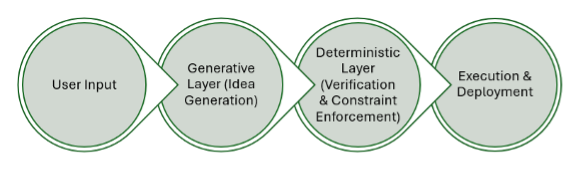
The answer is not to slow down on generative AI. It’s to pair it with a deterministic partner, to apply guardrails that catch errors, enforce constraints, and validate outputs before they reach execution. In a hybrid AI architecture, the responsibilities are cleanly divided:
The generative layer interprets human intent, generates candidate solutions, explores design alternatives, and explains reasoning in natural language.
The deterministic layer validates outputs against formal constraints, applies symbolic reasoning, enforces regulatory and security rules, and guarantees correctness before execution.
The orchestration layer coordinates the two, evaluates confidence scores, routes high-risk decisions to human review, and manages deployment and rollback.
Where Hybrid AI Architecture Is Being Used
Hybrid AI is already in practice across domains where creativity and correctness are both essential:
Code Refactoring: Generative models propose restructuring strategies for legacy systems. Deterministic analyzers confirm behavioral equivalence and run regression tests before deployment.
Security Remediation: Generative AI identifies potential vulnerabilities through pattern recognition. Deterministic systems confirm exploitability and validate remediation patches.
Business Logic Translation: Natural language requirements convert into structured rule sets. Deterministic engines validate rule consistency and execute decisions.
Design Systems: Generative models produce design variations while deterministic rules enforce accessibility, layout constraints, and brand guidelines.
Hybrid Patterns already in Use
Combining a generative or neural layer with a rule-based or symbolic layer has been used for years in various forms. What’s new is the scale, accessibility, and urgency.
In these systems, the generative AI layer handles natural language understanding, pattern recognition, and content generation. The deterministic layer manages rule-based, predefined flows that require consistency, control, and reliability. Two examples show how that works:
Google DeepMind’s AlphaGeometry
In January 2024, Google DeepMind introduced AlphaGeometry, an AI system that solves Olympiad-level geometry problems. It combines a language model with a rule-based deduction engine.
DeepMind described the system as combining “the predictive power of a neural language model with a rule-bound deduction engine, which work in tandem to find solutions.” Read the full DeepMind post: AlphaGeometry: An Olympiad-level AI system for geometry.
IBM’s Neuro-Symbolic AI
IBM Research frames its Neuro-Symbolic AI as a pathway toward artificial general intelligence, explicitly combining statistical machine learning with symbolic reasoning and formal logic.
IBM describes it as “augmenting and combining the strengths of statistical AI, like machine learning, with the capabilities of human-like symbolic knowledge and reasoning” – a revolution, not an evolution. More at IBM Research: Neuro-Symbolic AI.
The same pattern appears across the market. Google Cloud’s conversational agents, Amazon Bedrock with its guardrails framework, and Microsoft’s neuro-symbolic reasoning research all reflect the same architectural principle: generative systems identify patterns and propose paths; deterministic logic validates, enforces structure, and ensures reliable execution.
Building the Future on Hybrid AI: The Continuum Approach
At Alpha Omega, this approach shapes how we design automation solutions. Hybrid AI is the model we build with, deliver with, and have staked our Continuum Automation Framework on. We use this approach, and understand its value from direct experience, seeing firsthand what becomes possible when generative capability and deterministic control work together.
As AI matures, hybrid architectures will become the standard for intelligent systems in critical environments. The reason is straightforward: they deliver. Organizations that pair generative capability with deterministic control from the start build faster, operate more safely, and earn greater trust from the people who depend on their systems.
In Part 2, we break down the architecture, design choices, and engineering principles behind production-ready hybrid AI systems.
About the Author: Srinivas “Sri” Kothuri is Vice President of IT & Solutions at Alpha Omega, where he leads solution architecture and technical strategy for National Security pursuits. He brings more than 25 years of experience in digital transformation, cloud modernization, and AI-driven innovation across multiple federal agencies. Sri focuses on turning complex mission and acquisition requirements into practical, scalable solutions, prototypes, and reusable capabilities that strengthen capture efforts and support real operational impact.
Workday, AI, & Data: What Federal Agencies Must Do Next to Modernize ERP and HCM
Federal Workday modernization is entering a new phase where AI, trusted data, and governed workflows determine whether modernization programs deliver real mission value.
I came back from Workday SKO (Sales Kick-Off) in Chicago with one clear conclusion: the market has moved beyond AI as a feature discussion and toward AI as an operating model decision. The strongest message at SKO was that AI becomes useful at enterprise scale only when it sits on trusted data, operates within governed workflows, and operates across an ecosystem built to turn insight into action.
For federal agencies, the time for change is now. Modernization demands a secure, auditable, integration-ready foundation to support automation, analytics, and eventually agent-powered work across the enterprise.
In federal environments, AI is only as strong as the system, data, and controls it runs on.
Key Takeaway
Federal Workday modernization is shifting from system replacement to AI-enabled enterprise execution. Agencies that combine trusted systems of record, governed workflows, and secure automation will unlock the real value of AI across HR, finance, and mission support operations.
What Workday SKO Revealed About the Future of AI
Three themes came through consistently in Chicago.
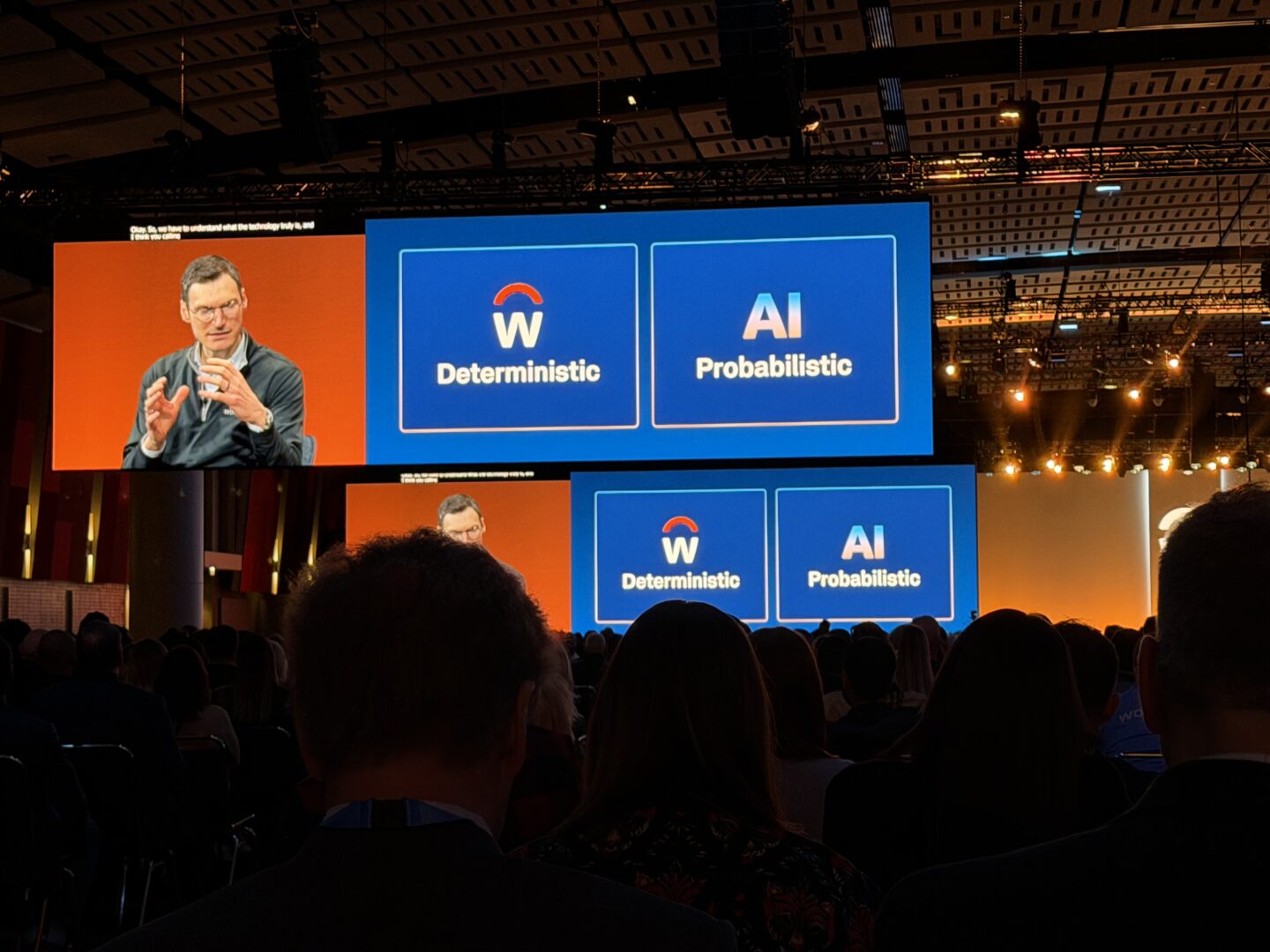
First, Workday drew a clear distinction between deterministic systems of record and probabilistic AI. AI has power, but it does not replace the operational discipline of an authoritative ERP and HCM foundation. In federal environments, that distinction matters even more because the cost of ambiguity is not just inefficiency—it is controlling weakness and audit exposure.
One of the clearest messages from the stage was the distinction between deterministic systems of record and probabilistic AI.
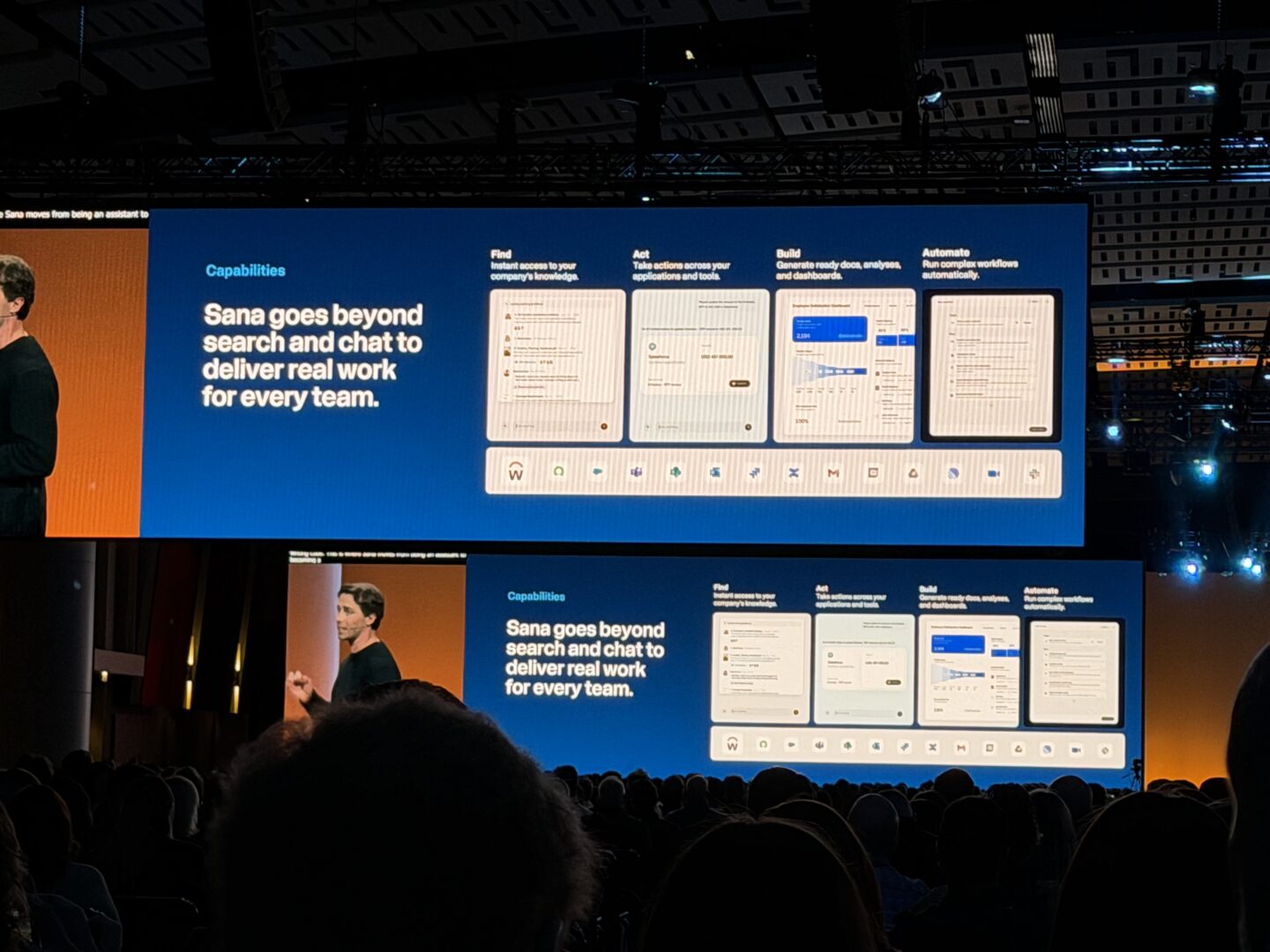
Second, Sana, Workday’s new AI experience platform, was positioned as much more than a conversational layer. The direction is toward a new front door for work where search, assistants, agents, and automation are tied directly to enterprise context across Workday and other applications.
This signals a shift toward an experience model where users do not simply retrieve answers—they move work forward inside governed workflows.
Sana was presented as the experience and orchestration layer across Workday and the broader enterprise application landscape.
Third, the conversation has shifted from answers to execution. The focus is no longer only on what AI can say. It is what AI can safely do, with governance, policy enforcement, and measurable outcomes. That also explains the strong emphasis on partner alignment at SKO. Workday knows enterprise value will not scale through product messaging alone. It will scale through ecosystem execution.
The Shift from AI Answers to AI Execution
One of the clearest themes at Workday SKO was the transition from answers to execution.
For years, enterprise AI discussions focused on generating insights or summarizing information. The new focus is on enabling AI to take action within enterprise systems, safely and predictably. That shift is significant in federal environments where every transaction must operate within strict security, compliance, and audit frameworks.
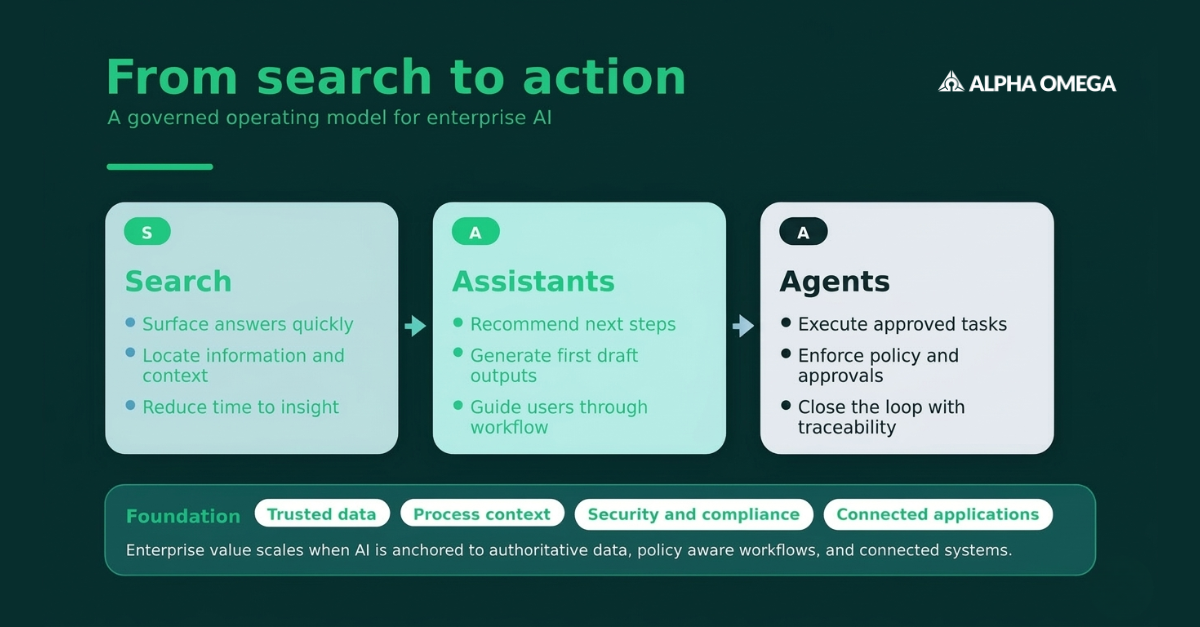
The market is moving from search to assistants to agents, and from answers to execution.
The progression the industry is moving toward is clear: search evolves into assistants, assistants mature into agents, and agents ultimately execute work inside enterprise platforms. In this model, AI can trigger workflows, automate approvals, and orchestrate processes across systems.
For federal agencies, that level of capability only becomes viable when AI operates on trusted enterprise data and within governed workflows. Without that foundation, automation introduces more risk than value.
Why Workday Modernization Matters for Federal Agencies
Federal agencies are operating under several simultaneous constraints.They must: – modernize while most IT budgets still support operations and maintenance of legacy environments.
– meet growing expectations around zero trust, cybersecurity, auditability, and compliance.
– integrate cloud platforms into complex legacy landscapes while driving change management in workforces that cannot absorb disruption without mission consequence.
That is why federal ERP modernization matters now.
Cloud ERP and HCM platforms are the data and workflow backbone for higher-order capabilities, including automation, analytics, and AI-enabled decision support.
A modern Workday foundation can standardize business processes, reduce manual reconciliation, improve data quality, and create a stronger control environment across HR and finance. These improvements establish the trusted data foundation required for AI to produce meaningful outcomes.
The broader AI conversation has also matured. Workday has cited research showing that 82% of organizations are expanding the use of AI agents. Federal agencies will not be insulated from that shift. The real question is whether those capabilities will be introduced through governed enterprise platforms or through disconnected tools that create more operational risk than value. In federal settings, AI in ERP environments must operate within trusted data, role-based security, policy-aware workflows, and auditable outcomes.
Responsible AI, enterprise trust, and governance are foundational requirements for scaled adoption.
How Alpha Omega Bridges Strategy to Execution
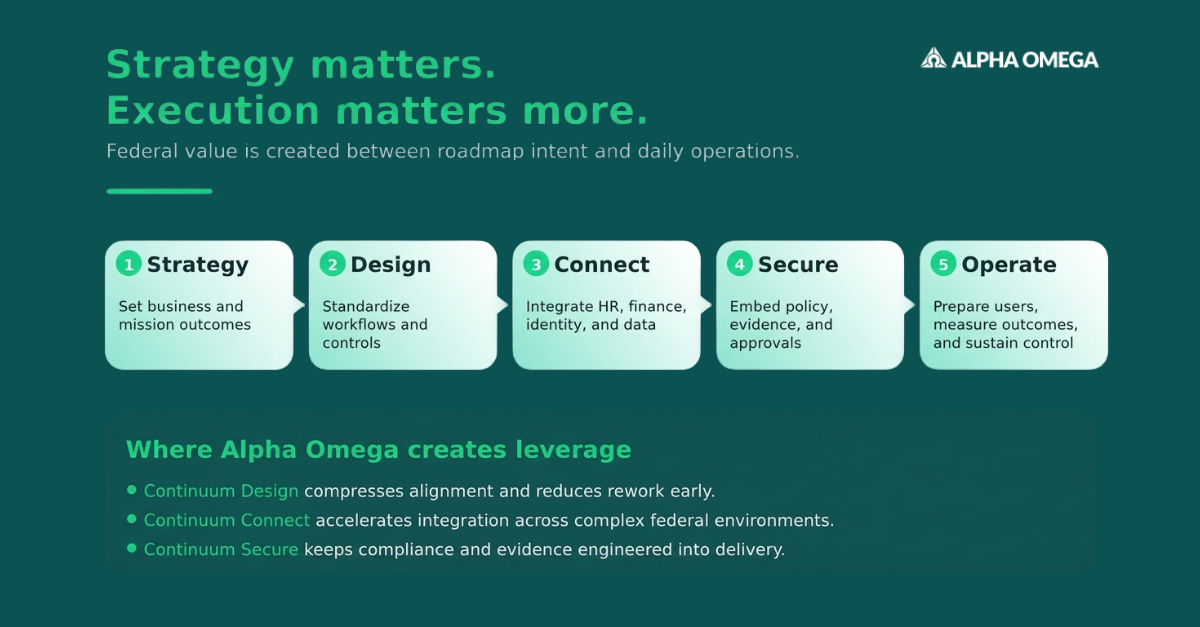
Federal Workday programs do not succeed simply because a tenant is configured correctly. They succeed when agencies can move from strategy to execution across architecture, integration, security, testing, adoption, and operational support.
Continuum Design helps agencies align modernization intent early through rapid prototyping and clearer requirements translation. On complex federal programs, this reduces rework, shortens decision cycles, and improves business ownership.
Continuum Connect addresses one of the hardest parts of federal delivery: integration across HR, finance, identity, shared services, reporting, and legacy mission systems. Workday can only function as a true system of engagement when the surrounding ecosystem is connected with discipline.
Continuum Secure reinforces the security-first posture federal agencies require. Compliance, evidence, and control validation cannot be bolted onto a Workday program at the end—they must be engineered into delivery from the start.
This is also why the SKO messaging around Workday Extend and Sana Agent Builder stood out. Workday is clearly building toward a platform where governed extensions, automation, and AI agents operate close to the enterprise data model and security framework. That direction aligns closely with Alpha Omega’s federal delivery model.
The opportunity is to operationalize Workday to reduce friction, strengthen control, and accelerate measurable outcomes.
What Agencies Should Do Next
Agencies that want to extract real value from Workday modernization should focus on four actions.
1. Treat modernization as data and process transformation, not application replacement. Standardize business processes, reduce exception handling, and improve data stewardship before scaling AI.
2. Rationalize integration architecture early. Agencies should identify where Workday must exchange data and trigger actions across finance, HR, identity, learning, case management, and mission support systems.
3. Build governance for AI and automation now. Ownership, access controls, policy enforcement, monitoring, and escalation paths must be defined before AI agents or advanced automation move into production workflows.
4. Invest in adoption as seriously as technology. Federal change management is never secondary. If users do not trust the system, understand the workflows, or see the control structure, adoption will stall regardless of platform capability.
Closing Perspective
Workday SKO was valuable not because it previewed another set of product features, but because it clarified where the enterprise technology market is heading.
The conversation has moved from AI curiosity to enterprise execution.For federal agencies, that raises the bar. Success will go to organizations that pair trusted systems of record with governed AI, strong integration architecture, and disciplined execution.
That is the lane Alpha Omega is built to support – Workday provides the platform. Federal agencies provide the mission. The task now is to bridge strategy to execution in a way that is secure, auditable, and outcome-driven.
Federal agencies that approach Workday modernization as a platform for trusted data, governed AI, and enterprise execution will be best positioned to deliver mission outcomes in the next generation of government operations.
About the Author – Chris Molitor is Vice President at Alpha Omega, leading ERP and HCM modernization initiatives for federal agencies. He works with government leaders to align enterprise systems, data, and emerging AI capabilities so modernization efforts translate into secure, operational outcomes—not just system deployments.
Alpha Omega Appoints Michael Bruce, Brittney Chappell, and Sri Kothuri to Leadership Supporting National Security Missions
Strengthens national security and federal mission leadership with three strategic appointments
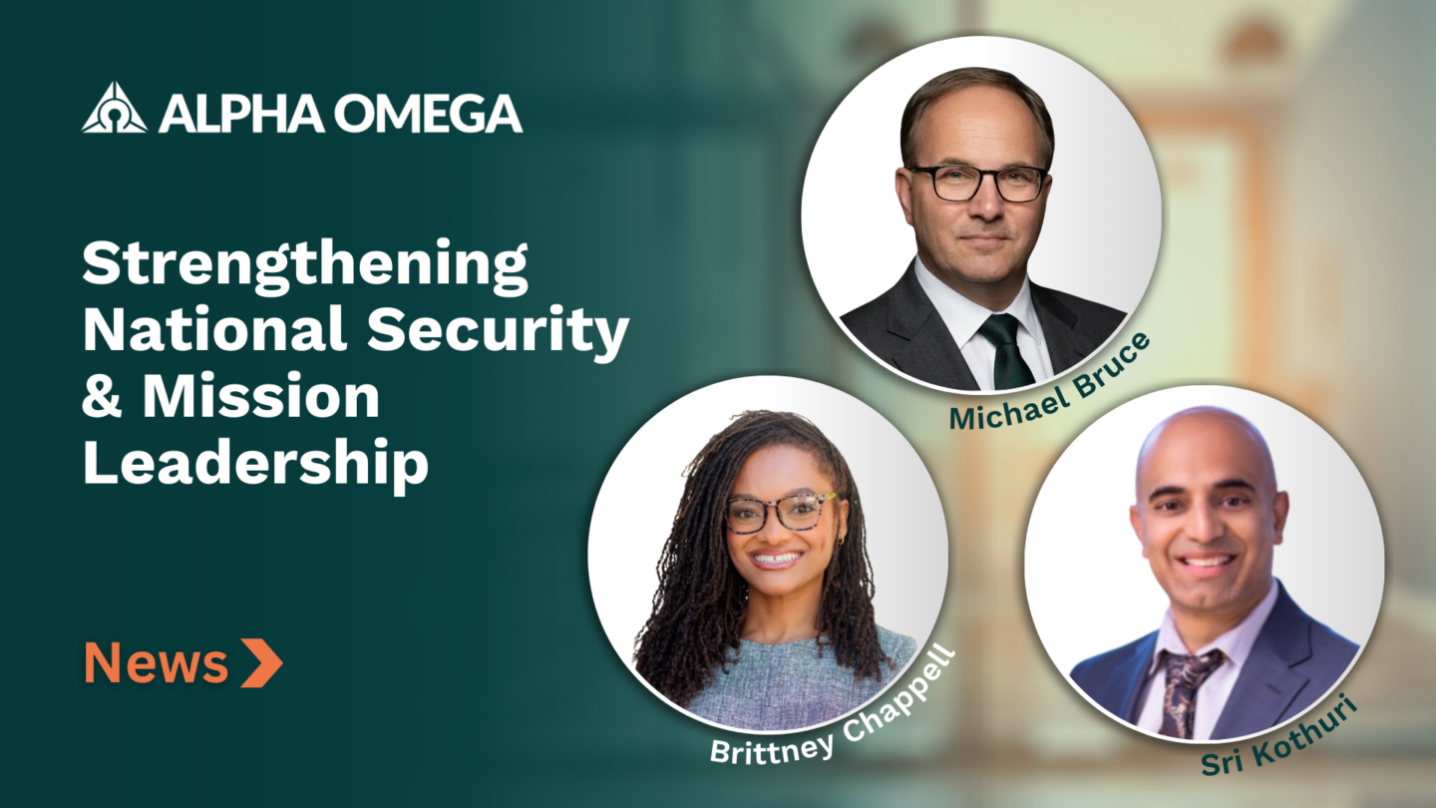
Vienna, Va. — March 9, 2026— Alpha Omega has appointed Michael Bruce, Brittney Chappell, and Srinivas (Sri) Kothuri to leadership roles as the federal technology and solutions firm realigns its business units to focus support on National Security and National Resilience missions.
Michael Bruce, SVP National Security
Michael Bruce joins the company as Senior Vice President and National Security Business Unit Lead, responsible for overseeing Alpha Omega’s federal national security portfolio and mission programs, and account teams supporting the U.S. Navy, U.S. Army, U.S. Air Force, Department of State, Department of Homeland Security, and emerging national security accounts.
Bruce brings more than 20 years of experience leading growth, operations, and mission delivery across the federal homeland security and law enforcement markets. He has served in leadership roles in both government and industry, including positions with the U.S. Department of Health and Human Services and the Transportation Security Administration.
Brittney Chappell, VP of Capture
Brittney Chappell joins Alpha Omega as Vice President of Capture, where she will lead capture strategy and support the company’s efforts to help agencies accelerate procurement timelines and deliver mission capabilities more quickly.
Chappell brings more than 15 years of federal acquisition and procurement experience leading sourcing strategies and managing $1B+ contract portfolios across NASA, the Department of Transportation, GSA Technology Transformation Services, FEDSIM, and the Executive Office of the President.
Sri Kothuri, VP of IT & Solutions
Srinivas (Sri) Kothuri joins as Vice President of IT & Solutions, where he will lead solution architecture and technical strategy for Alpha Omega’s National Security pursuits. Kothuri will serve as the lead solutions architect for high-priority captures, translating complex government requirements into technical solutions and prototypes that increase Probability of Win (PWin).
With more than 25 years of experience in digital transformation, cloud modernization, and AI-driven innovation across federal agencies—including the National Institutes of Health and the U.S. Department of Agriculture—Kothuri brings deep technical and mission expertise to Alpha Omega. In his role, he will focus on transforming reusable delivery capabilities into scalable offerings, integrating AI across existing programs, and developing proof-of-concept solutions that demonstrate technical value during the pre-award phase.
“As federal missions become more complex, leadership that can connect strategy, acquisition, and technical execution is essential,” said Eric Laychock, Chief Operating Officer of Alpha Omega. “Michael, Brittney, and Sri bring exactly that combination and will help strengthen how we support the national security and resilience missions our customers depend on.”
A widely circulated 2025 State of AI in Business study from MIT’s NANDA group found that 95% of enterprise AI pilots in federal government fail to generate measurable business value or scale into production systems.
In federal environments, the challenge is amplified by structural realities:
Security constraints and extended review cycles
Legacy architectures that resist integration
Compliance frameworks that demand auditability
Unclear operational ownership once pilots mature
Agencies are told to “use AI.” Yet pilots are often built without grounding in the workflows where they would actually operate. When leadership asks whether a solution can move into production, the answer becomes complicated. Security reviews stretch. Momentum fades. The pilot stalls.
The lesson is not that AI underperforms. It is that architecture determines survivability.
Federal Agencies Are Being Directed to Adopt AI
AI deployment in government is not discretionary experimentation. It is policy driven.
Executive Order 14179 calls for removing barriers to American leadership in artificial intelligence. OMB Memorandum M-24-10 directs agencies to accelerate responsible AI adoption while strengthening governance and risk management. The National AI Initiative Act of 2020 reinforces coordinated federal advancement of AI capabilities.
These directives do not ask agencies to experiment casually. They expect integration into mission systems under existing compliance and security guardrails. That makes pilot design consequential.
Why Most AI Pilots in Federal Government Fail to Reach Production
Frontier technology succeeds only when it delivers rapid time-to-value and integrates cleanly into existing workflows.Teams frequently attempt to build too much at once. New technology invites architectural ambition. Full-stack builds feel comprehensive and technically impressive, but in federal environments they can trigger months of security review and infrastructure approval.If a pilot is treated as a disposable experiment, it behaves like one. If it is designed as a production-ready system from the outset, its trajectory changes.
The difference between the 95 percent stall and the few that scale is rarely model sophistication. It is architectural discipline.
Designing for Production from Day One
In one engagement, we were asked to explore LLM-assisted workflow acceleration. The technically ambitious path was to build a new stack from scratch. It would have taken months to clear security review.
Instead, we embedded the capability inside an existing low-code operational application that already resided within the enterprise boundary. The first working version with LLM integration was built in hours rather than weeks. More importantly, it inherited identity controls, logging, and compliance enforcement from the tenant.
There was no restart for production. The pilot became the solution.
Build Inside Enterprise Guardrails
One of the most effective ways to improve pilot survivability is to build inside approved enterprise ecosystems rather than outside them. Low-code platforms such as Microsoft Power Platform provide governed environments that inherit the broader security and compliance stack. Infrastructure, identity enforcement, logging, data connectors, and tenant-level controls are already in place. In regulated federal environments, that inheritance is strategic. The fastest and most effective prototype is not always the one written from scratch. It is often the one embedded within trusted architectural boundaries.
What Is “Vibe Coding”?
Vibe coding refers to using AI-assisted development tools to rapidly generate, refactor, or modify software by describing the intended functionality in natural language rather than manually writing every line of code.
While this approach accelerates experimentation, unmanaged AI-generated code can quickly introduce security and governance risk. In federal systems, where identity management, logging, and compliance enforcement are mandatory, speed without guardrails increases exposure. Speed inside approved systems, by contrast, enables sustainable scale.
Align Talent with the Approved Stack
AI expertise alone is insufficient in federal environments. Engineers must understand integration patterns, compliance frameworks, FedRAMP constraints, and the operational limitations that government systems impose.
Organizations that align architectural fluency, certifications, and experience with cloud-native services and enterprise low-code platforms reduce delivery timelines and increase time-to-value. The goal is not simply to build AI functionality. It is to integrate intelligence into mission workflows without expanding the risk surface.
The Path Beyond the 95%
Agencies do not have to choose between speed and security. Moving beyond the 95 percent failure rate requires discipline in a few critical areas:
Designing pilots as production-ready systems from the outset
Building within approved enterprise ecosystems rather than outside them
Embedding identity, logging, and compliance controls from day one
Aligning technical talent with the authorized cloud and low-code stack
The organizations that scale are not necessarily using the most sophisticated models. They are intentional about architecture. When AI is embedded within systems prepared to support it, pilots evolve from proof-of-concept to durable mission capability.
About the author:Shareef Hussam a mission-focused Systems Engineer supporting National Security at Alpha Omega, specializing in AI, low-code platforms, and cloud solutions. He architects and builds secure, production-grade systems that translate operational requirements into scalable technical solutions. His work centers on embedding technology within real-world workflows to generate measurable business impact.
Manage Consent
To provide the best experiences, we use technologies like cookies to store and/or access device information. Consenting to these technologies will allow us to process data such as browsing behavior or unique IDs on this site. Not consenting or withdrawing consent, may adversely affect certain features and functions.
Functional
Always active
The technical storage or access is strictly necessary for the legitimate purpose of enabling the use of a specific service explicitly requested by the subscriber or user, or for the sole purpose of carrying out the transmission of a communication over an electronic communications network.
Preferences
The technical storage or access is necessary for the legitimate purpose of storing preferences that are not requested by the subscriber or user.
Statistics
The technical storage or access that is used exclusively for statistical purposes.The technical storage or access that is used exclusively for anonymous statistical purposes. Without a subpoena, voluntary compliance on the part of your Internet Service Provider, or additional records from a third party, information stored or retrieved for this purpose alone cannot usually be used to identify you.
Marketing
The technical storage or access is required to create user profiles to send advertising, or to track the user on a website or across several websites for similar marketing purposes.