Back to Blogs
 AI
AI
Hybrid AI: Why Generative and Deterministic AI Work Better Together

Hybrid AI: Why Generative and Deterministic AI Work Better Together
The race to adopt AI has pushed most organizations to ask the wrong question: generative AI or deterministic AI? But hybrid AI, the deliberate combination of both, is how the world’s most advanced AI systems are actually built. And it’s how Alpha Omega is evolving the Continuum Automation framework.
Artificial intelligence development has largely followed two separate paths. One path focuses on deterministic systems that deliver predictable and verifiable outcomes. The other focuses on generative systems that explore possibilities and create new outputs based on learned patterns. Each approach provides value, but each also carries limitations when used alone. The advantage comes from their combination, resulting in a class of intelligent systems capable of creativity without sacrificing reliability.
Two Approaches to AI—and Why Hybrid AI Solves What Neither Can Alone
Modern AI development has followed two distinct paths:
- Deterministic AI operates on defined rules and algorithms. Given identical inputs, it produces identical outputs—predictable, verifiable, and trustworthy. It excels at formal verification, compliance validation, and guaranteed execution. Its limit: it struggles with ambiguity and cannot discover genuinely new solutions.
- Generative AI learns patterns from data and creates new outputs based on those patterns—flexible, creative, capable of natural language understanding and rapid prototyping. Its limit: it cannot independently guarantee correctness. Without guardrails, it hallucinates.
Organizations increasingly face challenges that require both creativity and reliability: code modernization, security remediation, business logic automation, and AI-driven decision-making. Neither approach alone is sufficient. That tension is exactly what hybrid AI architecture is designed to resolve.
The Key to Hybrid AI: Putting Guardrails on Generative Systems
The surge in generative AI investment is justified—the capabilities are real and the opportunity is substantial. But generative AI without constraints creates a risk. It produces confident, fluent, and sometimes wrong outputs.
The answer is not to slow down on generative AI. It’s to pair it with a deterministic partner, to apply guardrails that catch errors, enforce constraints, and validate outputs before they reach execution. In a hybrid AI architecture, the responsibilities are cleanly divided:
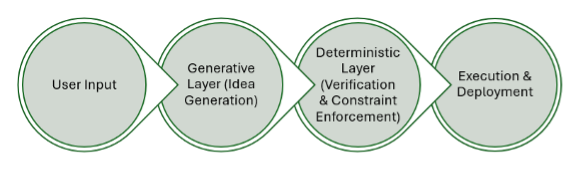
- The generative layer interprets human intent, generates candidate solutions, explores design alternatives, and explains reasoning in natural language.
- The deterministic layer validates outputs against formal constraints, applies symbolic reasoning, enforces regulatory and security rules, and guarantees correctness before execution.
- The orchestration layer coordinates the two, evaluates confidence scores, routes high-risk decisions to human review, and manages deployment and rollback.
Where Hybrid AI Architecture Is Being Used
Hybrid AI is already in practice across domains where creativity and correctness are both essential:
- Code Refactoring: Generative models propose restructuring strategies for legacy systems. Deterministic analyzers confirm behavioral equivalence and run regression tests before deployment.
- Security Remediation: Generative AI identifies potential vulnerabilities through pattern recognition. Deterministic systems confirm exploitability and validate remediation patches.
- Business Logic Translation: Natural language requirements convert into structured rule sets. Deterministic engines validate rule consistency and execute decisions.
- Design Systems: Generative models produce design variations while deterministic rules enforce accessibility, layout constraints, and brand guidelines.
Hybrid Patterns already in Use
Combining a generative or neural layer with a rule-based or symbolic layer has been used for years in various forms. What’s new is the scale, accessibility, and urgency.
In these systems, the generative AI layer handles natural language understanding, pattern recognition, and content generation. The deterministic layer manages rule-based, predefined flows that require consistency, control, and reliability. Two examples show how that works:
Google DeepMind’s AlphaGeometry
In January 2024, Google DeepMind introduced AlphaGeometry, an AI system that solves Olympiad-level geometry problems. It combines a language model with a rule-based deduction engine.
DeepMind described the system as combining “the predictive power of a neural language model with a rule-bound deduction engine, which work in tandem to find solutions.” Read the full DeepMind post: AlphaGeometry: An Olympiad-level AI system for geometry.
IBM’s Neuro-Symbolic AI
IBM Research frames its Neuro-Symbolic AI as a pathway toward artificial general intelligence, explicitly combining statistical machine learning with symbolic reasoning and formal logic.
IBM describes it as “augmenting and combining the strengths of statistical AI, like machine learning, with the capabilities of human-like symbolic knowledge and reasoning” – a revolution, not an evolution. More at IBM Research: Neuro-Symbolic AI.
The same pattern appears across the market. Google Cloud’s conversational agents, Amazon Bedrock with its guardrails framework, and Microsoft’s neuro-symbolic reasoning research all reflect the same architectural principle: generative systems identify patterns and propose paths; deterministic logic validates, enforces structure, and ensures reliable execution.
Building the Future on Hybrid AI: The Continuum Approach
At Alpha Omega, this approach shapes how we design automation solutions. Hybrid AI is the model we build with, deliver with, and have staked our Continuum Automation Framework on. We use this approach, and understand its value from direct experience, seeing firsthand what becomes possible when generative capability and deterministic control work together.
As AI matures, hybrid architectures will become the standard for intelligent systems in critical environments. The reason is straightforward: they deliver. Organizations that pair generative capability with deterministic control from the start build faster, operate more safely, and earn greater trust from the people who depend on their systems.
In Part 2, we break down the architecture, design choices, and engineering principles behind production-ready hybrid AI systems.