Back to Blogs
 AI
AI
Federal Data Management in the AI Era

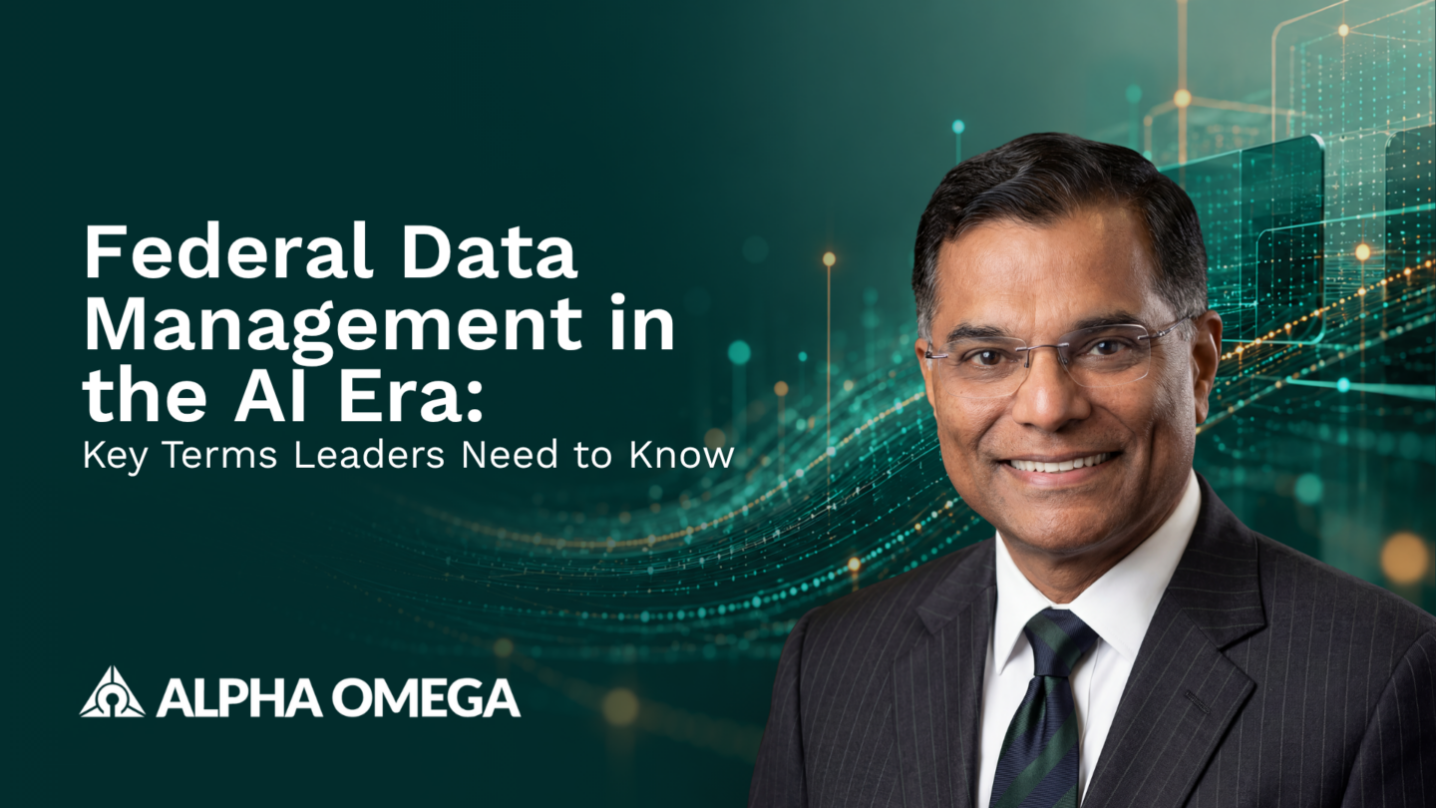
Federal Data Management in the AI Era: Key Terms Leaders Need to Know
Before there were servers, screens, or search engines, there was data. The word itself traces back to the Latin datum, meaning “something given.” A gift. A starting point. A truth handed to us by observation, experience, or measurement. In ancient philosophy, data were the world’s raw facts, the sensory inputs from which knowledge was constructed. In theology and rhetoric, Alpha and Omega, the first and last letters of the Greek alphabet, signified totality: the beginning and the end, the complete whole. Here at Alpha Omega, we believe data is exactly that: the beginning of every decision and the end of every outcome. Data is Alpha. Data is Omega.
Why Trusted Data Matters for AI-Ready Federal Missions
Genesis: From Clay Tablets to Client-Server
For most of human history, data lived in physical form. Carved into stone, pressed into clay, and inked onto parchment. Libraries were the original databases. Scribes were the original data engineers. The value of data has never changed; only the container has.
When computing emerged in the mid-20th century, data moved from paper to magnetic storage. The client-server model of the 1980s and 90s became a turning point: for the first time, data could be stored centrally and retrieved on demand. Organizations built relational databases, structured information into rows and columns, and established the idea that data could be managed, governed by rules, secured behind walls, and queried with precision. Data became an organizational asset.
On the Move: Web, Mobile, and the Data Explosion
The internet shattered those walls. Web applications in the late 1990s and 2000s transformed data from a back-office asset into a living, real-time resource shared across networks. Then smartphones arrived, and mobile apps put data creation in nearly every human hand. By the 2020s, the volume, velocity, and variety of data had become too large for traditional approaches alone.
The bigger shift wasn’t just volume. Data stopped being something organizations simply held. It became something communities, individuals, sensors, applications, and machines generated together. That shift changed everything about who owns data, who can access it, who can trust it, and who benefits from it.
Welcome to the AI Era: A New Data Vocabulary for a New World
We are now firmly inside the age of AI applications, and this era demands a new frame of reference. For federal agencies and mission-focused organizations, AI-ready data is not just a technical prerequisite. It is the foundation for trusted intelligence, transparent decision-making, interoperable architectures, and responsible automation. That starts with language.
Here are the foundational concepts leaders, practitioners, and informed citizens need to navigate the AI-powered future:
Data Ontology is the formal structure that defines what data means and how concepts relate to one another. AI systems do not just store data; they reason over it. Without a shared ontology, machines cannot communicate meaningfully across systems, and humans cannot trust that the same word means the same thing from one mission environment to the next.
Full Data Provenance means every data workflow is transparent and traceable. From its origin to its transformation to its use, lineage matters. In AI, knowing where data came from, what changed along the way, and where it lands is as important as the data itself. Linked Open Data extends this idea by connecting trusted datasets across institutions so knowledge can move with context instead of confusion.
Democratized Data challenges the idea that data power belongs only to a select few. In the AI era, access and representation matter. Who gets to train the models? Whose communities appear in the datasets? Who needs protection, consent, or exclusion from certain uses? The goal should be value for stakeholders, delivered securely and responsibly, without bias, hallucination, or sycophantic outcomes that simply tell users what they want to hear.
Digital Twin Ecosystems are live, interconnected data environments that mirror real-world systems, from cities and supply chains to human bodies and federal programs. They allow AI to simulate, predict, and optimize across domains before decisions are made in the real world.
Community Data Governance and Open Data Curation put people and mission owners closer to the decisions about how data is collected, described, shared, and protected. This is not a side issue. In the AI era, governance is how organizations turn raw information into trusted, accountable, mission-ready data.
When AI and Data Collide: A Glossary of Challenges
The same AI systems that promise to unlock knowledge, accelerate discovery, and connect communities also introduce deep and complex risks. Many of those risks are rooted directly in data. Understanding these challenges is not pessimism; it is preparation.
Here is the critical vocabulary of AI-related data risk that every informed leader, practitioner, and organization should know:
Algorithmic Bias occurs when the data used to train an AI model reflects historical inequities, cultural blind spots, or incomplete representation, and the model learns to reproduce and amplify those patterns at scale. If the data is skewed, the AI will be too. Bias is not always a bug introduced by bad actors; it is often a silent inheritance baked into the data itself.
Data Poisoning is a form of adversarial attack in which bad actors deliberately corrupt or manipulate a training dataset to cause an AI model to behave incorrectly, make wrong predictions, misclassify inputs, or produce harmful outputs. As AI becomes part of critical infrastructure, data poisoning becomes a national security concern.
Model Hallucination occurs when AI systems generate fabricated outputs, including facts, citations, names, or statistics, and present them with confidence. Large language models can produce hallucinations when they process patterns in data without grounding those patterns in verified truth. The data went in; misinformation came out.
Data Colonialism describes the extractive relationship in which powerful organizations harvest data from communities, nations, or underrepresented populations without clear consent, compensation, or benefit-sharing, then use that data to build systems that serve others. The core issue is not only collection. It is power, ownership, and whether the people represented in the data share in the value it creates.
Surveillance Capitalism describes an economic model where platforms harvest personal data, such as browsing habits, location, social connections, and health signals, and monetize it through behavioral prediction and advertising. AI supercharges this model by making predictions faster, cheaper, and more precise than ever before.
Data Sovereignty is the principle, and increasingly a legal right, that a community, nation, or individual has authority over data generated within or about them. It is the counterforce to extractive data practices, asserting that data is not a free resource to be taken but a protected asset tied to identity, consent, and self-determination.
Shadow Data refers to data that organizations collect, store, or process outside official governance structures. Data quietly accumulated in shadow IT systems, third-party tools, spreadsheets, or undocumented pipelines can become source material for AI systems. When that happens, provenance becomes difficult to establish, and accountability becomes harder to enforce.
Data Decay and Model Drift describe the problem of time: the world changes, but AI models do not always keep up. When a model relies on stale data or data that no longer reflects current reality, its outputs quietly lose accuracy and relevance. An AI system that makes decisions from outdated data can create as much risk as no AI at all.
Synthetic Data Risks arise when AI-generated data, created artificially to supplement real datasets, is fed back into training pipelines without rigorous validation. As synthetic data proliferates, distinguishing it from real-world observations becomes harder, and models risk training on circular, self-referential loops untethered from ground truth.
Digital Exclusion and the AI Divide describe the growing gap between people who have the infrastructure, literacy, and agency to participate in AI-powered systems and people who do not. When communities lack broadband, devices, or data literacy, AI systems may overlook them in the datasets that shape how models understand the world.
Informed Consent at Scale is one of AI’s most urgent unresolved data problems. Traditional consent assumes a person agrees to a specific use of their data. That model breaks down when organizations aggregate, repurpose, resell, and feed data into models that no one imagined when they first collected it. Who consented to train the model? In many cases, almost no one did so explicitly.
Regulatory Fragmentation is the patchwork of inconsistent, jurisdiction-specific laws governing AI and data. It creates compliance complexity, enforcement gaps, and incentives to move data wherever oversight is weakest. GDPR in Europe, state-level privacy laws in the U.S., and sector-specific rules in healthcare and finance are only a few examples.
These are not abstract concerns for technologists alone. They are the lived realities of communities, patients, students, workers, and citizens navigating an AI-saturated world while often unaware of the risks already embedded in the systems around them. At Alpha Omega, we believe naming these challenges is the first act of accountability. You cannot govern what you cannot name.
Conclusion
Data has always been humanity’s most enduring currency. From the first tally marks scratched into bone to the trillion-parameter models reshaping our world today, data has powered strategic planning and execution. The AI era does not change that truth; it intensifies it. Trusted AI depends on data that teams can govern, trace, secure, connect, and understand.
The terms in this post are a compass. Understanding the promise and the peril is how individuals, communities, agencies, and organizations step into the AI future as informed participants, not passive subjects. The conversation starts here, with data. It always has.
Data is where we start. Data is where we end. Data is Alpha, and Data is Omega.