Back to Blogs
 AI
AI
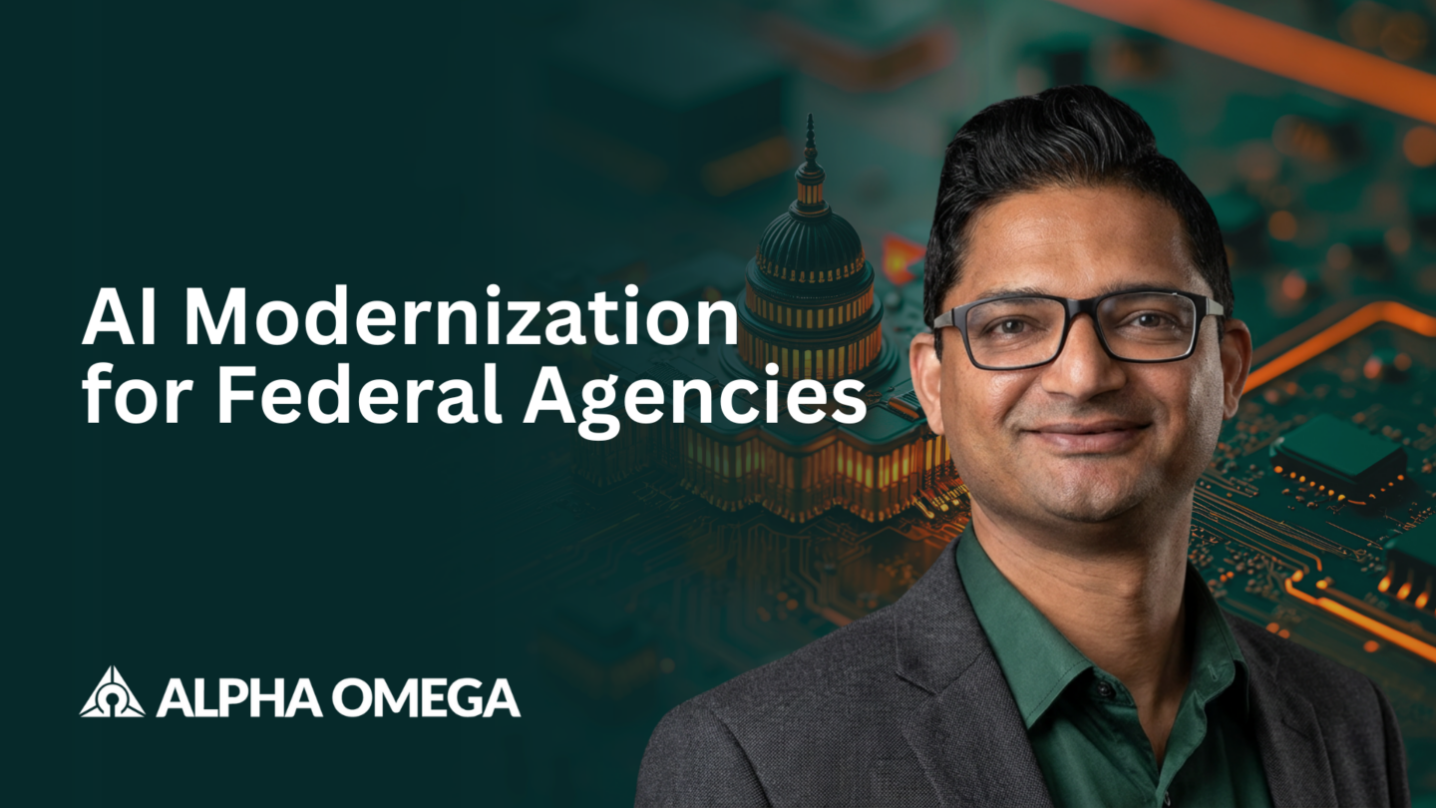
AI Modernization for Federal Agencies

AI modernization for federal agencies is not the shortcut we hoped for.
Across the federal enterprise, agencies are racing to adopt artificial intelligence to automate decisions, accelerate analysis, and improve operational tempo. Yet many AI initiatives stall, underperform, or fail to operationalize.
The reason isn’t the algorithms.
It’s the legacy systems underneath them.
AI modernization for federal agencies cannot succeed when intelligence is layered onto brittle architectures, siloed data, and manual workflows. In national security and mission-critical environments—where reliability, auditability, and resilience are non-negotiable—modernization must come before intelligence. More precisely, AI must be paired with a deliberate architectural transformation that prepares systems to support intelligence at scale.
I call this transformation a legacy lift.
What is AI modernization for federal agencies?
AI modernization for federal agencies is the process of integrating artificial intelligence into mission systems by first modernizing data, architecture, security, and workflows—ensuring AI operates securely, compliantly, and at operational scale.
Why AI Modernization fails without legacy system modernization.
Most government mission systems were never designed to support AI.
They were built to:
- Execute deterministic, rules-based workflows
- Store data in rigid schemas
- Prioritize stability over adaptability
AI-driven systems demand the opposite:
- Continuous, near–real-time data ingestion
- Flexible integration patterns
- Observability and feedback loops
- Human-in-the-loop accountability
When agencies attempt to “bolt on” AI to legacy platforms, they encounter predictable failure modes:
- Inconsistent or incomplete data pipelines
- Latency that undermines real-time decision support
- Security gaps introduced by shadow integrations
- Compliance challenges driven by opaque model behavior
Rather than compensating for weaknesses, AI amplifies them. Without foundational modernization, intelligence becomes fragile, unscalable, and difficult to trust.
What is a Legacy Lift?
A legacy lift is a targeted modernization approach that prepares federal mission systems for AI by improving data readiness, modularity, security, and human oversight—without requiring a full system rewrite or multi-year pause on delivery.
The goal is to decouple, stabilize, and standardize just enough of the underlying architecture to enable intelligence-driven outcomes safely and sustainably.
A successful legacy lift focuses on four foundational layers.
Layer 1: Data readiness before intelligence
AI is only as effective as the data it consumes. Yet many mission systems still rely on:
- Batch updates instead of real-time feeds
- Hard-coded, brittle integrations
- Inconsistent data definitions across systems
A legacy lift prioritizes:
- Canonical data models
- Secure, API-driven data access
- Data lineage and provenance tracking
- Clear ownership and stewardship
Without these foundations, AI outputs cannot be trusted—especially in environments that require auditability, oversight, and defensibility.
Layer 2: Modular architecture that can evolve
Monolithic systems resist change. AI requires experimentation.
Modernized mission systems should:
- Expose functionality through services and APIs
- Separate data, logic, and presentation layers
- Allow AI components to be swapped, tuned, or retired without disrupting operations
This modularity enables agencies to test and deploy AI responsibly—introducing intelligence incrementally without destabilizing mission-critical workflows.
Layer 3: Built-in security and compliance
In national security contexts, AI must operate within:
- Zero Trust principles
- Continuous monitoring requirements
- RMF, FISMA, and emerging AI governance mandates
A legacy lift integrates security and compliance into the architecture itself, not as after-the-fact controls. This includes:
- Identity-aware data access
- Policy-driven authorization
- Automated evidence generation for audits
AI systems that cannot explain their behavior or prove compliance will not scale—regardless of their technical sophistication.
Layer 4: Human-centered AI integration
AI should accelerate human decision-making, not replace it.
Modernized systems must support:
- Explainable outputs
- Clear confidence indicators
- Human override and escalation paths
In operational environments where decisions carry real-world consequences, trust is built when operators understand not just what the system recommends—but why.
How long does an ATO take without modernization?
In many federal environments, obtaining an Authorization to Operate (ATO) can take six to eighteen months. These prolonged timelines delay innovation, increase system risk, and discourage iterative improvement.
Legacy lifts that embed security, automation, and continuous monitoring early in the lifecycle enable agencies to dramatically shorten approval cycles—moving from point-in-time authorization toward continuous authorization models that support faster delivery without compromising compliance.
How can Agencies reduce risk when modernizing for AI?
Agencies can reduce risk when modernizing for AI by modernizing data foundations first, embedding security and compliance into system architecture, and introducing AI incrementally with human oversight and continuous monitoring.
What Agencies can do in the next 90 days.
Modernization does not require a blank slate. The most effective transformations start small and deliver momentum quickly.
In the next 90 days, agencies can:
1. Identify a rapid contractual pathway and funding source to pilot AI-enabled modernization
2. Select one mission workflow where AI could deliver value if foundational constraints were addressed
3. Define a fixed-price procurement approach for scaling successful pilots
4. Targeting 50–70% cost reductions compared to traditional modernization efforts
5. Measure success by operational outcomes—not scope or capacity
This approach reduces risk while creating a clear path from experimentation to production.
If we do nothing:
Without a legacy lift, agencies will continue to:
- Spend heavily on AI pilots that never operationalize
- Accumulate technical debt while chasing innovation
- Introduce security and compliance risk unintentionally
- Fall behind adversaries modernizing holistically
AI is not a silver bullet. But when paired with deliberate modernization, it becomes a force multiplier.
The Bottom Line
Mission modernization is no longer about replacing old systems—it’s about preparing them to think.
AI modernization for federal agencies succeeds only when legacy systems are ready to support intelligence. A legacy lift provides the path forward, enabling agencies to evolve mission systems without breaking trust, compliance, or continuity.